By Brian Campued
“As we hit the ground running in 2026, once again, we start a new era in our educational system.”
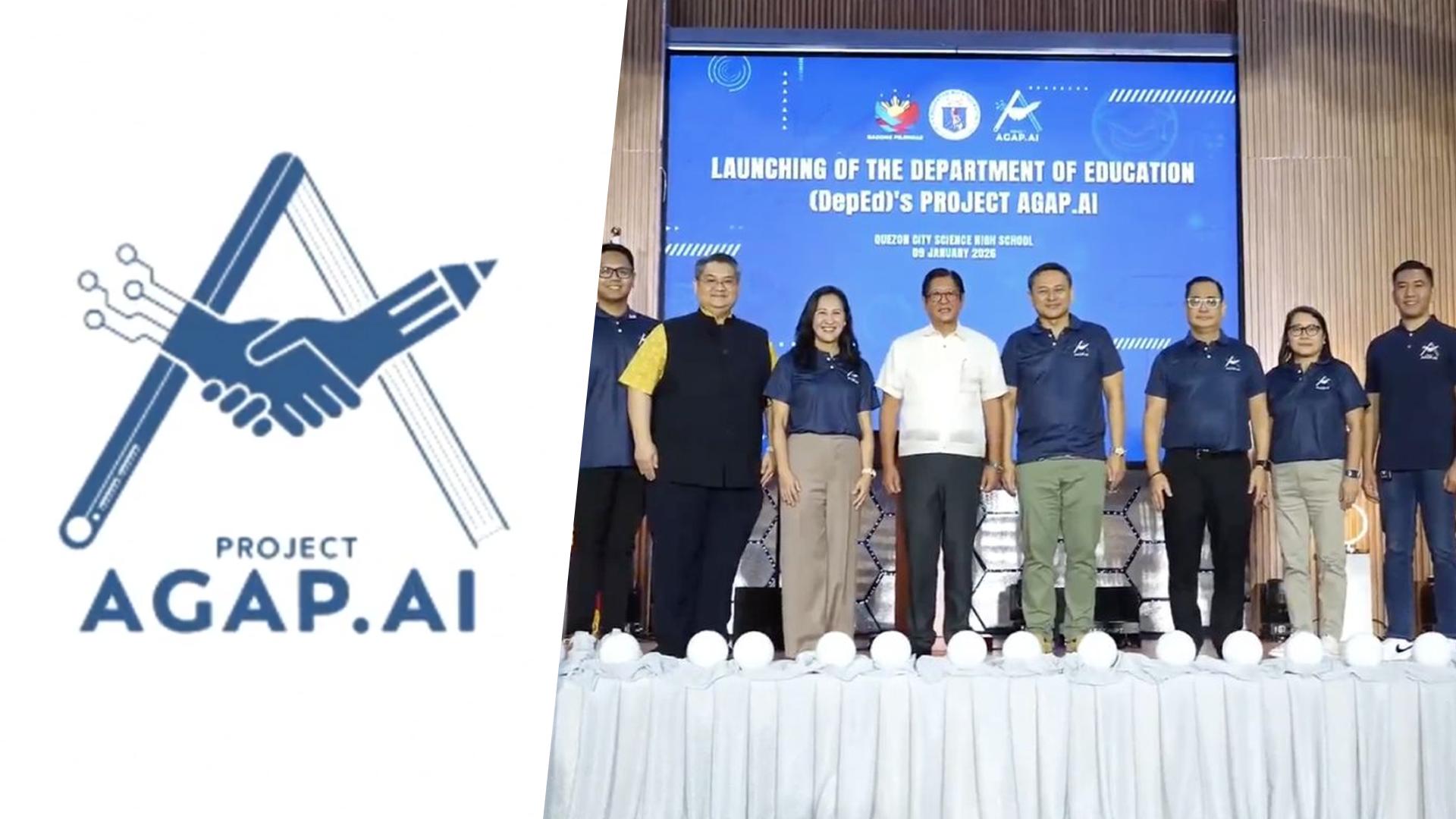
In line with the administration’s push for digitalization in the Philippines and commitment to improving the country’s education system, President Ferdinand R. Marcos Jr. led the launch of the “Project AGAP.AI” at the Quezon City Science High School (QCSHS) on Friday.
Short for “Accelerating Governance and Adaptive Pedagogy through Artificial Intelligence,” Project AGAP.AI serves as the Department of Education’s (DepEd) flagship program for all initiatives aimed at integrating artificial intelligence (AI) in the delivery of quality basic education.
The project promotes the responsible and ethical use of AI to support teaching and learning, enhance digital readiness of the Philippine education system, and strengthen education governance.
“In our language, agapay means ‘to support’ or ‘to bridge.’ This is what we are trying to do today: Standing next to our people and bridging the gap between technology and education,” the President said.

In his speech, Marcos noted the prevalence of AI in today’s society—from communication to problem-solving. However, he stressed that this technological breakthrough must be used to empower students in their learning journey.
“I must say that this generation is very fortunate to be in a world where information and tools are readily available,” he said. “But you must use it to help you think and support your learning. It should never replace your drive, your creativity, and grit to learn about our world.”
READ MORE: PBBM talks about AI regulation, cyberbullying in podcast with university students
To support the flagship program, DepEd is developing the foundational guidelines on AI in basic education that will serve as the first national framework for the ethical and responsible use of AI in schools.
With the support of the Association of Southeast Asian Nations (ASEAN) Foundation and Google.org, DepEd will likewise roll out “AI Ready ASEAN Philippines”, a national AI skills training program to equip up to 1.5 million Filipinos, including learners, teachers, and parents with the necessary skills on responsible AI use, detecting misinformation, privacy and security, and AI literacy.
Aside from training, AI-focused training modules will also be given to educators to guide them in teaching AI, “whilst at the same time keeping up with the developing new technologies as they come down the pipeline.”
To enhance classroom instruction and school operations, DepEd will pilot emerging AI-powered tools and platforms to “help the education system make smarter decisions while upholding fairness and data privacy.”
DepEd is also closely working with the Massachusetts Institute of Technology (MIT), MIT Responsible AI for Social Empowerment and Education, and Day of AI to integrate AI concepts into the basic education curriculum.

“All of these initiatives will ensure that AI in education prepares our institutions to keep pace with technology and that every Filipino benefits from those new technologies,” the President emphasized.
For DepEd Sec. Sonny Angara, Project AGAP.AI, is guided by the ASEAN Vision 2045 as well as the digital transformation agenda of the Marcos Jr. administration, putting premium on education as foundation for a digitally empowered Philippines.
“Isang malinaw na framework, na nakaangkla sa Bagong Pilipinas at sa Quality Basic Education Development Plan. Para palakasin ang pagtuturo, pagandahin ang pamamahala, at maghatid ng mas mahusay na resulta sa buong education system,” Angra said.
“Makatao. Makaguro. Makabata. This is how we build a future-ready Philippines. And a future-ready ASEAN,” the DepEd chief added.
AI as an ‘engine’ for nat’l development
Meanwhile, the Chief Executive underscored the importance of leveraging AI as an “engine” for national development in support of accelerating economic growth.
He announced that the government is establishing the Philippine AI Program Framework, which focuses on building robust infrastructure and upskilling the workforce to “future-proof” the country’s economy.
As Chair of the Association of Southeast Asian Nations (ASEAN) this year, Marcos said the Philippines is also building a harmonized and human-centered AI ecosystem across Southeast Asia, focusing on five vital sectors: finance, agriculture, healthcare, manufacturing, and education.
“Through investment in AI research and development, we ensure that this technology delivers real benefits while remaining ethical and responsible.
Indeed, we are taking the lead in building an innovative environment for Filipinos, as well as for our ASEAN brothers and sisters,” he said.
During the event, Marcos, together with Angara and Quezon City Mayor Joy Belmonte, toured the booths of DepEd’s local and international partner organizations on technological innovation.
The Office of the President also donated two units of Starlink satellite internet service and one unit of Smartboard interactive touchscreen to QCSHS.
-jpv