

By Dean Aubrey Caratiquet
March has been a month characterized by uncertainty, as it primarily revolved around the rising fuel prices brought on by the Middle East conflict that has disrupted the global energy market and other critical sectors.
This makes the Philippine Statistics Authority’s (PSA) recent report a beacon of optimism as the domestic labor market remained largely shielded from the repercussions of the global oil shock.
In a press conference on Wednesday, National Statistician Claire Dennis Mapa noted that the country’s unemployment rate eased to 5.0% in March 2026 from 5.1% in February 2026.
Such figures represent approximately 80,000 fewer individuals without a job, with 2.58 million unemployed persons in March 2026 compared to 2.66 million registered in the previous month.
The employment rate for March 2026 was pegged at 95.0%, slightly lower than the 5.1% recorded in February 2026.
This represents 49.07 million employed persons reported in March, an increase from 8.02 million employed in March 2025, but a decrease from 49.43 million in the previous month.
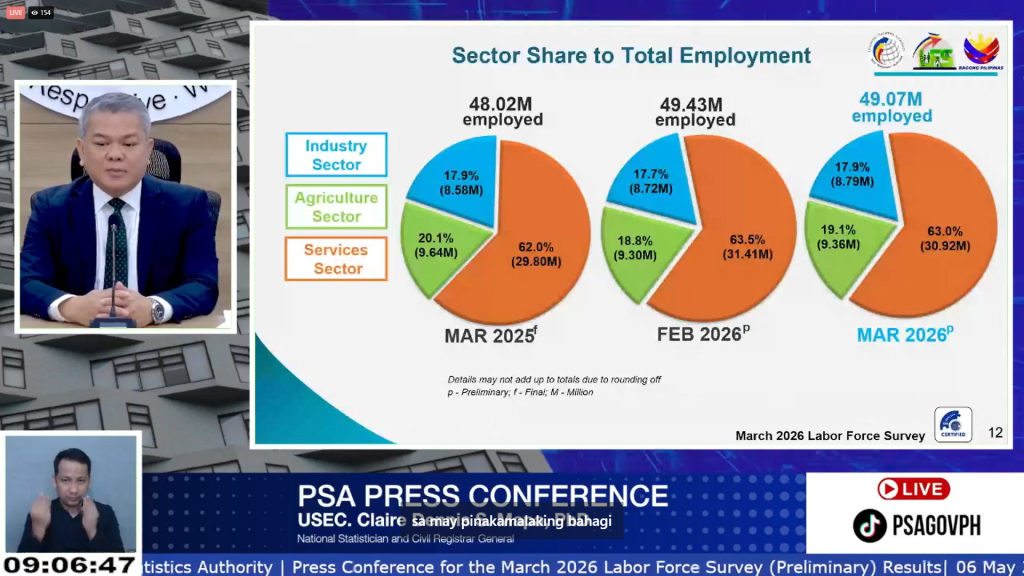
The following sectors were touted by the PSA as the primary drivers of employment growth on an annual basis (from March 2025 to March 2026):
- Transportation and Storage (4.05 million; up from 3.55 million)
- Administrative and Support Service Activities (3.02 million; up from 2.56 million)
- Professional, Scientific, and Technical Activities (481,000; up from 271,000)
- Construction (4.73 million; up from 4.56 million)
- Mining and Quarrying (325,000; up from 178,000)
Underemployment refers to employed persons who yearn to have additional income through extra work hours or a sideline to augment their primary occupation. In this regard, the underemployment rate was recorded at 12.3%, lower than the 13.4% in March 2025, but higher than the rate of 11.8% in February 2026.
This represents 6.03 million of the 49.07 million employed individuals seeking either additional hours of work or another job in order for them to make ends meet.
The labor force participation rate (LFPR) was recorded at 63.3% in March 2026, higher than the 62.9% in March 2025 but lower than the 63.8% in February 2026.
Such numbers represent a total of 51.65 million Filipinos in the labor force—higher than the 49.95 million registered in March 2025 but lower than the 52.09 million in the previous month.
Altogether, these figures show that the domestic labor force continues to remain in relatively good shape despite inflationary pressures and other challenges brought about by volatile oil prices and rising costs of basic commodities.
jpv

