
By Connie Calipay | Philippine News Agency
By Connie Calipay | Philippine News Agency
The Philippine Institute of Volcanology and Seismology (Phivolcs) has recorded an increase in volcanic sulfur dioxide (SO₂) emissions from Mayon Volcano, averaging 6,569 tons on Wednesday, the highest daily emission in the past 15 years.
In an advisory on Thursday, Phivolcs said the running average for February has risen to 5,503 tons per day, up from January’s average of 2,571 tons per day.
This increase in SO₂ emissions has occurred without similar increases in rockfall events, pyroclastic density currents (PDCs) or “uson” activity, or other signs of heightened lava effusion at the summit crater.
Strong degassing from the summit, accompanied by aseismic ash emission, was also visually observed during the day.
Phivolcs said the rise in volcanic SO₂ concentrations, albeit for a relatively short period, could foreshadow new intrusions into the Mayon edifice that could lead to further eruptive activity.
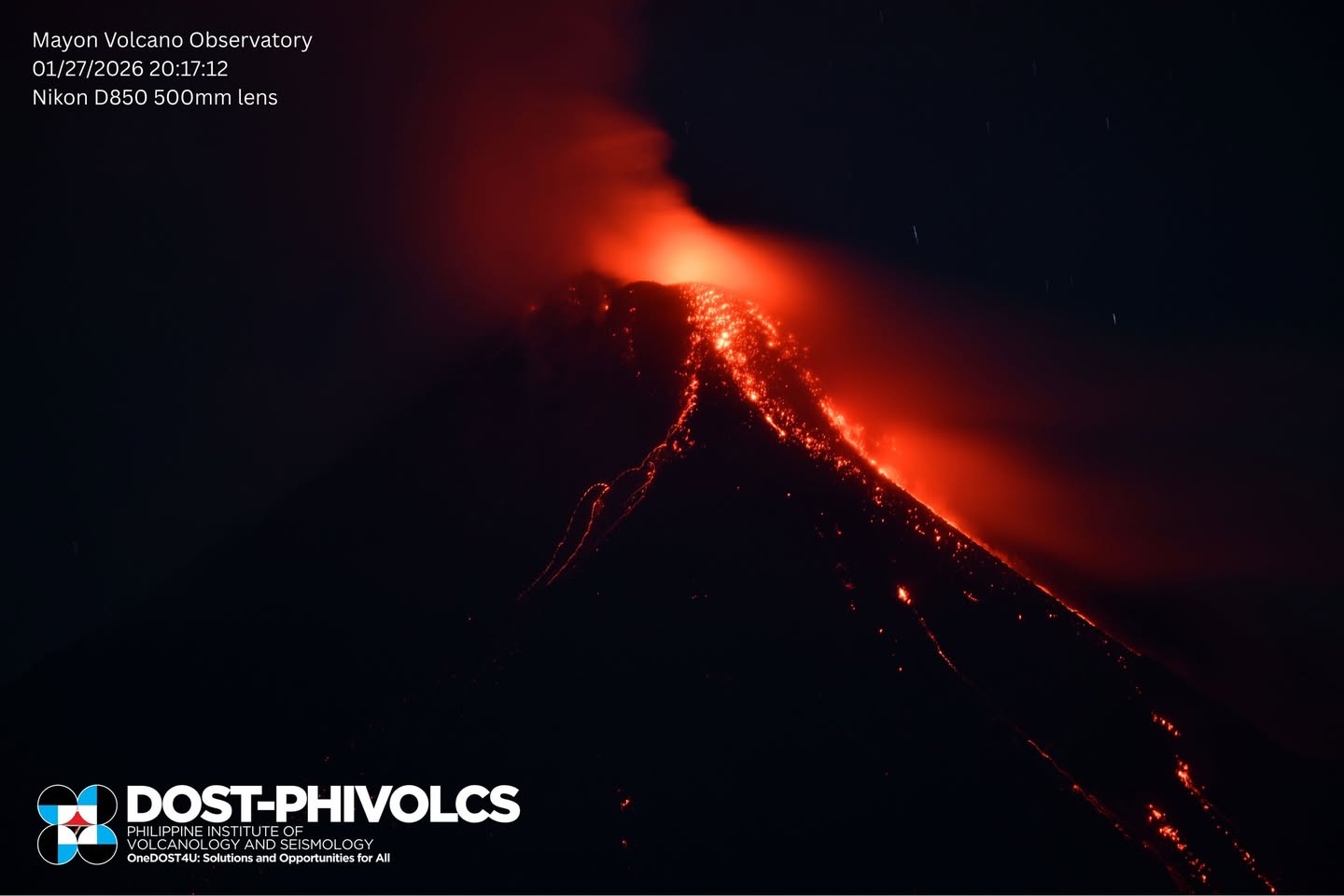
The agency reminded anew that Mayon Volcano remains at Alert Level 3 as effusive eruption at the summit continues, but the likelihood of lava fountaining or a moderately explosive eruption has again increased.
This means that while ongoing lava effusion continues to generate new lava flows, and collapse-fed rockfalls and PDCs on the southern and eastern upper slopes, potential lava fountaining or moderate explosions could produce similar lava flows, PDCs, and rockfalls on all sectors of the volcano.
The public is strongly advised to stay outside the 6-km radius Permanent Danger Zone (PDZ) due to the threat posed by these and other volcanic hazards.
Residents within an 8-km radius are urged to be prepared for possible evacuation should monitoring parameters suddenly escalate and the alert level be raised to Alert Level 4.
Phivolcs also advised increased vigilance and preemptive measures against lahars and sediment-laden streamflows along channels draining the edifice, as prolonged heavy rains over Albay province may accompany the passage of Tropical Storm Basyang (international name: Penha).
Civil aviation authorities are likewise urged to advise pilots to avoid flying close to the volcano’s summit, as ash from sudden eruptions can be hazardous to aircraft. (PNA)

