
By Ruth Abbey Gita-Carlos | Philippine News Agency
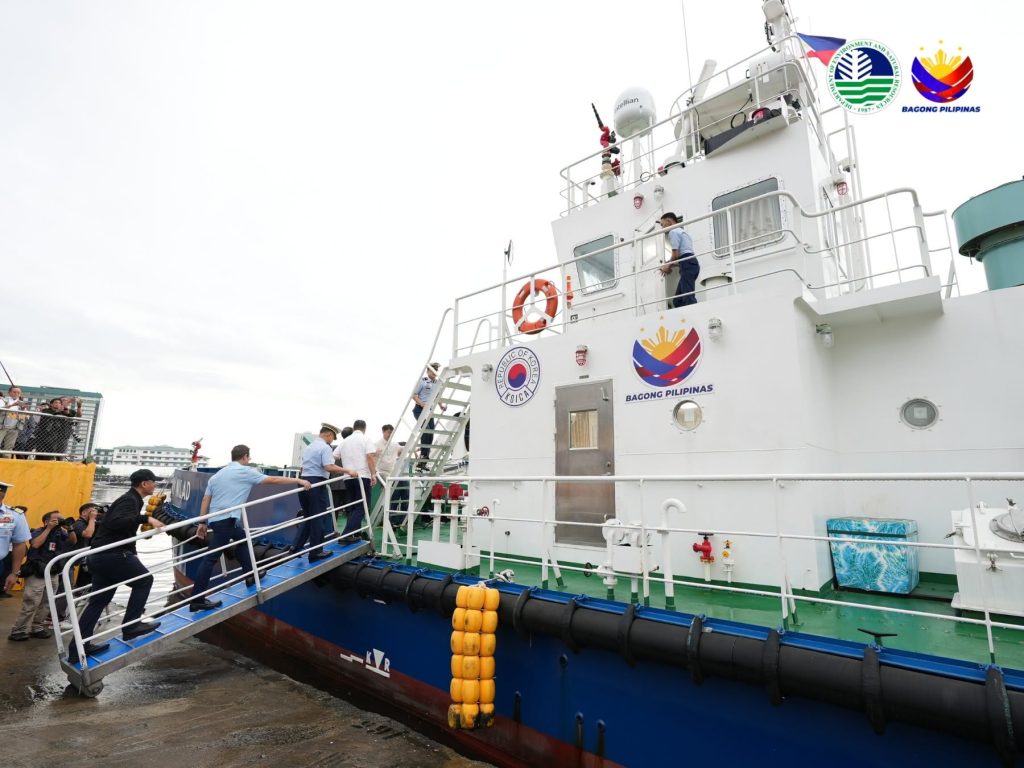
President Ferdinand R. Marcos Jr. on Tuesday expressed optimism that the goal of restoring Manila Bay to a cleaner condition is within reach following the deployment of state-of-the-art marine cleanup vessel MV Nilad.
In a speech delivered during the inauguration of MV Nilad at South Harbor in Port Area, Marcos said the Enhancement of Marine Litter Management in Manila Bay (EMLM) Project, launched by the Philippines in partnership with South Korea, would help accelerate Manila Bay’s ecological recovery.
Marcos stressed the importance of the partnership between the two countries in advancing the rehabilitation and restoration of Manila Bay by enhancing the Philippines’ capability to collect floating waste, respond to pollution incidents, and protect coastal ecosystems.
“The MV Nilad is a working vessel built for real and urgent tasks. It can collect, sort, and store up to ten tons of marine litter in a single operation. It can operate for as much as 300 to 400 hours annually. It is equipped not only for waste retrieval but also for oil spill response and environmental monitoring,” he said in a speech delivered by Transportation Secretary Giovanni Lopez.
“MV Nilad will also aid our research. The Department of Environment and Natural Resources personnel can conduct environmental monitoring and litter assessment, turning every clean-up operation into an opportunity to learn more about our bay,” Marcos added.
The $8.2-million project facilitated South Korea’s donation of MV Nilad to the Philippines to strengthen the country’s capacity to manage marine litter, improve environmental monitoring, build local capabilities, and raise public awareness of marine protection.
The 25‑meter, 101‑ton vessel is designed for continuous cleanup operations, equipped with a trash skimmer for collecting floating debris, a deck crane for handling and unloading waste, and an oil boom for rapid response to oil spill incidents.
Marcos called on the Department of Environment and Natural Resources and the Philippines Coast Guard to “take care of MV Nilad so that it may continue to take care of Manila Bay.”
He made the statement while acknowledging that Manila Bay, despite being “an iconic body of water,” remains one of the country’s “most environmentally stressed water bodies.”
“For a long time, our government agencies have lacked a dedicated vessel capable of continuous marine litter collection, waste retrieval, and emergency oil spill response in Manila Bay,” he said. “I look forward to seeing clearer waters in Manila Bay for ourselves and our children.”
A survey conducted by De La Salle University‑Dasmariñas under the EMLM Project found that more than 6.5 million litter items remain scattered across the bay’s 190‑kilometer coastline, weighing over 203,000 kilograms.
Plastics account for 91% of all collected waste, mostly from everyday consumption such as single‑use packaging, sachets, plastic bags, beverage containers, and cigarette butts.
Data showed that litter volume in Manila Bay dropped by 36% in 2024, while the total weight of collected waste declined by 42%.

