
By Joann Villanueva | Philippine News Agency
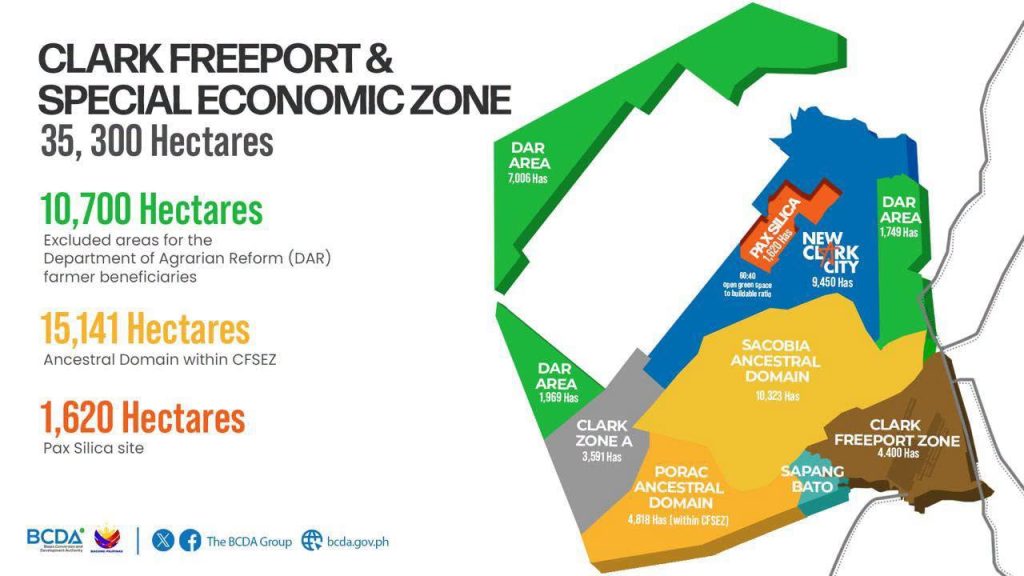
Site development in the planned U.S.-led artificial intelligence (AI) hub Pax Silica in Central Luzon is eyed to start within three to five years, covering around 500 hectares of the 1,620-hectare site.
“We see this as a long-term (investment). The first phase will be around 500 hectares. We see that in three to five years,” Bases Conversion and Development Authority (BCDA) President and Chief Executive Officer (PCEO) Joshua Bingcang said in a briefing at the New Clark City in Tarlac on Friday.
Full operations are seen within a 30-year period, which is projected to increase the country’s exports to around $200 billion.
In 2025, merchandise exports posted a record-high $84.48 billion, largely driven by semiconductors.
The Pax Silica project is seen to make the Philippines an AI hub, allowing more semiconductor firms and those catering to AI needs to locate in the country.
Bingcang clarified earlier news reports saying Pax Silica is an energy-intensive project due to data centers.
He said the data centers that will be established, if ever, are for the use of the semiconductor firms that will locate in the site, not hyperscalers or major data centers that cater to global clients.
“We will not put up data centers here. It will be for something which the New Clark City is really built for—predominantly, it will be for industrial use,” he said.
Bingcang said New Clark City’s master plan development is made to cater to several industries, and if there will be major data centers, these are not part of the Pax Silica initiative and will be located outside of the 4-acre site.
During the same briefing, Trade and Industry Undersecretary and Board of Investments managing head Ceferino Rodolfo said the Philippines joined the coalition, which now includes around 23 countries, to elevate the value proposition for domestic minerals and the semiconductors industry.
He explained that each party in the coalition has its own reason for joining the initiative, noting the rising demand for AI and its requirements.
“For the Philippines’ case, we are here because we would like to add value to the activities that we currently have in the Philippines. For example, for the minerals that we are able to export, we would like to add more value to the minerals that we are exporting largely in unprocessed form. For our semiconductor industry, we would like to move up the value chain,” he said.
Rodolfo said that while this is different from the reasons of the other countries, this converges with the other factors.
He said the pact is non-binding, which allows the countries that signed the pact to just end their commitment if they want to.
Asked what the Philippines will not gain if it exits the coalition, Rodolfo discounted this move, saying not being a party to the initiative means you will not have access to whatever innovation it will have.
“That’s why there is a need for a coordinated effort for investments. It’s non-binding but we share the same principles and you are branded as a trusted partner,” he added.

