
By Jose Cielito Reganit | Philippine News Agency
Department of Social Welfare and Development (DSWD) Secretary Rex Gatchalian on Thursday said 600,000 beneficiaries of the Walang Gutom Program (WGP) reported significant improvements in hunger, food insecurity, and food poverty according to a two-round survey conducted by the Social Weather Stations (SWS).
“Kaya na namin ngayon sabihin na 600,000 na pamilyang Pilipino ang kumakain na nang tama,” Gatchalian told reporters during a Palace briefing on Thursday.
He pointed out that the survey was commissioned by Globe Telecom and not the DSWD.
“Ang kinuha nilang nagfi-field survey will be SWS dahil SWS yung nagpapatakbo ng regular na quarterly survey on such topics. The questionnaire that we used, that Globe commissioned them to use, is the same questionnaire na ginagamit doon sa regular run nila quarterly,” he said.
The survey, which covered 2,400 respondents, was conducted in two rounds: the first from Feb. 24 to March 8, and the second from June 22 to July 1.
The DSWD chief emphasized that the survey aimed to determine changes in the condition of WGP household-beneficiaries and non-beneficiary households, particularly their experiences of hunger, food insecurity, and their own assessment of their food poverty status.
Based on the results discussed by SWS Vice President and Chief Operating Officer Gerardo “Jay” Sandoval and SWS Research Fellow Dr. Roehlano Briones, hunger among WGP beneficiaries declined by 6.7 percentage points, from 33.6% in the first round to 26.9% in the second round.
This was a considerably larger improvement compared with the 1.4-percentage-point decline recorded among non-WGP beneficiaries, whose reported experience of hunger decreased from 38.3% to 36.9%.
In terms of the food insecurity indicator, the results recorded improvements in food security among WGP beneficiaries. The proportion declined by 4.7 percentage points, from 94.0% to 89.3% between the two survey rounds.
This contrasts with non-WGP beneficiaries, who experienced a slight increase of 0.6 percentage points, from 95.9% to 96.5%.
For the last indicator on the respondents’ own perception of their food poverty status, WGP beneficiaries who considered themselves food poor declined by 1.4 percentage points, from 79.0% in the first round to 77.6% in the second round.
Meanwhile, the proportion among non-WGP beneficiaries increased by 1.3 percentage points, from 84.4% to 85.7%.
For this year, Gatchalian said the WGP will continue to strengthen its implementation by adding 150,000 household beneficiaries.
“Ang total na natin ngayon ay 600,000 beneficiaries. This year, we target the remaining 150,000 [beneficiaries] to form the entire 750,000 food poor families. Ayon sa PSA (Philippine Statistics Authority), may 750,000 tayo na rated na food poor families, ay maipapasok na natin,” he said.
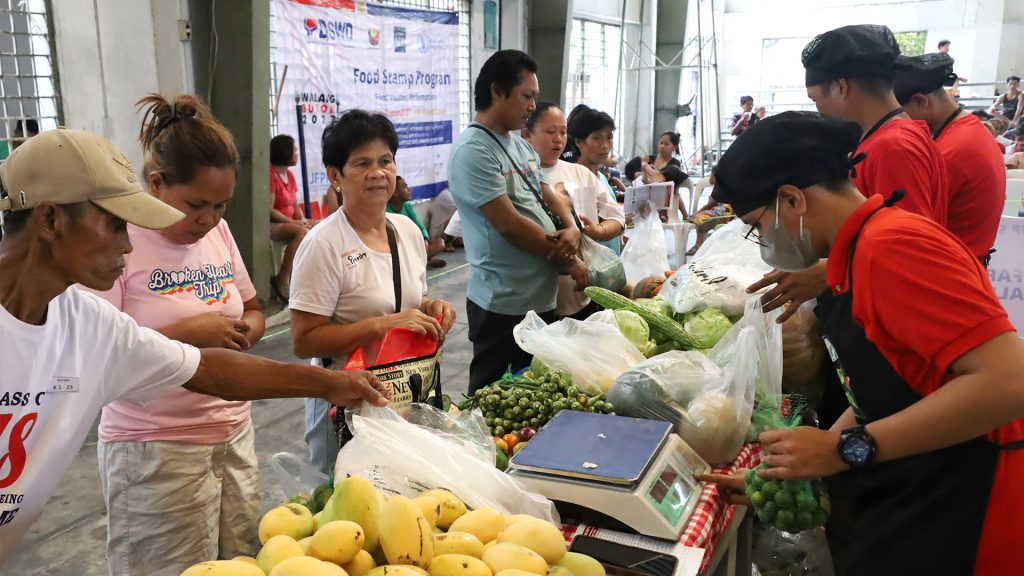
Launched in 2023 and institutionalized in 2024 through Executive Order No. 44, the WGP serves as the Philippine government’s flagship anti-hunger program based on the directive of President Ferdinand R. Marcos Jr. to combat food insecurity and reduce involuntary hunger among Filipino families.
Under the WGP, beneficiaries receive P3,000 in food credits provided through Electronic Benefit Transfer (EBT) cards. The food credits in the EBT cards are intended to purchase nutritious food items and are non-convertible to cash.
The DSWD chief, however, stressed that the program is conditional as beneficiaries need to undergo the Kalusugan, Kakayahan at Kabuhayan (3K) sessions. Under the 3K, the beneficiaries are provided with knowledge on nutrition as well as capacity-building and upskilling activities.
“Pero this is a conditional program. Sa tuwing nagre-redeem sila, uma-attend sila ng tinatawag namin na Kalusugan, Kakayahan, at Kabuhayan sessions, wherein may food nutritional development sessions, tinuturuan sila kung paano kumain ng mura, masustansya, at masarap na pagkain. Partner namin dito ang DOLE (Department of Labor and Employment) at ang TESDA (Technical Education and Skills Development Authority) para sa skills upskilling nila para makahanap sila ng trabaho bilang kondisyon,” Gatchalian said.
The WGP also promotes social and behavioral change among food-poor households by teaching them how to prepare nutritious, delicious, and affordable meals, empowering households to prioritize healthy diets and adequate nutrition.

