
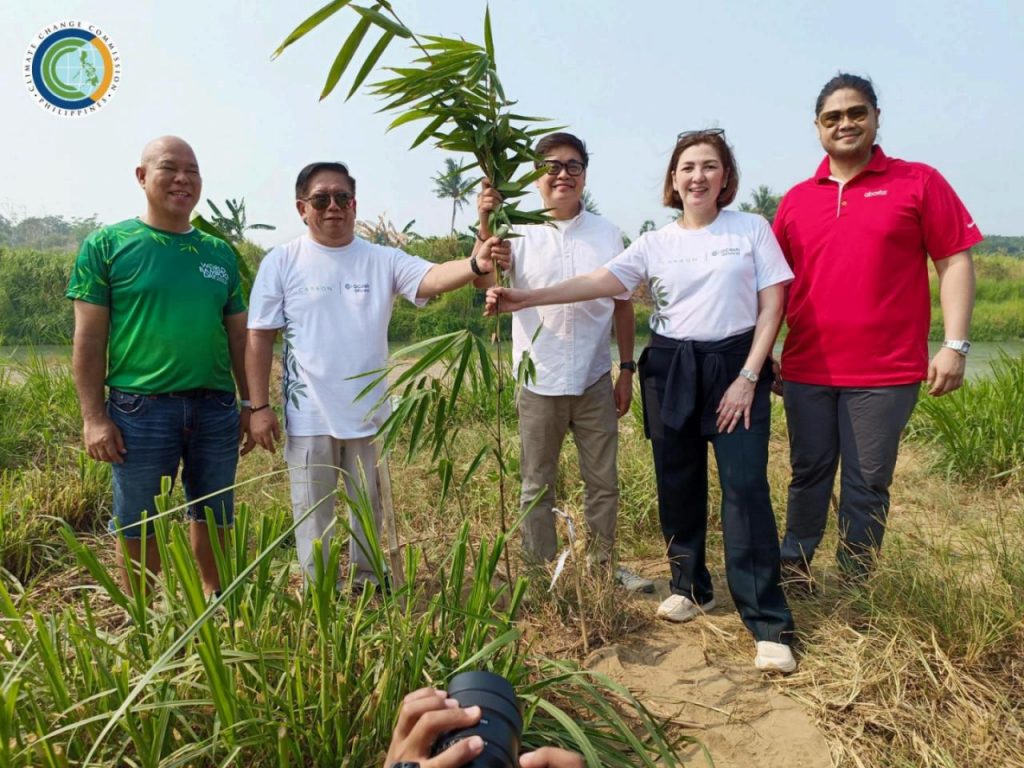
The Climate Change Commission (CCC) welcomed a long-term partnership to grow 1 million trees and help restore 1,200 hectares in Balamban, Cebu, calling it a practical contribution to the Marcos Jr. administration’s agenda for climate resilience, low-carbon development, and sustainable growth.
The five-year greening partnership brings together the Municipality of Balamban, Aboitiz Foundation through its CarbonPH restoration program, and GCash GForest, with communities, people’s organizations and other government and private-sector partners.
More than 3,000 volunteers joined the program’s first major on-ground activity on Sept. 19, planting bamboo and native trees across identified restoration areas.
“This partnership recognizes a fundamental truth: planting is an activity, but growing a forest is a long-term responsibility,” said CCC Vice Chairperson and Executive Director Robert E.A. Borje.
“The more meaningful measure is not simply how many seedlings enter the ground on planting day. It is how many survive, how much land is restored, how well watersheds and biodiversity are protected, and whether communities gain lasting livelihoods and greater resilience,” he added.
The program targets at least 85-percent tree survival through nurseries, sustained maintenance, monitoring, protection and community stewardship. Native and endemic species—including Cebu Cinnamon or kaningag, narra, molave, katmon, almaciga, and bagilumbang—will be grown alongside bamboo, fruit-bearing trees and agroforestry crops such as cacao, coffee, and jackfruit.
Bamboo and native trees were also planted along the river corridor to help rehabilitate the watershed, stabilize riverbanks, reduce erosion, and support natural flood mitigation.
Held during World Bamboo Day, the activity highlighted bamboo’s potential contribution to ecosystem restoration, climate action and local development. When properly selected, planted, managed and sustainably utilized, bamboo can support watershed rehabilitation, carbon storage, enterprise and community livelihoods.
“Bamboo is valuable not merely because it grows quickly, but because it can connect ecosystem restoration with production and income,” Borje said. “For restoration to endure, communities must see both ecological and economic value in protecting what they have helped grow.”
The CCC recognized the Municipality of Balamban for anchoring the initiative in local priorities and community participation. The Cebu Bamboo Industry Development Council and local people’s organizations can help connect bamboo growing with responsible production, value-chain development, and livelihoods.
Aboitiz Foundation, through CarbonPH, brings a long-term landscape-restoration model, resources and partnerships. CarbonPH forms part of the Foundation’s 40-year commitment to help restore Cebu’s forests, watersheds, and ecosystems.
GCash GForest connects digital participation with restoration on the ground. Green-energy points generated through everyday digital activities help support actual tree growing, enabling millions of Filipinos to participate beyond the planting sites.
The Department of Environment and Natural Resources–Forest Management Bureau provides the broader technical and policy framework for sustainable forest and watershed management.
“This partnership demonstrates how different responsibilities can reinforce one another,” Borje said. “The local government provides leadership. Communities provide knowledge and stewardship. Businesses contribute resources, technology and networks. National institutions provide policy direction and technical support.”
The initiative supports President Ferdinand R. Marcos Jr.’s direction to move the government from reactive responses toward proactive and predictive governance.
As the President said in his 2026 State of the Nation Address, “We have moved on from the reactive approach. Now, we are not only proactive, but predictive as well.”
“Restoring degraded landscapes, protecting watersheds and strengthening livelihoods before climate impacts intensify are concrete expressions of predictive governance and preventive adaptation,” Borje said.
Under President Marcos, who chairs the CCC, the Philippines completed and adopted its first National Adaptation Plan (NAP) for 2023–2050. The NAP provides the country’s long-term framework for reducing climate vulnerability and strengthening resilience across interconnected sectors.
The Balamban initiative supports NAP priorities on ecosystems and biodiversity, water resources, agriculture and livelihoods, and integrated land-use management. Restoring forests and watersheds can reduce erosion and flood risks, protect water sources, strengthen biodiversity and help communities manage interconnected climate risks.
The initiative also supports the Philippines’ commitments under the Paris Agreement by strengthening natural carbon sinks while generating adaptation benefits and opportunities for sustainable local development.
Borje said that contributing to climate resilience does not stop at planting trees.
“For initiatives such as CarbonPH to contribute credibly to national climate goals, we must measure more than the number of seedlings planted. We must track survival and growth, restored land, improved carbon stocks, ecosystem benefits and community outcomes.”
He added that the partnership shows how national policy can be translated into local action through a one-country-team approach.
“Balamban is showing how climate resilience, low-carbon development and sustainable growth can take root in the same landscape,” Borje said. “If we grow the trees, protect the watershed and build viable livelihoods around restoration, local action can help transform the nation.”
The CCC, as the lead policy-making body of the government on climate change, continues to advance the implementation of the National Adaptation Plan, the National Climate Risk Management Framework and the country’s commitments under the Paris Agreement in partnership with national agencies, local governments, communities, development partners and the private sector. (PR)

