
Agence France-Presse
Authorities in southern Brazil scrambled Sunday to rescue people from raging floods and mudslides in what has become the region’s largest ever climate catastrophe, with at least 78 dead and 115,000 forced from their homes.
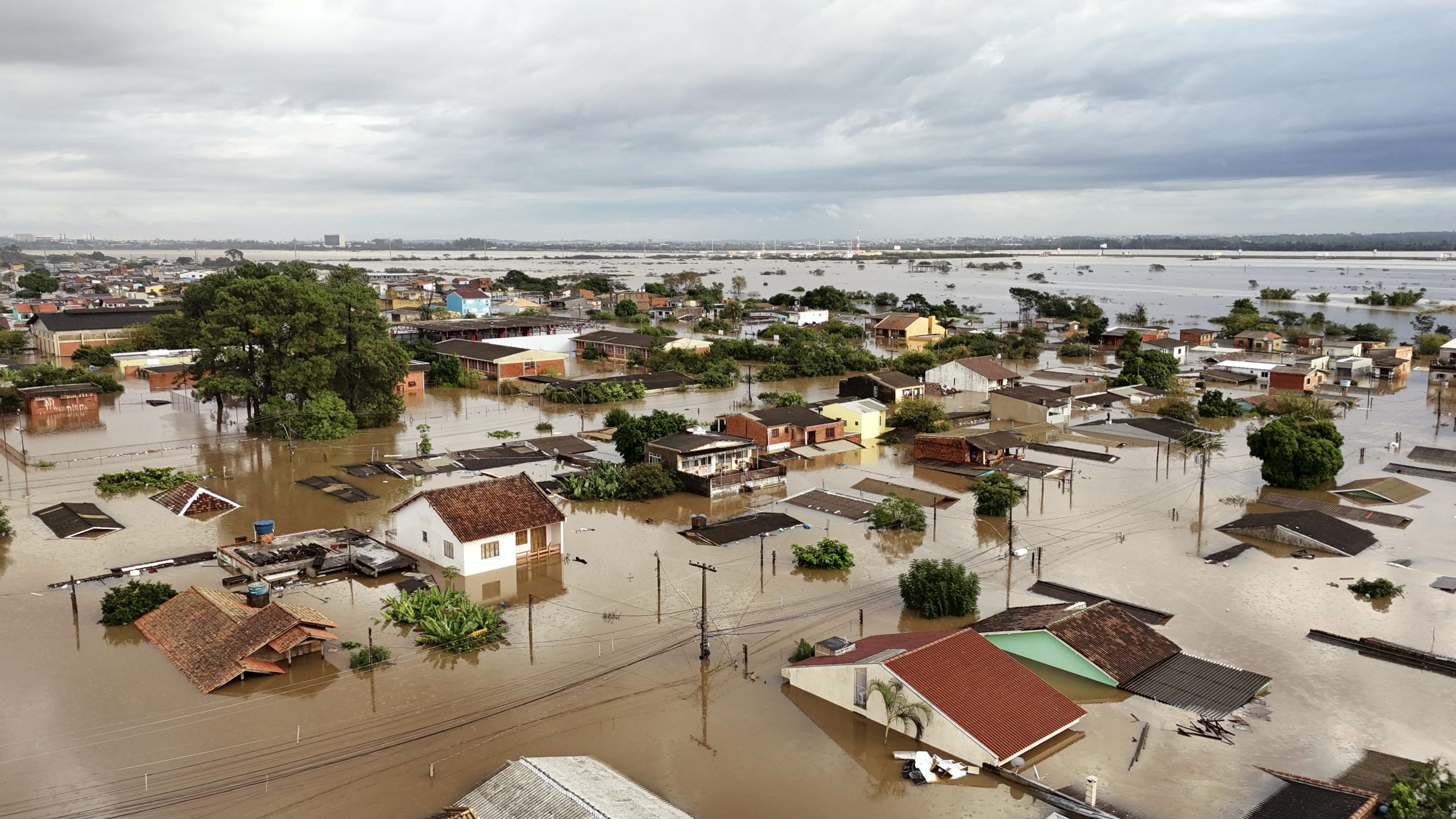
Entire cities were underwater, with thousands of people cut off from the world by the floodwater, brought by days of torrential rains.
In Porto Alegre, the capital of Rio Grande do Sul state, residents stood on rooftops hoping to be rescued as others in canoes or small boats navigated streets that have become rivers.
After what one climatologist called “a disastrous cocktail” of climate change and the El Niño effect, more than 3,000 soldiers, firefighters, and other rescuers were trying to reach residents, who were in many cases trapped without basic supplies such as running water or electricity.
Civil defense officials said at least 105 people were missing in the latest of a string of catastrophic weather events to hit the South American giant.
“It looks like a scene out of a war, and after it is over it will require a post-war approach,” Rio Grande do Sul governor Eduardo Leite said, flanked by President Luiz Inacio Lula da Silva and several government ministers.
Lula promised the government would provide all necessary resources for reconstruction.
Besides Porto Alegre, another 341 towns and villages have been hit by the flooding.
Soldiers are setting up field hospitals after hundreds of patients had to be evacuated from regular hospitals, while civilians have also formed volunteer groups to gather basic supplies, including life jackets, water and fuel.
“Everyone helps in their own way, as they can,” said Luis Eduardo da Silva, a 32-year-old volunteer.
The Guaiba River, which flows through the city of 1.4 million people, reached a record high level of 5.3 meters (17.4 feet), according to the local municipality, well above the historic peak of 4.76 meters that had stood as a record since devastating 1941 floods.
“Rio Grande do Sul has always been a meeting point between tropical and polar air masses,” climatologist Francisco Eliseu Aquino told AFP.
“But these interactions intensified with climate change” to create “a disastrous cocktail that makes the atmosphere more unstable and encourages storms.”
Rosana Custodio, a 37-year-old nurse, fled her flooded Porto Alegre home with her husband and three children.
“During the night on Thursday the waters began to rise very quickly,” she told AFP via a WhatsApp message.
“In a hurry, we went out to look for a safer place. But we couldn’t walk… My husband put our two little ones in a kayak and rowed with bamboo. My son and I swam to the end of the street,” she said.
Her family was safe, but “we’ve lost everything we had.”
‘It’s terrifying’
Authorities scrambled to evacuate swamped neighborhoods as rescue workers used four-wheel-drive vehicles – and even jet skis – to maneuver through waist-deep water in search of the stranded.
Governor Leite said his state, normally one of Brazil’s most prosperous, would need heavy investment to rebuild.
Long lines formed as people tried to board buses, although bus services to and from the city center were canceled.
The Porto Alegre international airport suspended all flights on Friday for an undetermined period, with its runways underwater.
Lula posted a video of a helicopter depositing a soldier atop a house, who then used a brick to pound a hole in the roof and rescue a baby wrapped in a blanket.
The speed of the rising waters unnerved many.
“It’s terrifying because we saw the water rise in an absurd way, it rose at a very high speed,” said Greta Bittencourt, a 32-year-old professional poker player.
‘Disastrous cocktail’
Leite said this was the worst natural disaster in the history of Rio Grande do Sul, which is home to agroindustrial production of soy, rice, wheat and corn.
Lula, who visited the state twice in a matter of days, has blamed the disaster on climate change.
South America’s largest country has recently experienced a string of extreme weather events, including a cyclone in September that killed at least 31 people.

