
By Nanette Guadalquiver/PNA
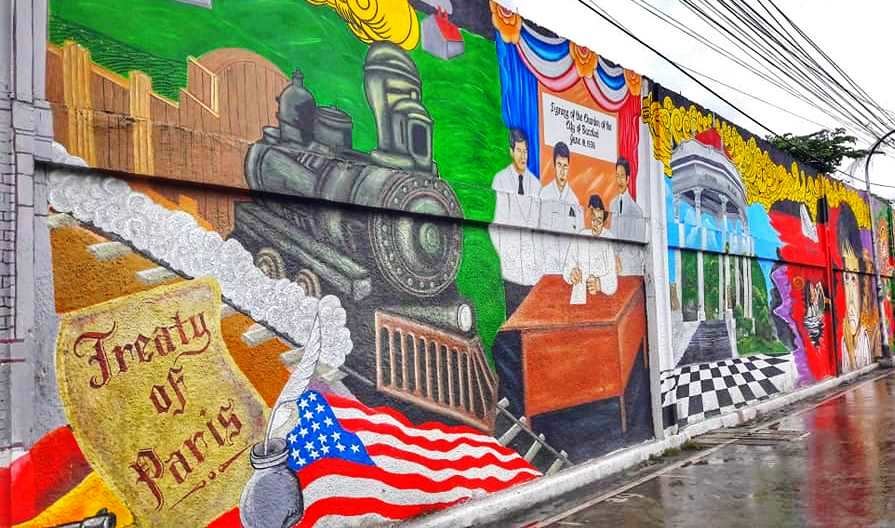
BACOLOD CITY — The city’s celebration of its eight decades of existence is depicted in a historical mural dubbed “Bacolod @ 80,” painted on the walls of the Bacolod North Cemetery on Burgos Extension Road.
Brenda Burdeos, officer-in-charge of City Cooperative and Livelihood Development Office and designated project head, said on Thursday the mural is a series of flashbacks of Bacolod’s history.
“Tourists can easily see the chronological significance of the mural,” she said.
Burdeos’ late husband, visual artist Rafael “Karlo” Burdeos Jr., conceptualized the project earlier this year, and tapped fellow local artists to work on the mural project, which was inaugurated on Tuesday afternoon.
“This is also a legacy of my husband as an artist,” the city official added.
The “Bacolod Historical Mural @ 80” project, which was presented by Burdeos’ team in May during a press briefing with Mayor Evelio Leonardia, obtained a financial grant of PHP125,000 from the National Commission for Culture and the Arts (NCCA).
Last August, a team from the NCCA led by National Committee on Visual Arts head and Arts in Public Spaces project director Edgar Fernandez arrived in the city to assist local artists working on the mural.
Leonardia said the giant artwork could also be one of the tourist attractions in the city, if maintained, with a story properly narrated to tourists.
“It is now one of our treasures in Bacolod,” Leonardia said.
The murals have seven frames, depicting the history of Bacolod since it became a chartered city in 1938 up to the present.
The first frame shows the theme of the city’s 80th-year celebration “Full Speed Ahead,” with some major awards received by Bacolod.
The second frame depicts the significance of agriculture, especially of sugarcane farming and sugar production to Bacolod as the capital city of Negros Occidental, while the third features the Cinco de Noviembre revolt of the Negrenses against the Spaniards.
The fourth frame shows the modernization of sugar milling; the fifth, the signing of the Charter of Bacolod by President Manuel Quezon; the sixth, the dark moments in Negros Occidental; and the seventh frame, the MassKara Festival.

