
By Raymond Carl Dela Cruz | Philippine News Agency
The Land Transportation Franchising and Regulatory Board (LTFRB) on Tuesday announced a fare hike for all modes of land transportation, an increase averaging 19%, likely to take effect Thursday.
In a press conference at the LTFRB headquarters, LTFRB Chair Vigor Mendoza II said the fare hike was “thoroughly deliberated and supported by data and analysis” by the agency, the Department of Transportation (DOTr), and the Department of Economy, Planning and Development (DEPDev).
“And this is timely because the transport sector is currently facing a serious challenge on the prices of petroleum products as a result of the Middle East tensions,” Mendoza said.
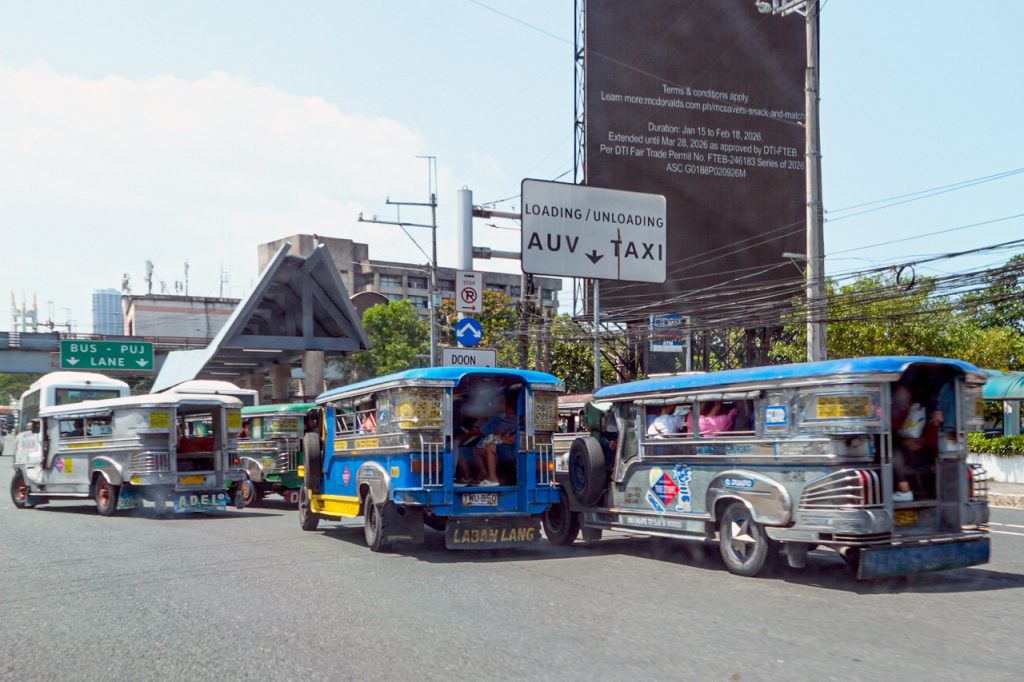
The LTFRB has approved a P1 increase in the minimum fare of traditional jeepneys (from P13 to P14) plus P2 for every succeeding kilometer, while modern jeepneys will have a P2 increase in the minimum fare (from P15 to P17) plus P2.30 for every succeeding kilometer.
For airport taxis, the flagdown rate was increased by P40 for the first 500 meters, from P75 to P115, with no changes in the succeeding 300-meter and two-minute wait time charges.
For transport network vehicle services (TNVS), the LTFRB approved a P20 increase and a P15 pick-up fare per km, increasing the base fare for sedans from P45 to P65; AUVs from P55 to P75; hatchbacks from P35 to P55; and premium TNVS from P145 to P165.
Per-km and per-minute charges for TNVS remained unchanged.
For ordinary buses in Metro Manila and other cities, the LTFRB approved a P2 increase in the minimum fare—from P13 to P15 for the first 5 km, plus P2.49 for every succeeding kilometer.
For air-conditioned buses in Metro Manila and other cities, there will be a P3 increase, from P15 to PHP18 for the first 5 km, plus P2.98 for every succeeding kilometer.
For ordinary buses in provincial operations, a P1 increase was approved for the first 5 km, with charges for succeeding kilometers varying depending on the type of passenger bus.
For ordinary taxis and UV Express units, petitions for fare hikes have just recently been filed by transport groups and are still being studied.
Mendoza noted that the increase will be permanent and will take effect once the changes are published by the UP Law Center, likely by Thursday.
“These are permanent decisions. When they get their fare guides, pwede nila implement kaagad ito,” he said.
He noted that a fare matrix must be posted inside the PUV before implementing the new fares.
Earlier, the DOTr, the Department of Social Welfare and Development (DSWD), and local governments in Metro Manila began the distribution of fuel subsidies for tricycle drivers across 30 sites in the region.
The fuel subsidy distribution will continue and expand to drivers and operators of other modes of public land transport in the coming weeks as part of government efforts to ease the effects of rising fuel prices brought on by the conflict in the Middle East.

