

Myanmar and Bangladesh have signed an agreement for the return home of hundreds of thousands of Rohingya who fled to Bangladesh to escape violence in Myanmar’s Rakhine state, according to officials from both countries.
Myint Kyaing, a permanent secretary with Myanmar’s Ministry of Labor, Immigration and Population, said a memorandum of understanding had been signed Thursday, but gave no other details. More than 600,000 people have fled across the border to camps in Bangladesh, which said the repatriations are to begin within two months.
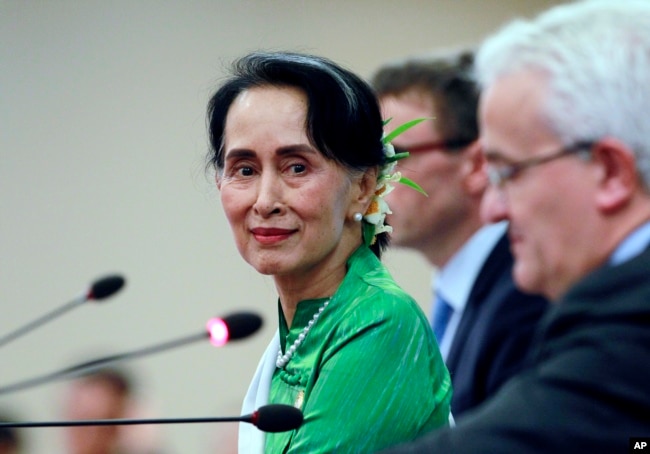
Reports said the deal was signed following talks in Myanmar’s capital, Naypyitaw, with Myanmar State Counselor Aung San Suu Kyi and Bangladesh’s foreign minister, Abul Hassan Mahmood Ali. The French news agency AFP quoted Ali as saying, “This is a primary step. [They] will take back [Rohingya]. Now we have to start working.”
The development came one day after U.S. Secretary of State Rex Tillerson said violence in Rakhine state targeting the Muslim Rohingya qualified as ethnic cleansing.
Wednesday’s announcement marked the first time the State Department had designated the violence as ethnic cleansing. Officials briefing reporters called the designation a descriptive term.
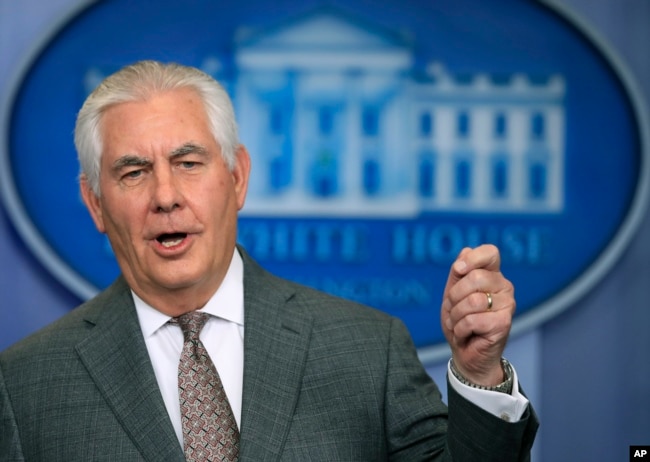
In a written statement, Tillerson said, “After a careful and thorough analysis of available facts, it is clear that the situation in northern Rakhine state constitutes ethnic cleansing against the Rohingya.”
Tillerson also noted in his statement he had visited Myanmar November 15 and met separately with Myanmar’s State Counsellor Aung San Suu Kyi and the Commander-in-Chief of the Armed Forces, Senior General Min Aung Hlaing. In referring to Myanmar as Burma, Tillerson said he “reaffirmed the United States’ strong commitment to Burma’s successful democratic transition as the elected government strives to implement reforms, bring peace and reconciliation to the nation, and resolve a devastating crisis in Rakhine State.”
Tillerson went on to say those responsible for the atrocities must be held accountable.
Myanmar’s military repeatedly has rejected accusations that atrocities, including rape and extrajudicial killings, are occurring in northern Rakhine, the epicenter of violence the U.N. has qualified as “textbook ethnic cleansing.”
The latest unrest erupted after Rohingya militants attacked police posts in Myanmar on August 25, prompting a military crackdown.
The government in mainly Buddhist Myanmar does not recognize the Rohingya, referring to them as “Bengali” to imply origins in Bangladesh. Officials in Bangladesh say the Rohingya are “Myanmar nationals” and that it is a mistake to refer to them as Bangladeshis.
Aung San Suu Kyi has faced criticism for her response to the crisis. She initially maintained there had been “a huge iceberg of misinformation” about the plight of the Rohingya.
Amnesty’s reaction
Human rights group Amnesty International said earlier this week that discrimination against the Rohingya had worsened considerably in the last five years, and that it amounted to “dehumanizing apartheid.” In response to Thursday’s announcement, the rights group said Rohingya returns in Myanmar were “unthinkable” until the “apartheid system” was dismantled.
A statement from Charmain Mohamed, Amnesty’s director for refugee and migrant rights, said, “While precise details of this deal have not yet been revealed, talk of returns is clearly premature at a time when Rohingya refugees continue to trickle into Bangladesh on an almost daily basis as they flee ethnic cleansing in Myanmar.”
Mohamed also said, “There can be no safe or dignified returns of Rohingya to Myanmar while a system of apartheid remains in the country, and thousands are held there in conditions that amount to concentration camps.”
Pope Francis is scheduled to visit Myanmar and Bangladesh beginning next week. | via VOANews

