
By Ruth Abbey Gita-Carlos | Philippine News Agency
President Ferdinand R. Marcos Jr. on Thursday emphasized the importance of faster and expanded internet connectivity as a key driver of national development, saying digital access is now a necessity that empowers Filipinos to learn, work, and access essential services.
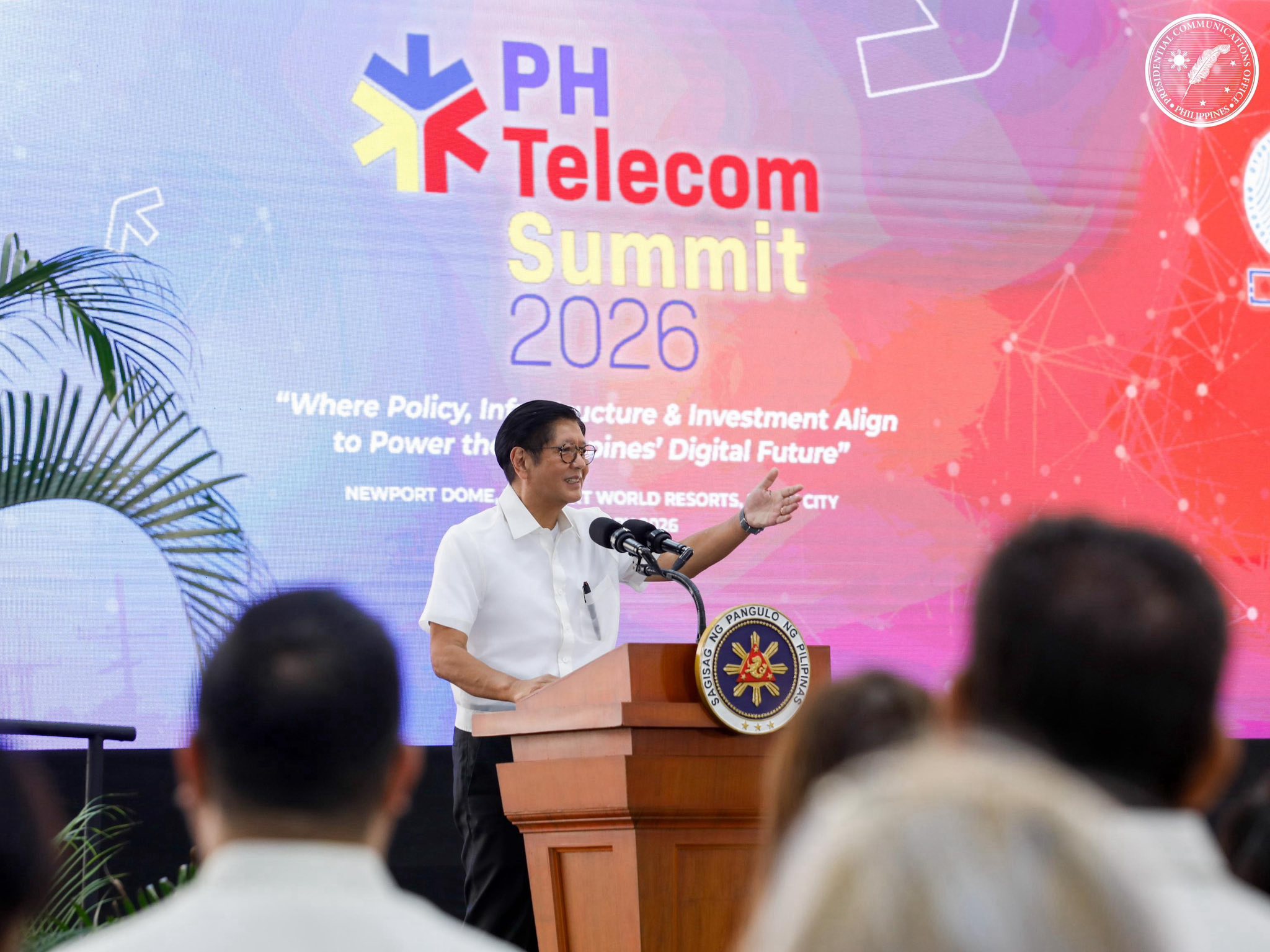
Speaking at the Philippine Telco Summit 2026 at the Newport Dome in Pasay City, Marcos reaffirmed his administration’s commitment to ensuring that every Filipino, especially those in remote and far-flung areas, has access to reliable and affordable internet.
“Broadband and mobile Internet speeds have improved in recent years. These gains mean faster access to education, health services, government programs, and livelihoods,” Marcos said.
“After all, in today’s age, connectivity is a right, a necessity, and a lifeline. Still, challenges continue to remain.”
The President noted that while the telecommunications sector has seen significant growth due to sustained investments and policy reforms, many rural and remote areas continue to face unstable signals and limited broadband access.
He lamented that persistent delays in permits, right-of-way restrictions, fiber cuts, and power interruptions further worsen connectivity issues.
“These affect real lives. They limit access to education, constrain economic opportunity, and slow national progress,” Marcos said.
To address the gaps, he said, the government, through the Department of Information and Communications Technology (DICT), is accelerating reforms to make Internet services faster, more affordable, and more accessible.
Marcos cited the continued rollout of 5G networks, expansion of fiber optic infrastructure, and growth of mobile broadband services, which he said have transformed how Filipinos access education, healthcare, and government services.

By the third quarter of 2025, telecommunications providers are expected to deploy more than 1.8 billion cable devices nationwide, connecting millions of homes, schools, and businesses to opportunities previously beyond reach, he said.
Marcos also stressed that the implementation of the Konektadong Pinoy Act removed barriers to entry in the telecommunications sector and promoted infrastructure sharing to reduce costs and improve efficiency.
He highlighted the completion of the three phases of the National Fiber Backbone Project, noting that the first phase provided internet connectivity to 360 government agencies, benefiting 10 million transacting members of the public, while the second and third phases expanded access to an estimated 690 government agencies, benefiting nearly 17 million transacting members of the public.
Marcos also cited government initiatives, such as the National Broadband Program and the Free Wi-Fi Internet Access Program, which now operate in thousands of public locations nationwide.
He said improving digital connectivity supports inclusive growth, strengthens governance, and prepares Filipinos to compete in the digital economy.
“Last year, the Philippine telecommunications sector was valued at more than $6 billion. More important than that figure is what it represents—years of investment, progressive reform, and a clear belief that digital access can uplift lives,” Marcos said.
The one-day summit focuses on policy direction, strategic investments, and the deployment of key technologies, including fiber networks, 5G, satellite systems, and data centers, to deliver reliable, affordable, and inclusive connectivity for communities, businesses, schools, and local government units.
It features discussions on major government initiatives, such as the National Digital Connectivity Plan and the Konektadong Pinoy Act, alongside sessions on digital skills, employment opportunities, reporting systems, and strengthening the country’s digital backbone.

