
By Alec Go
Inflation for January accelerated to 8.7%, up from the 8.1% in December 2022 and the highest since November 2008, the Philippine Statistics Authority (PSA) reported Tuesday, Feb. 7.
This is also higher than the 3.0% in January 2022.
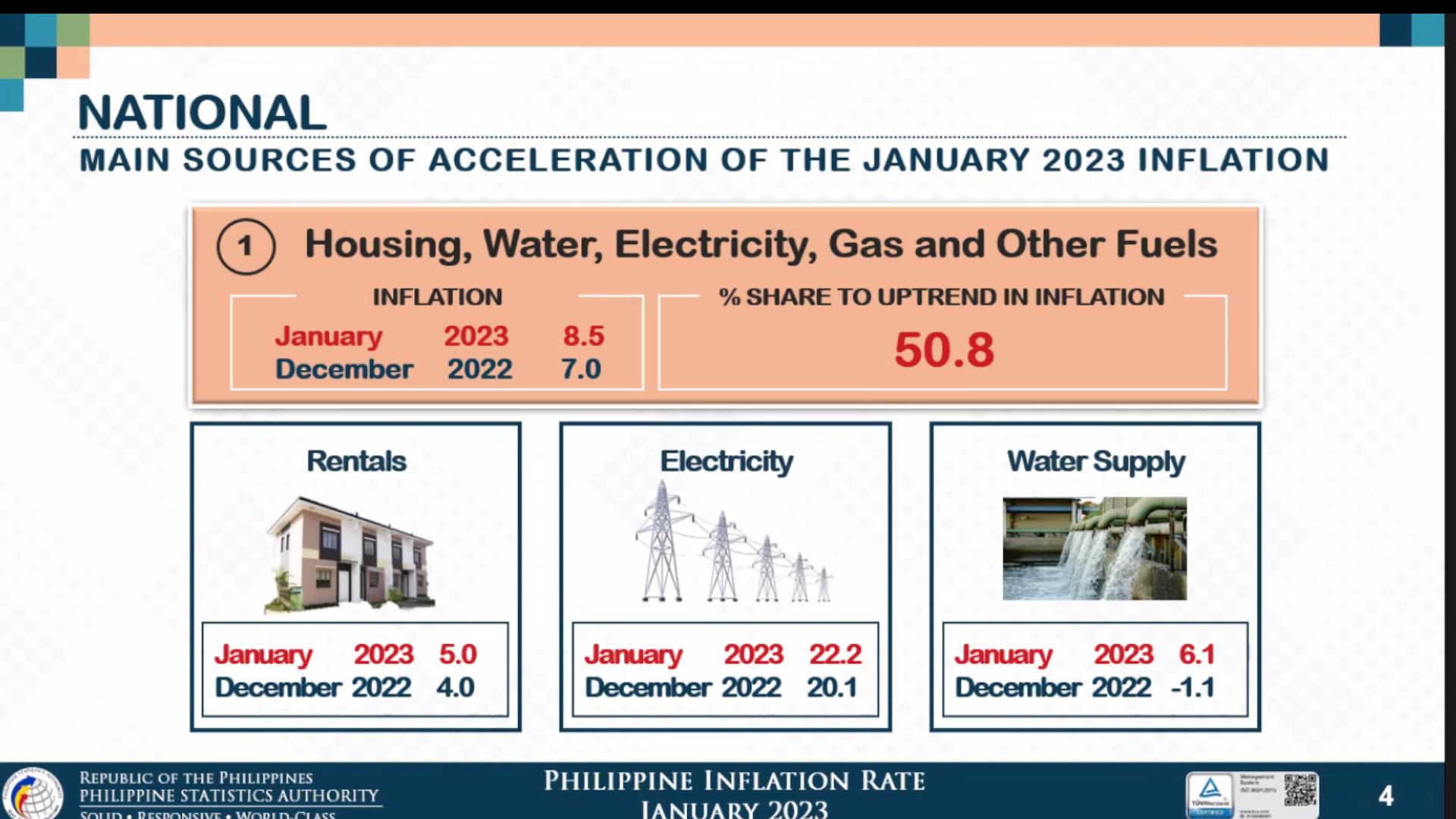
Higher housing, water, electricity, gas and other fuel inflation at 8.5% from December’s 7.0% was the main source of the acceleration with 50.8% share to overall figure.
Food and non-alcoholic beverages’ 10.7% from December’s 10.2% followed with a 29.9% share to the uptrend. Inflation for restaurants and accommodation services at 7.6% also contributed to the latest figure with a 9.1% share.
“Out of the 13 major commodity groups that we’re tracking, nine commodity groups actually increased this January compared to December,” National Statistician Dennis Mapa said, noting that transport inflation went down but remained double digit.
“If there are changes, particularly downward direction dito sa mga commodity groups na ito, particularly mga matataas na weight, we can also see that it will go down. But right now, there are risks associated with the high inflation across different commodity groups,” he added.
The National Capital Region posted an 8.6% rate from December’s 7.6%, while price movement in areas outside the metro also accelerated to 8.7% from 8.2%. This is also due to higher housing, water, electricity, and gas rates.
Following the report, the National Economic and Development Authority (NEDA) said the government is prioritizing improved agricultural productivity and food and energy security.
“As part of the administration’s 8-point agenda and the Philippine Development Plan 2023-2028, the government is implementing measures to ease price pressures and cushion the impact of inflation, especially on basic commodities,” NEDA Secretary Arsenio Balisacan said.
“Our measures are meant to balance the interests among local food producers, consumers, and the overall economy,” he added. – gb

