
By Che Palicte/Philippine News Agency
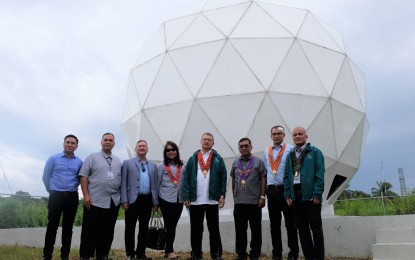
DAVAO CITY — The Philippines’ largest satellite-tracking antenna is now fully operational here.
Launched on Sunday, the Davao GRS Ground Receiving Station (D-GRS) called Philippine Earth Data Resource and Observation (PEDRO) will have the same functions as that of the first GRS installed at Department of Science and Technology-Advanced Science and Technology Institute (DOST-ASTI) in Quezon City.
Harold Bryan Paler, Senior Science Research Specialist of DOST- ASTI, said on Monday the system is very helpful since the country is starting to leverage on space technology to address challenges such as disasters.
“This tracking system will take images of the affected areas. It will be processed and downloaded and will be distributed to the concerned disaster agencies,” he said.
It is designed to communicate with Earth observation satellites, including the Philippines’ very own Diwata-1 and Diwata-2 microsatellites, by receiving, processing, and distributing space-borne imagery.
Paler said that it has direct access to a broad range of optical (high-resolution, multispectral) and synthetic aperture radar (cloud-penetrating, day-night-imaging) satellite data.
Apart from post-disaster images, the D-GRS will be utilized for agricultural monitoring, maritime surveillance and urban mapping.
Compared to the ASTI GRS in Quezon City with only 3.7 meters, the D-GRS has a 7.3-meter satellite-tracking antenna, which will allow more efficient download of images at a higher bandwidth.
With the D-GRS in full operation, the reception, processing, and satellite data storage cycle will open more opportunities to promote inclusive innovation, reaching more Filipino scientists and researchers in return, Paler added.
The D-GRS was installed at the Civil Aviation Authority Philippines Transmitter Facility here and was established by DOST-XI and Department of Information and Communications Technology.
For the latest updates about this story, visit the Philippine News Agency website

