
Remains of new species of duck-billed dinosaur found in Chile

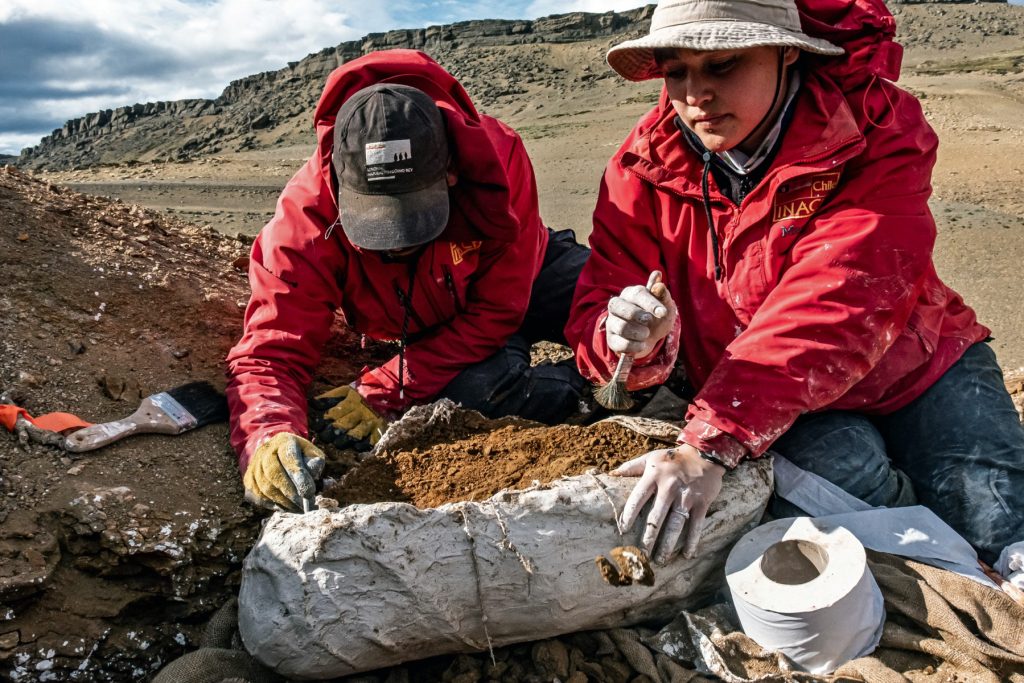
Handout picture released on June 16, 2023 by Chile’s State University showing scientists of the Chilean Antarctic Institute (INACH) looking for dinosaur fossiles at the Valle del Rio de las Chinas, Magallanes, Chile, on December 22, 2017. – Chilean scientists have discovered a new species of duck-billed dinosaur that lived 72 million years ago in the far south of Chile. ‘Gonkoken nanoi’ is the name of this new dinosaur species from an ancestral lineage of hadrosaurs, which would have migrated to the Southern Hemisphere long before more advanced forms, and it is believed that they may have even reached Antarctica. (Photo by INACH / Universidad de Chile / AFP)

Agence France-Presse

Remains of a species of herbivorous dinosaur previously unknown in the southern hemisphere have been discovered in Chile, challenging long-held beliefs about the range of duck-billed dinosaurs, scientists said Friday, June 16.

Measuring up to four meters in length and weighing a ton, Gonkoken nanoi lived 72 million years ago in the extreme south of what is now Chilean Patagonia.

“These were slender-looking dinosaurs, which could easily adopt a bipedal and quadrupedal posture to reach the vegetation at height and at ground level,” said Alexander Vargas, director of the paleontological network of the University of Chile and one of the authors of the study published by the journal Science Advances and presented in Santiago.

The discovery demonstrated that Chilean Patagonia served as a refuge for very ancient species of hadrosaurs, a type of duck-billed dinosaur common in North America, Asia and Europe during the Cretaceous period, from 145 to 66 million years ago.

Their presence in the remote southern lands surprised scientists, who will have to “understand how their ancestors got there,” Vargas said.

Gonkoken nanoi, the fifth species of dinosaur discovered in Chile, was actually found in 2013, kicking off a decade-long investigation.

The name Gonkoken comes from the Tehuelche language, the first inhabitants of the region, and means “similar to a wild duck or a swan.” – gb

Popular

PBBM hails Presidential Air Wing for nearly six decades of service to the nation

By Dean Aubrey Caratiquet After navigating a jam-packed itinerary in Central Luzon, President Ferdinand R. Marcos Jr. rounded off his Wednesday engagements with an attendance...

PBBM eyes more concrete measures to address effects of climate change

By Dean Aubrey Caratiquet As climate change makes its presence felt in various countries, especially the Philippines, President Ferdinand R. Marcos Jr. has shifted his...

PBBM to LGUs: Observe firm implementation of ‘no-build zones’ to address flooding woes

By Dean Aubrey Caratiquet As the enhanced southwest monsoon (habagat) continues to shed light on long-neglected matters, President Ferdinand R. Marcos Jr. made it clear...

PBBM vows stronger ties in meeting with Nigerian ambassador

By Dean Aubrey Caratiquet Expanding the scope of the Philippines’ international relations beyond its usual trading partners, President Ferdinand R. Marcos Jr. expressed his commitment...