
Agence France-Presse
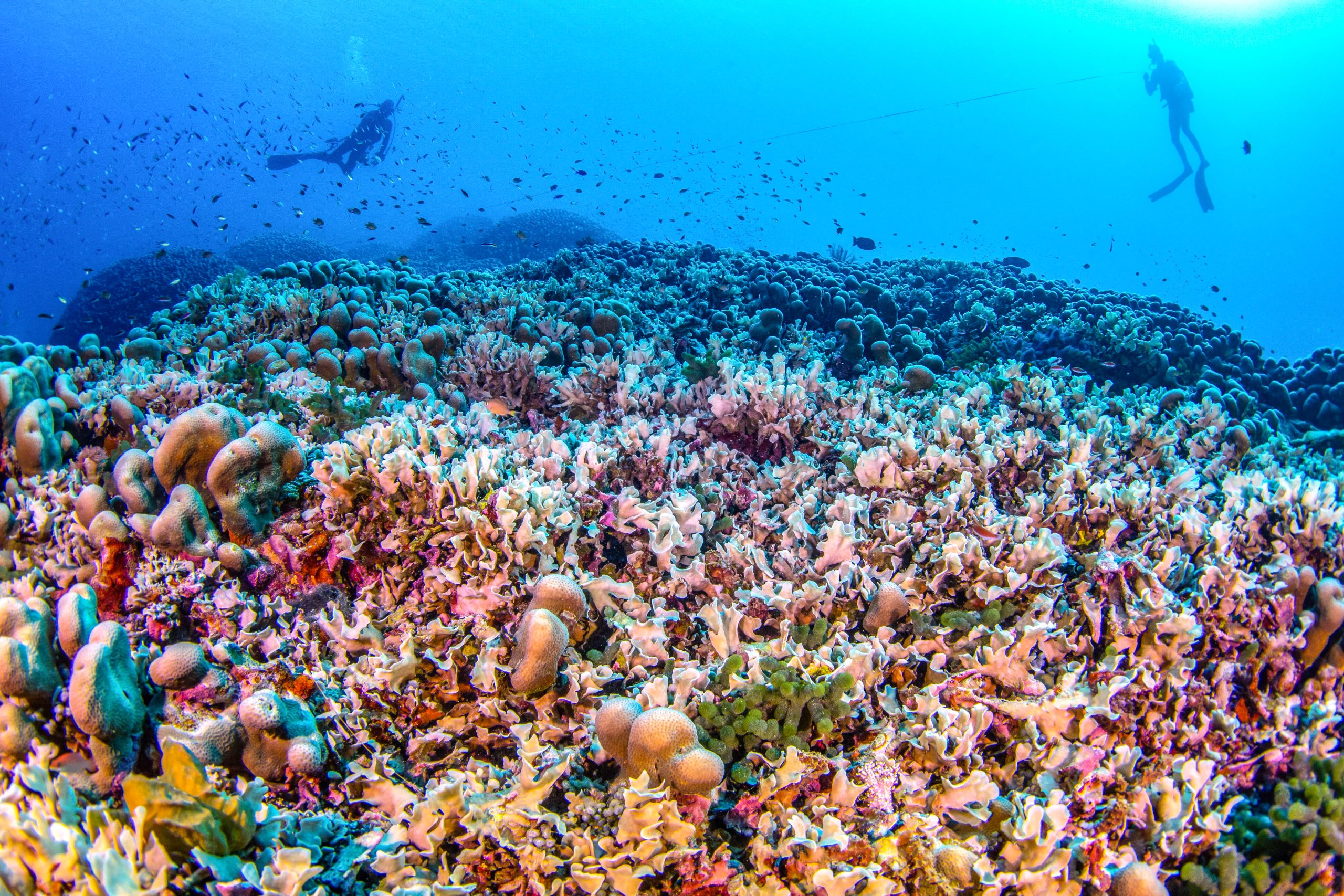
Scientists say they have found the world’s largest coral near the Pacific’s Solomon Islands, announcing Thursday a major discovery “pulsing with life and color.”
The coral is so immense that researchers sailing the crystal waters of the Solomon archipelago initially thought they had stumbled across a hulking shipwreck.
“Just when we think there is nothing left to discover on planet earth, we find a massive coral made of nearly one billion little polyps, pulsing with life and color,” marine ecologist Enric Sala said.
The standalone structure had been growing for some 300 years, the researchers said, formed from a “complex network” of tiny coral polyps.
It was distinct from a coral reef, which is made from many distinct coral colonies, they explained.
Measuring 34 meters wide (111 feet) and 32 meters long (104 feet), the team said the “mega coral” was three times bigger than the previous record holder—a coral dubbed “Big Momma” in American Samoa.
“While Big Momma looked like a huge scoop of ice cream plopped down on the reef, this newly discovered coral is as if the ice cream started to melt, spreading forever along the seafloor,” said lead scientist Molly Timmers.
It was longer than a blue whale and was thought to be “so colossal” that it could “be seen from space.”
The coral was discovered at the southeastern tip of the Solomon Islands in an area known as the Three Sisters.
It was spotted by a National Geographic team embarking on a scientific expedition in the region.
Hotter and more acidic oceans have drained the life from corals in many of the region’s tropical waters, including Australia’s famed Great Barrier Reef.
But this latest discovery offered a small glimmer of hope, the research team said.
‘Beacon of hope’
“While the nearby shallow reefs were degraded due to warmer seas, witnessing this large healthy coral oasis in slightly deeper waters is a beacon of hope,” said coral scientist Eric Brown.
The lush rainforests and pristine waters of Solomon Islands have long been celebrated for their ecological diversity.
Wildlife observations made in Solomon Islands in the 1920s helped prove a key part of Charles Darwin’s theory of evolution.
“There is so much to learn about the richness of marine life and the ocean ecosystem, but this finding opens doors of knowledge,” said top Solomon Islands official Collin Beck.
“More scientific research is needed to better understand our rich biodiversity and our planet.”

