
Michael Bowman/VOA NEWS
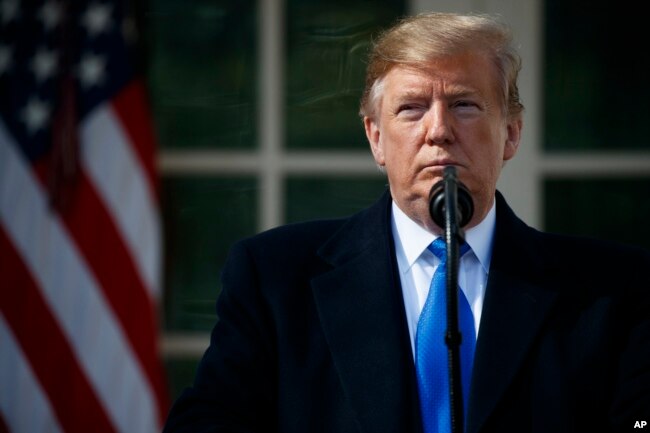
CAPITOL HILL — The U.S. Senate is expected to deliver a legislative black eye to President Donald Trump on Thursday, when it votes on disapproving the president’s national emergency declaration to fund wall construction along the U.S.-Mexico border.
A handful of Senate Republicans have committed to joining a unified Democratic caucus in rejecting the emergency declaration, all but assuring the disapproval measure’s passage in a chamber where Republicans have a narrow 53-47 majority.
“Are we going to say, anytime a president can’t get his way with Congress, he can declare an emergency and Congress will meekly shrug its shoulders?” Minority Leader Chuck Schumer, a New York Democrat, said. “What a disgrace.”
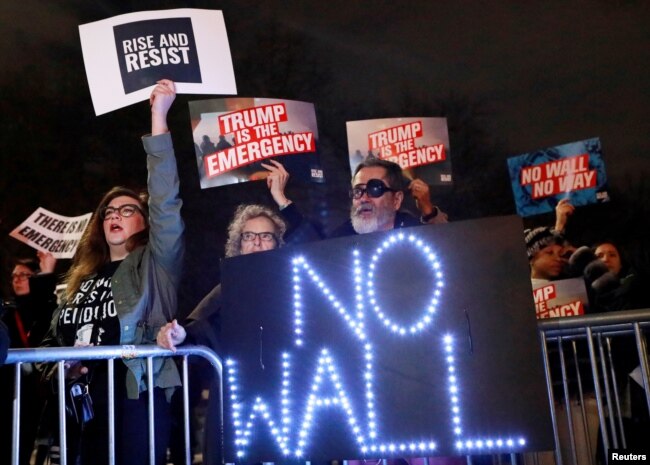
Many Republicans have expressed unease over the national emergency declaration, noting the U.S. Constitution grants Congress authority over spending matters. But most are expected to vote against the disapproval measure, citing an urgent need to secure America’s southern border.
“I’m voting with you, Mr. President,” Oklahoma Republican Sen. James Inhofe tweeted. “There is no country without borders.”
No Longer Certain
Veto probable
The Democratically-led House of Representatives already approved the measure, which is expected to trigger the first veto of Trump’s presidency should it reach his desk.
“It is about Border Security and the Wall [stopping Crime, Drugs, etc.], not Constitutionality and Precedent,” the president recently wrote on Twitter.
Congress has not funded Trump’s border wall requests, including under unified Republican control of the legislature, as existed for the first two years of his term in office. Earlier this year, a politically-divided Congress provided limited funds to erect new fencing along small sections of the U.S.-Mexico border, an outlay Trump deemed inadequate.
A national emergency declaration empowers a president to redirect federal funds in response to a sudden and grave crisis. Democrats noted that America’s border deficiencies have been debated for decades, and in making the declaration, Trump himself said he “didn’t have to do it.”
Major stumbling block
For some Republicans, a major stumbling block is setting a precedent that could be used by a future Democratic president to evade the will of Congress.
“Imagine in the future a socialist-inclined president who wants to fund the Green New Deal [Global Warming resolution] or declare an emergency against the Second Amendment [constitutional right to bear arms],” Kentucky Sen. Rand Paul said. “Congress needs to fund border security — no question. But no president should go around Congress.”
As the Senate prepared to vote, some Republicans put forth legislation to limit the National Emergencies Act, which became law in 1976 and has been used by all presidents since to trigger swift federal action. Democrats noted the Republican proposal would do nothing to rein in Trump’s current emergency declaration.
House Speaker Nancy Pelosi, a California Democrat, declared the bill will not pass Congress.
“The House will not take up this legislation to give President Trump a pass [on the emergency declaration],” Pelosi said in a statement.
Campaign promise
Building a border wall was one of Trump’s primary promises to voters in his 2016 presidential campaign. Trump repeatedly stated that Mexico, not the United States, would pay for it.
The White House argued Mexico is paying for the wall indirectly as a result of the expected economic benefits from a new free trade agreement negotiated between the United States, Canada and Mexico.
Aside from congressional action, the national emergency declaration is being challenged in the federal court system, which may have the final word in whether it survives.

