
By Brian Campued
Let’s go down memory lane, but with a modern twist!
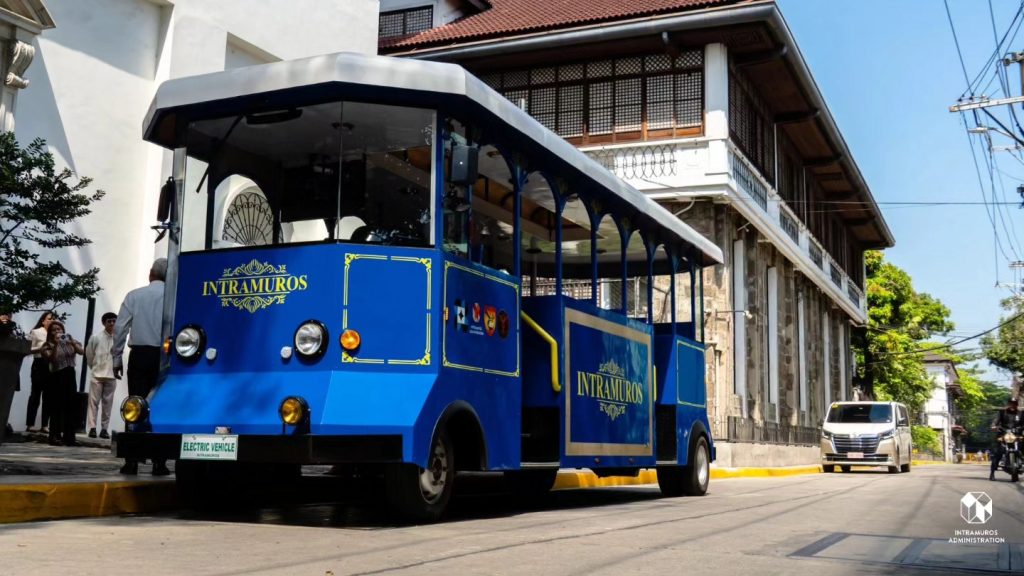
The Department of Science and Technology (DOST) and Intramuros Administration (IA) recently launched the e-Tranvia, first-ever locally-made electric vehicle that would ferry tourists as they explore the historic Walled City.
Unveiled on March 19, the 18-seater e-Tranvia was developed through the collective efforts of the DOST-Industrial Technology Development Institute (ITDI), University of the Philippines Diliman (UPD), and Cagayan State University (CSU).
According to the DOST, the electric vehicle’s design was drawn from 19th-century trams that once roamed Intramuros, providing sustainable transport while preserving heritage.
Built and designed by Filipino engineers, the e-Tranvia runs on electricity and incorporates indigenous materials like abaca.
“CSU developed the concept and design, and assembled its vehicle frame, suspension system, and paneling for the body and roof using the DOST-ITDI’s innovation of the locally manufactured abaca-fiber composite material as the body and roofing panels,” the DOST said in a press release.
“UPD, on the other hand, led its electrical and electronic design, which includes a lithium-ion battery system, an electric motor and controller, and a charging infrastructure, eyeing to refrain from the diesel-powered system of the existing trams in Intramuros,” it added.
The launch of the Filipino ingenuity was timely, as the country grapples with rising fuel prices brought by the ongoing Middle East conflict.
“Developing it ensures that electric mobility becomes practical, reliable, and accessible for all Filipinos… Ang mga inobasyong gawa ng Pilipino, para sa Pilipino, ang gagabay at magiging tulay ng ating mga kababayan sa panahon ng pangangailangan,” DOST Sec. Renato Solidum Jr. said.
The service is currently available for free through a rolling tour, with a designated tourism officer guiding tourists as they travel along major historic sites in the Walled City, such as Fort Santiago, Centro de Turismo, Museo de Intramuros, Foro de Intramuros, Baluarte de San Diego, schools located in the area, and the Pasig Esplanade.
“This collaboration reflects the strength of partnerships between the government and the academe in delivering practical and people-centered solutions… May this continue to inspire similar efforts to promote greener mobility, smarter tourism systems, and a more sustainable future for our cities,” Intramuros Administrator Joan Padilla said.
Only one unit is currently deployed in Intramuros, with three more expected to be added. Additional units are also planned for South Cotabato, Cagayan, and Malacañang. (with report from Rod Lagusad / PTV News)
-jpv

