
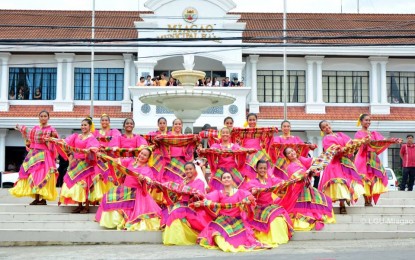
ILOILO CITY — The hablon-weaving town of Miag-ao, Iloilo is eyeing to become a source of cotton yarns from its own soil.
Dindo Nemiada, Department of Trade and Industry (DTI) coordinator and Miag-ao’s local economic enterprise consultant, on Saturday said the town’s cotton program started in 2018.
“Our weavers purchase polyester fiber for making our hand-woven fabrics. The production of cotton yarn will provide them lesser cost of materials,” Nemiada said.
As encouraged by Miag-ao mayor Dr. Macario Napulan, the town’s cotton program is meant to grow the plants and process it to yarns.
Miag-ao is currently growing cotton plants in Barangays Durog, Dawog, Baraclayan, Maricolcol, and Kirayan Tacas.
Forty cotton farmers are being supported by the Philippine Fiber Industry Development by providing them with seeds, pest control chemicals, training, and technical assistance.
In return, farmers allotted a portion of their land and rendered labor in growing cotton plants. Nemiada said the cotton farm in Miag-ao occupies 20 hectares.
“Cotton plants grow for five months and we expect harvest in March or April this year,” he added.
As for the cotton yarn processing, Nemiada said the local government of Miag-ao, Department of Science and Technology (DOST), and the Iloilo Science and Technology University (ISAT-U) are set to sign a memorandum of agreement on the first week of March.
The DOST-Philippine Textile Research Institute (PTRI) will provide spinning, ginning, and other cotton processing machines that will be installed at the research property of ISAT-U.
The cotton yarns will not only be made exclusive for the use of Miag-ao weavers, Nemiada said.
The DOST-PTRI and the Philippine textile council, HABI, already expressed willingness to source cotton yarns from Miag-ao.
Senator Cynthia Villar, chairperson of the senate committee on agriculture and food, also expressed support for the cotton program.
In previous interviews, Villar said the cotton yarn processing in Miag-ao will also benefit weavers from other parts of the country, who still import the raw material.
“Miag-ao’s hablon have a brighter future with the cotton farm and cotton processing in town,” Nemiada added.
Hablon is a Hiligaynon word for habol, which refers to both the weaving process and its finished fabric.

