
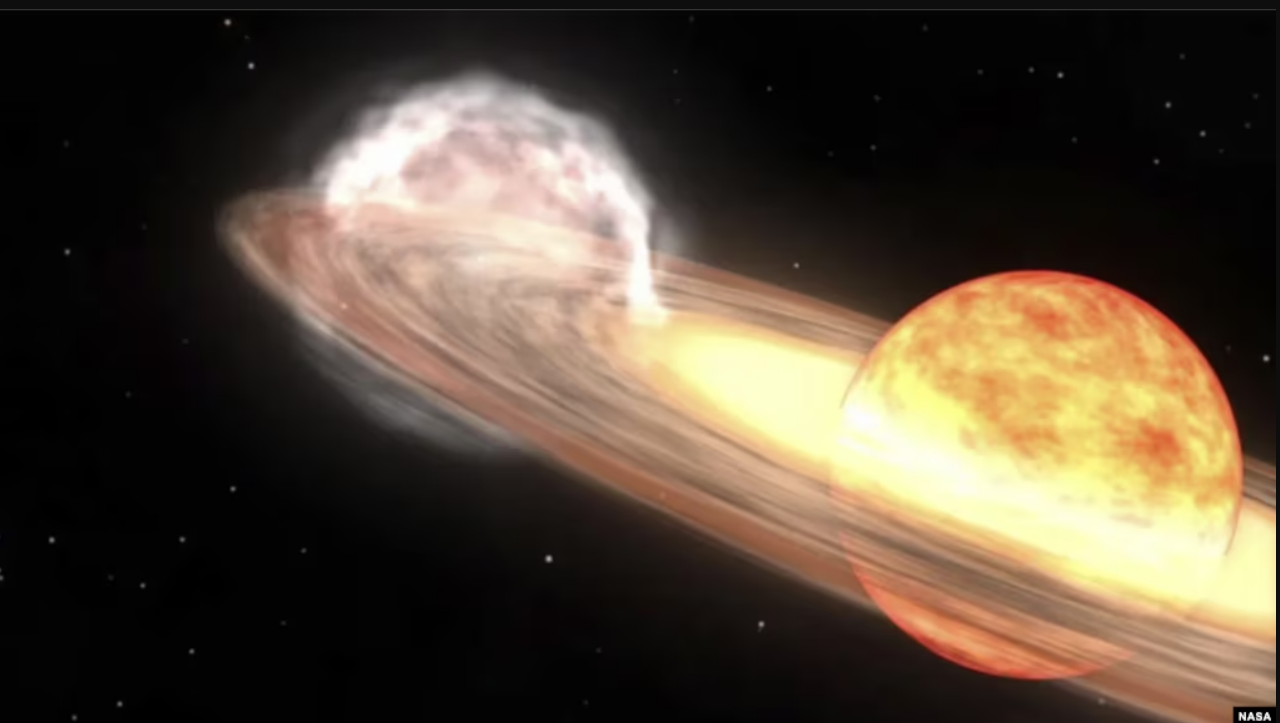
A nova eruption predicted to occur by September is being described by the National Aeronautics and Space Administration (NASA) as a “once-in-a-lifetime” event that will be visible to the human eye.
Researchers tracking T Coronae Borealis—known as T CrB—say the eruption could occur any time before September. T CrB generally erupts every 80 years, and was last visible from Earth in 1946.
T CrB comprises a white dwarf and a red giant that orbit each other. A white dwarf is a “dead” star because its atoms no longer fuse to create nuclear fuel. A red giant is a star that no longer has hydrogen at its core to cause nuclear fusion. The red giant’s hydrogen accumulates on the white dwarf, where it builds up, eventually leading to a thermonuclear explosion, which NASA says usually occurs every 80 years.
When this explosive event — known as a nova — occurs, people can expect to see a bright glow for about a week, before it dissipates and becomes invisible to the human eye.
Brian Kloppenborg, the executive director of the American Association of Variable Star Observers, told VOA the eruption is similar in some ways to a hydrogen bomb because the hydrogen in the star builds up, culminating in an eruption.
“They’re really dramatic events, and most of the light that comes out is broadband, meaning that it’s [a] thermal emission,” Kloppenborg said. “So, it’ll look…kind of like a hydrogen bomb on Earth, where it’s just lots and lots of really bright white light.”
Koji Mukai, an astrophysics researcher at NASA, told VOA in an email, “It’s not a great spectacle on its own. It’s the backstory…or the prospect of fantastic scientific results…that makes it exciting.”
Mukai said T CrB’s nova will likely become the brightest nova since Nova Cygni in 1975, which reached a peak magnitude of 2.0. The magnitude scale dates to the early astronomers. Simply put, it describes how bright a star is to observers, taking into consideration its relative distance. The brightest stars in the sky are considered to be of first magnitude. The dimmest stars visible to the naked eye are of sixth magnitude.
The Sun for example is -26.7 magnitude and is the brightest celestial object humans can view from Earth. But if the sun were much farther away, in comparison to other stars, its “perceived brightness” would drop to a magnitude of 4.7.
With modern technology, researchers hope to get an unparalleled look at T CrB’s nova.
“Because of this, and because we have a suite of ground-based and space-born instruments with unprecedented capabilities, we can obtain a holistic view of the nova that we have never been able to until now,” Mukai said.
Researchers were able to predict T CrB’s imminent eruption by identifying a sudden drop in the nova’s brightness in April 2023, which usually happens about a year before it erupts.
Brad Schaefer, an astronomy and astrophysics professor at Louisiana State University, told VOA his research, identifying the pre-eruption dip, aligns with similar patterns that occurred before the nova’s previous eruption in 1946.
“It’s not going to be a spectacular thing, but it is going to be the brightest nova of generations,” he said.
Schaefer said the process of the eruption lasts about 60 days, but the peak brightness will last for no more than three days.
NASA said in a statement that a nova is different from a supernova, which is a final explosion that destroys dying stars.
When a nova event occurs, the dwarf star stays intact and repeats the process, which can last for hundreds of thousands of years.
“There are a few recurrent novae with very short cycles, but typically, we don’t often see a repeated outburst in a human lifetime, and rarely one so relatively close to our own system,” said Rebekah Hounsell, a NASA scientist who studies nova events. “It’s incredibly exciting to have this front-row seat.”

