

By Brian Campued
President Ferdinand R. Marcos Jr. on Wednesday signed Republic Act (RA) No. 12316, granting him emergency powers to suspend or reduce excise taxes on fuel as part of the government’s efforts to cushion the impact of rising oil prices brought by the ongoing tensions in the Middle East.
Excise tax is a form of indirect tax imposed on specific goods, services, or activities—such as fuel, tobacco, and alcohol.
RA 12316 states that the President, upon the recommendation of the Development Budget Coordination Committee (DBCC) and in coordination with the Secretary of the Department of Energy, may suspend or reduce excise taxes on petroleum products if the average Dubai crude oil price reaches or exceeds $80 per barrel for one month.
“The suspension or reduction may be applied to specific petroleum products and implemented either as a full suspension or partial reduction of the applicable excise tax rates…, as may be warranted by prevailing conditions,” the law stated.
The law also limits any suspension or reduction to “a period not exceeding three months.” This may be extended as long as the total duration of all extensions does not exceed one calendar year.
Further, excise taxes on fuel products will automatically revert to normal rates without further legislative or executive action when Dubai crude oil prices fall below $80 per barrel or when the three-month period ends, whichever comes first.
The President, through the DBCC and in coordination with the DOE, is likewise required to submit a report to Congress on the factual basis and policy goals for the suspension or reduction of excise taxes; estimated foregone revenues, including social benefits; as well as the expected impact on inflation and fuel prices.
“The report shall include a recommendation on whether the suspension or reduction of excise taxes should be maintained, modified or lifted, and shall form part of the basis for any continued suspension or reduction,” the law stated.
Oil companies will also be directed to submit to the DOE monthly information on the cost components of the price of petroleum products sold, while the Bureau of Internal Revenue and the Bureau of Customs are instructed to submit monthly information on the declared value and volume of petroleum products suspended or reduced.
“The power of the President to temporarily suspend or reduce the excise tax on petroleum products… shall be exercised only until Dec. 31, 2028,” the law read.
Once implemented, gasoline prices could drop by around P10 per liter, while diesel and kerosene may go down by about P6 and P5 per liter, respectively—giving relief for Filipinos affected by high oil prices, including public transport workers, farmers, and fisherfolk.
-av
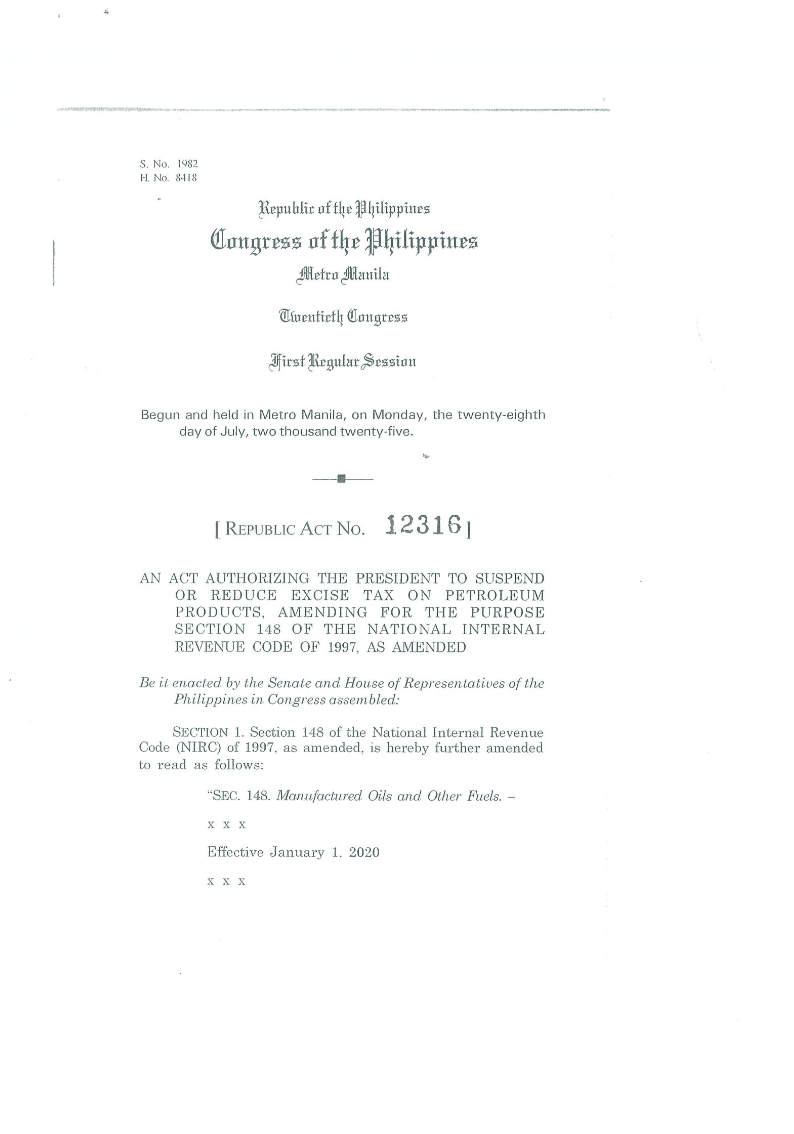 President Ferdinand R. Marcos Jr. signs Republic Act (RA) No. 12316, granting him emergency powers to suspend or reduce excise taxes on fuel. (Photo courtesy: PCO)
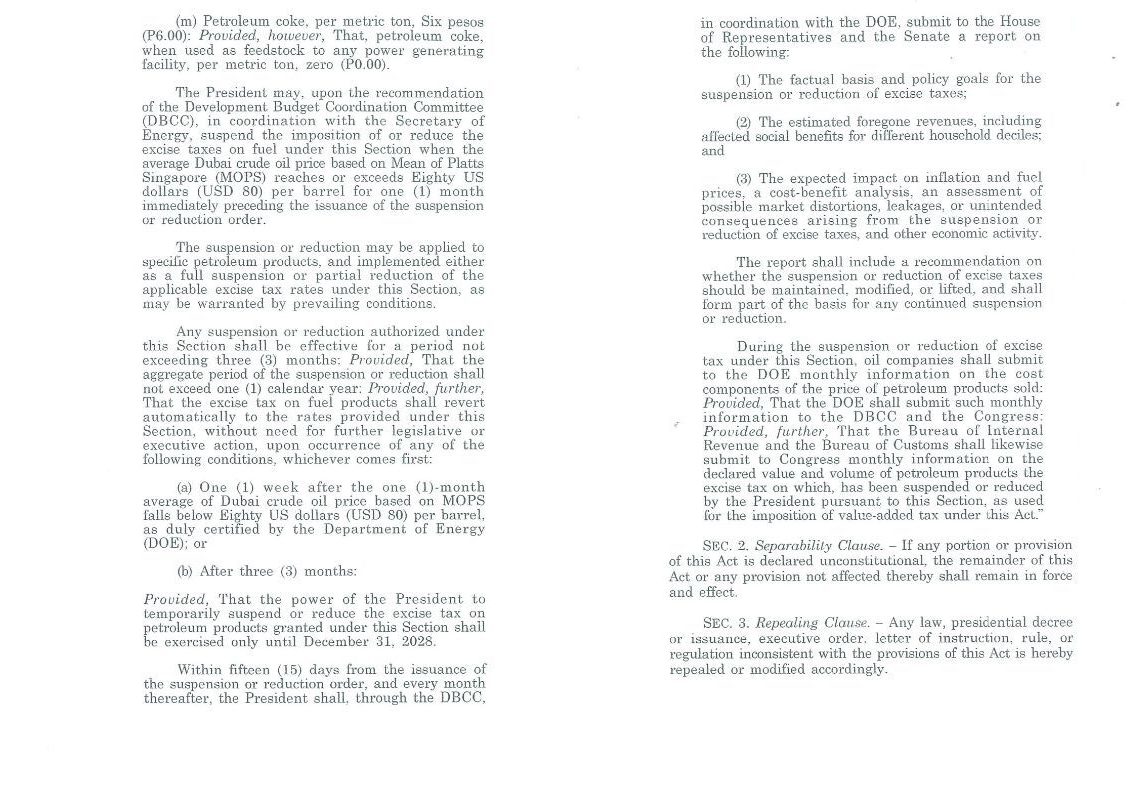 President Ferdinand R. Marcos Jr. signs Republic Act (RA) No. 12316, granting him emergency powers to suspend or reduce excise taxes on fuel. (Photo courtesy: PCO)
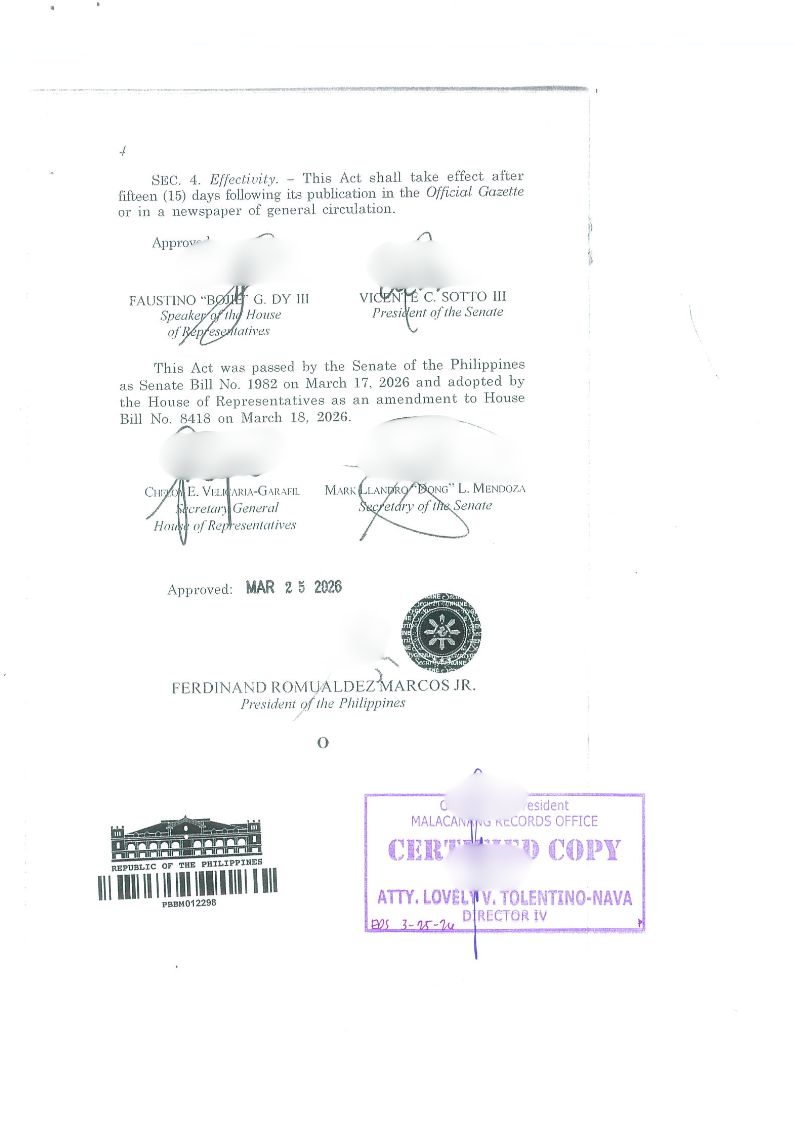 President Ferdinand R. Marcos Jr. signs Republic Act (RA) No. 12316, granting him emergency powers to suspend or reduce excise taxes on fuel. (Photo courtesy: PCO)
