
By Darryl John Esguerra | Philippine News Agency
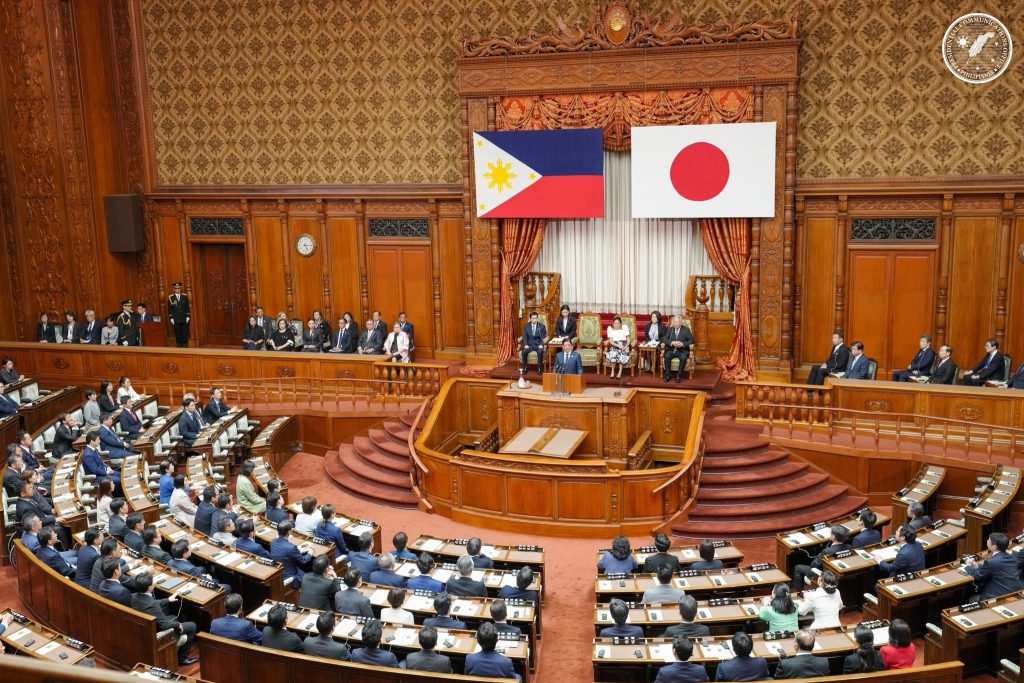
President Ferdinand R. Marcos Jr. on Thursday underscored the importance of upholding international law, maritime security, and a rules-based order in the Indo-Pacific during his historic address before the National Diet, Japan’s national legislature.
Speaking before members of Japan’s parliament during his four-day state visit, President Marcos described the Philippines and Japan as “maritime democracies” committed to keeping regional seas “open, secure, and governed by rules, not by force.”
“As maritime democracies, the Philippines and Japan are committed to strengthening maritime security and ensuring that our seas remain open, secure, and governed by rules, not by force,” he said.
Both the Philippines and Japan have territorial disputes with China.
Beijing has been stepping up activities in the South China Sea, a vast, resource-rich body of water it claims entirely as its own, including features in the West Philippine Sea that are well within Manila’s exclusive economic zone.
Meanwhile, China also claims the Japanese-controlled Senkaku Islands in the East China Sea.
In his speech, the President highlighted the evolution of Philippine-Japan relations from post-war reconciliation into a strategic partnership anchored on “deep mutual trust.”
“The relationship between the Philippines and Japan is at its core a story of transformation from reconciliation to deep mutual trust,” Marcos Jr. said.
He recalled how former President Elpidio Quirino pursued reconciliation with Japan following World War II, paving the way for the normalization of diplomatic relations in 1956.
This year marks the 70th anniversary of normalized diplomatic relations between the Philippines and Japan.
The President also underscored the growing scope of bilateral cooperation, including in security, maritime and defense cooperation, resilient supply chains, artificial intelligence, space technology, clean energy, and digital innovation.
He noted Japan’s role as one of the Philippines’ leading economic partners and largest providers of development assistance.
“Peace is the foundation upon which our shared prosperity is built,” Marcos Jr. said.
The President likewise reaffirmed the Philippines’ commitment to the peaceful settlement of disputes under international law, including the United Nations Convention on the Law of the Sea (UNCLOS).
“In July of this year, we mark the 10th anniversary of the Arbitral Award on the South China Sea, which embodies the Philippines’ determination to resolve disputes through peaceful means and mechanisms provided under international law,” he said.
Marcos Jr. also cited the contributions of nearly 360,000 Filipinos working in Japan, in sectors such as healthcare, education, manufacturing, agriculture, and services.
According to Philippine Ambassador to Japan Mylene Garcia-Albano, addressing the National Diet—which is composed of the House of Representatives (lower house) and the House of Councilors (upper house)—is a rare privilege accorded only to select foreign leaders.
Marcos is the fourth Philippine leader to speak before the National Diet, following the late Carlos Garcia in 1958, Gloria Macapagal-Arroyo in 2002, and the late Benigno Aquino III in 2015.

