
By Dean Aubrey Caratiquet
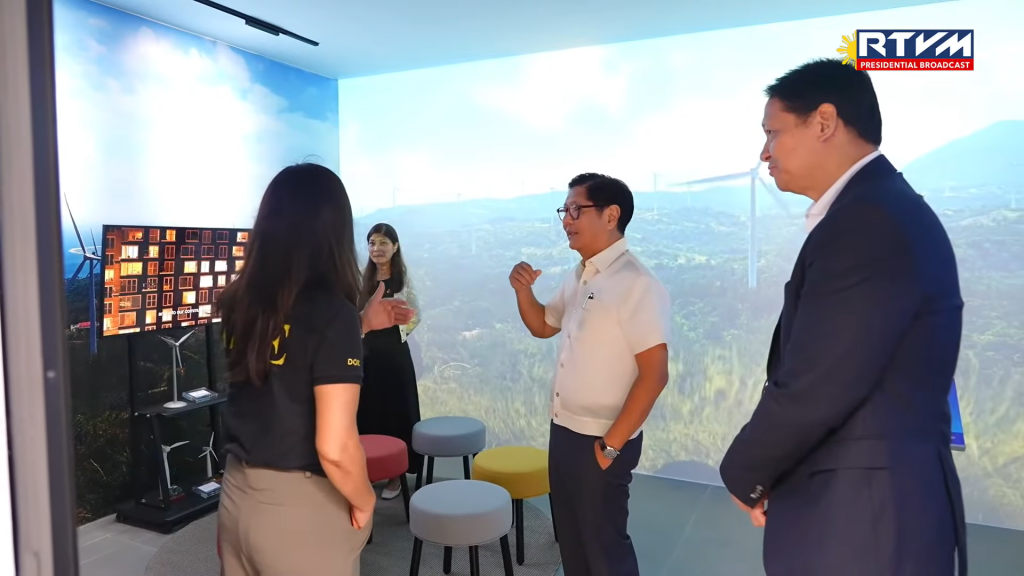
Reinforcing his message for a more energy-secure future during his recent State of the Nation Address (SONA), President Ferdinand R. Marcos Jr. led the inauguration of the Energy Museum on Wednesday.
Accompanied by Department of Energy (DOE) Secretary Sharon Garin, the President embarked on a walkthrough of the various interactive exhibits on the country’s diverse energy resources and technologies such as solar, geothermal, wind, hydro, natural gas, and energy storage.
These would help Filipinos understand how these are tapped to be converted into electricity that keeps the economy running, allowing Filipinos to be informed of the struggles that the government continues to face in energizing homes and industries across the archipelago.
President Marcos Jr. said in his speech, “To every young Filipino who walks through these pods and sees an engineer, a geoscientist, a policy analyst reflected in these exhibits, I say: This could be you. This is the future of the Philippines that will be built by the students who will visit or stand in this museum.”
He went on to share a brief history of the Electric Power Industry Reform Act of 2001 (Republic Act No. 9136), as he commemorated the 25th anniversary of the passage of this legislation, noting how it led to the restructuring of the power industry spearheaded by the private sector.
President Marcos Jr. meanwhile shared the country’s progress towards sustainability, noting that as of press time, a quarter of the nation’s electricity supply is derived from renewable sources, with the goal of reaching 30% by 2030 and 50% by 2040.
He likewise shared that he is working closely with the private partners in the process of institutionalizing amendments to EPIRA, which include the removal of charging system loss fees and corresponding value-added tax (VAT) to consumers.
The Chief Executive concluded by encouraging the citizenry to participate in the Oras Natin sa Efficiency campaign to aid in the conservation measures and maintain energy efficiency amid persisting geopolitical developments in the Middle East.
avds

