
By Brian Campued
As a net importer of petroleum products, the Philippines is highly vulnerable to external developments that may affect both price and supply, such as the global disruptions spawned by the Middle East conflict.
To help reduce the country’s reliance on imported fuels, the government is committed to exploring and fast-tracking alternative energy sources amid the global oil crisis while advancing the country’s efforts to mitigate the effects of climate change.
For the Department of Science and Technology (DOST), locally-sourced bamboo pellets and charcoal briquettes are promising biomass energy sources.
“By converting abundant biomass materials into efficient fuels, we offer a renewable, locally sourced substitute that can help with our country’s needs,” DOST Sec. Renato Solidum Jr. said in a news release dated April 15.
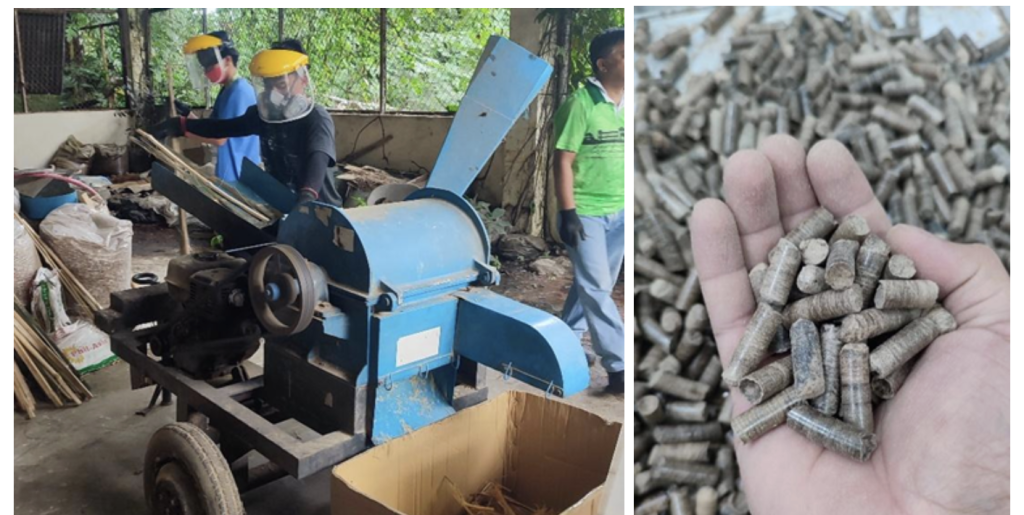
The DOST – Forest Products Research and Development Institute (DOST-FPRDI) developed a densified form of bamboo designed for optimum combustion, which has higher energy density than other biomass materials, such as wood chips and agricultural residues.
“Materials with high energy density contain and give off more energy,” the DOST said.
A charcoal briquette, on the other hand, is a compacted mass of fuel material made from a mix of charcoal fines and binder, and molded under pressure.
“Compared to regular charcoal, these briquettes are less messy and easier to handle because they are compact and uniform in size. They also burn slowly, give more intense heat per unit volume, and are almost smokeless when burning,” it said.
According to DOST-FPRDI researcher Anniver Ryan Lapuz, bamboo pellets, which are typically cylindrical in shape and with a diameter of about 8-12 mm and a length of 20-30 mm, are also lightweight and easy to transport.
“One cubic meter of these pellets can generate as much as 12.15 gigajoules (GJ). One GJ is approximately 277 kilowatt hours (kWh),” Lapuz said.
These pellets can be used as co-firing fuel in coal-fired power plants or as supplementary fuel source to conventional materials such as bagasse and rice hull for biomass-based industries.
Bamboo pellets can also be used for cooking, as these are denser and give higher heating value than regular charcoal (uling).
In a radio interview, Lapuz said that they have tested using bamboo pellets in gasifiers for 10 KwH small-scale generators, but more studies are still underway for industrial use.
“Puwede naman po talaga siyang panluto, puwede rin po siya as animal litter. Pero ang talagang dine-develop po natin yung ating bamboo pellet para po for fuel crisis… sa industrial [use], sa mga boilers at sa power generation,” the researcher explained.
Meanwhile, DOST-FPRDI Director Rico Cabangon highlighted bamboo’s ability to grow fast and thrive “almost anywhere,” making it an ideal and reliable biomass energy source.
Some bamboo species, according to Cabangon, can grow more than one meter per day or about 4 centimeters per hour.
“By turning a fast-growing local resource like bamboo into a fuel alternative, we are helping build a future that is less dependent on finite resources and more grounded in sustainable materials,” he said.
The DOST-FPRDI has been at the forefront of research, development, and technology transfer regarding the use of wood and non-wood forest products to support local industries and sustainability.
Other bamboo innovations the agency is promoting is the “Silyang Pinoy,” a multifunctional engineered bamboo school furniture for disaster preparedness. It is also pushing for research on making bamboo as part of fire-safe construction and building components.
-avds

