
By Darryl John Esguerra | Philippine News Agency
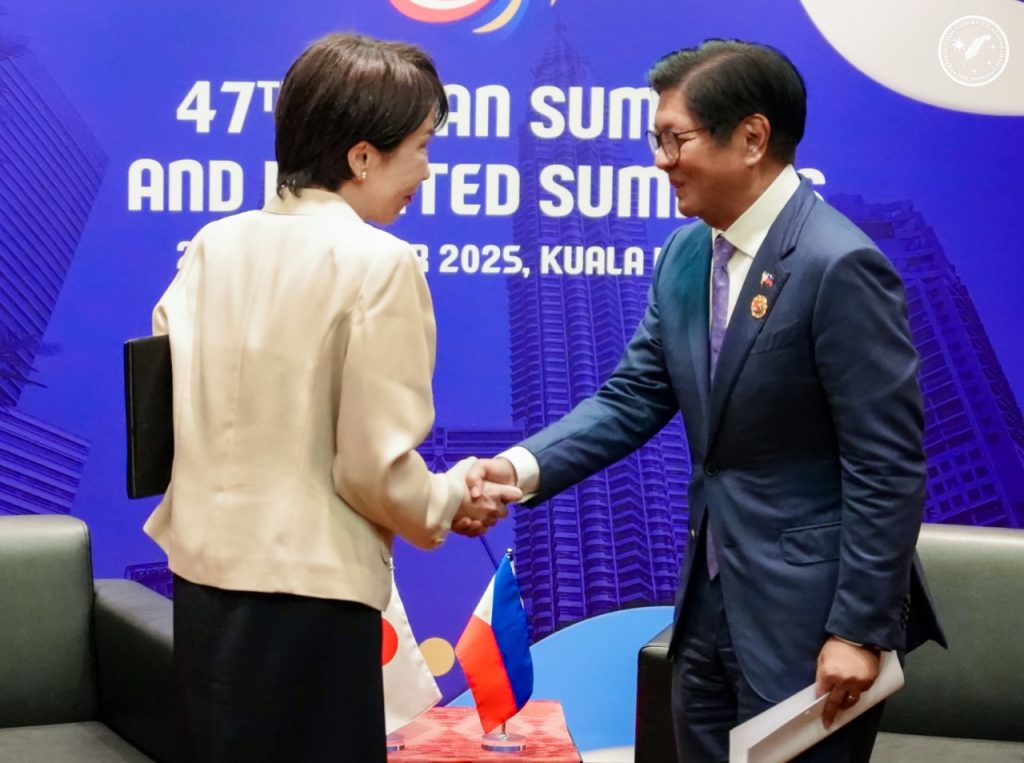
President Ferdinand R. Marcos Jr. is expecting regional security, coercive activities and growing Indo-Pacific tensions to dominate his upcoming talks with Japanese Prime Minister Sanae Takaichi when he visits Tokyo later this month.
Speaking to Japanese media on Monday in Malacañang, Marcos said both the Philippines and Japan have faced similar security concerns involving “coercive acts” and “gray-zone tactics” in regional waters, particularly in the South China Sea.
“And as Japan and the Philippines have experienced the same difficulties in terms of coercive acts, in terms of different gray zone tactics that are being exercised in the South China Sea, that is something that we will certainly be discussing,” Marcos said.
Both the Philippines and Japan have territorial disputes with China.
Beijing has been stepping up activities in the South China Sea, a vast, resource-rich body of water it claims entirely as its own including features in the West Philippine Sea that are well within Manila’s exclusive economic zone.
Meanwhile, China also claims the Japanese-controlled Senkaku Islands in the East China Sea.
The President said the evolving security environment in the Indo-Pacific has made closer partnerships and coordination among allies increasingly necessary.
He noted that Japan’s shift toward a more active defense posture represents a “significant development” for the region, particularly as Tokyo expands its participation in regional security activities.
For the first time, Japan actively participated in this year’s Balikatan Exercises instead of merely joining as an observer, a move Marcos described as important for improving interoperability and joint readiness among allied forces.
Balikatan Exercise is the largest annual bilateral military exercise between the Armed Forces of the Philippines and the United States military.
“That changes the playing field,” Marcos said, referring to Japan’s evolving defense policy.
The President said Manila hopes to gain a clearer understanding of how Japan intends to implement its new security posture and how it could translate into expanded bilateral and multilateral cooperation involving ASEAN and other Indo-Pacific partners.
“This extends now all the way to the Indo-Pacific,” Marcos said, adding that discussions may include information-sharing, technology cooperation, military training, and coordinated regional initiatives.
The Philippines and Japan have significantly strengthened security ties in recent years amid growing tensions involving China’s maritime activities and broader strategic competition in the region.
Marcos reiterated that Philippine foreign policy remains anchored on “national interest and peace,” emphasizing adherence to international law and the peaceful resolution of disputes under the United Nations Convention on the Law of the Sea.
“We are searching for peace in the region and the freedom of navigation in our seas, and the peaceful resolution of any conflict. That has been our standard position, and I think it is the right one,” he said.

