
By Dean Aubrey Caratiquet
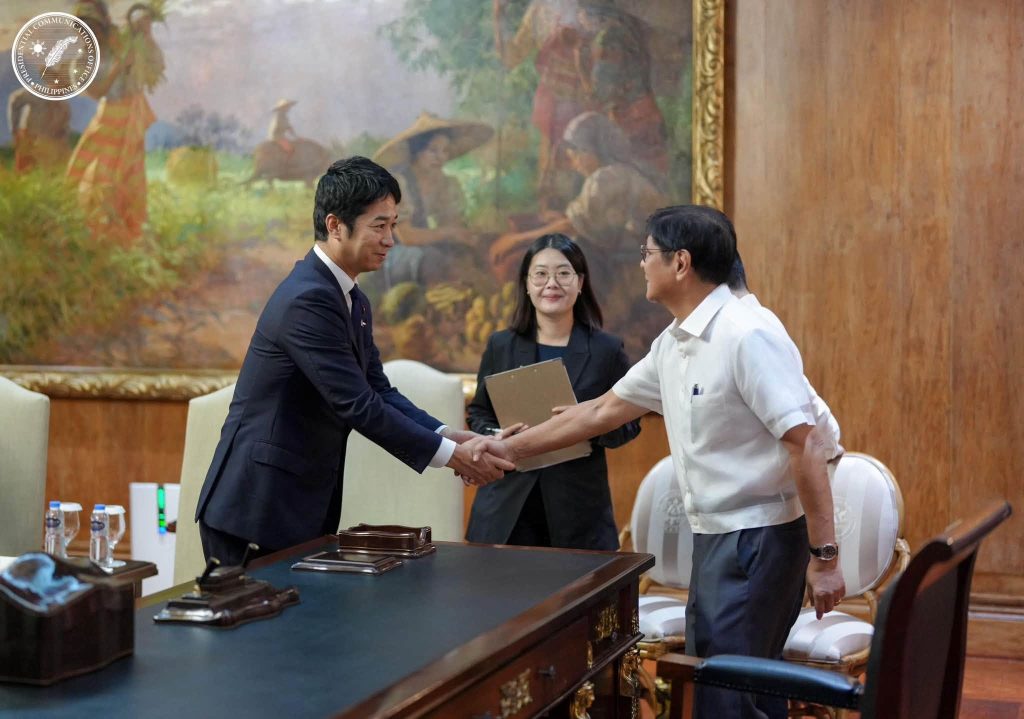
In a courtesy call at Malacañang on Monday, President Ferdinand R. Marcos Jr. welcomed Hon. Fujita Fumitake and expressed gratitude for the lawmaker’s visit to the Philippines.
H.E. Fujita, a member of Japan’s House of Representatives and a Co-representative of the Japan Innovation Party (JIP), met with President Marcos Jr. as part of a 3-day stint in Manila from August 2-4.
The President said in his speech, “Despite not being able to meet with you during our trip to Japan, you were able to come and be with us. Thank you very much. Japan has always been an important partner in the Philippine economic development ever since we have established our diplomatic relations, which has now expanded to every other areas of cooperation.”
The Japan Innovation Party, a center-right and reform-oriented political party, serves as the junior coalition partner of Japan’s ruling Liberal Democratic Party (LDP).
The party’s policy priorities are closely aligned with the Philippines-Japan Comprehensive Strategic Partnership, particularly in maritime and defense cooperation, supply chain resilience, and the promotion of a rules-based Indo-Pacific.
H.E. Fujita’s visit coincides with the commemoration of the 70th anniversary of PH-Japan diplomatic relations, and the 15th anniversary of their Strengthened Strategic Partnership, established in 2011.
An indispensable ally
This, as the East Asian nation remains the Philippines’ second-largest trading partner, second-largest export market, third-largest source of imports, largest official development assistance (ODA) loan provider, and third-largest grant provider.
Among the commodities exported by Manila to Tokyo were mechanical machinery; edible fruits and nuts; electrical equipment; and ores and minerals. Meanwhile, Japanese imports bound for the Philippines include industrial equipment, motor vehicles and parts, and plastic products.
Japan also remained a leading source of foreign investments, with net foreign direct investments (FDI) reaching US$734.47 million in 2025.
These investments are directed towards priority sectors such as information technology and business process management (IT-BPM), public-private partnership (PPP) projects, aquaculture, and manufacturing.
People-to-people ties between the two countries also continue to strengthen. Japanese tourist arrivals to the Philippines increased to 502,546 in 2025 from 444,528 in 2024, while an estimated 337,227 Filipinos were residing in Japan as of June 2024.
Cash remittances from overseas Filipino workers (OFWs) in Japan amounted to US$1.61 billion in 2025, slightly lower than the US$1.71 billion recorded in 2024.
jpv

