
By Dean Aubrey Caratiquet
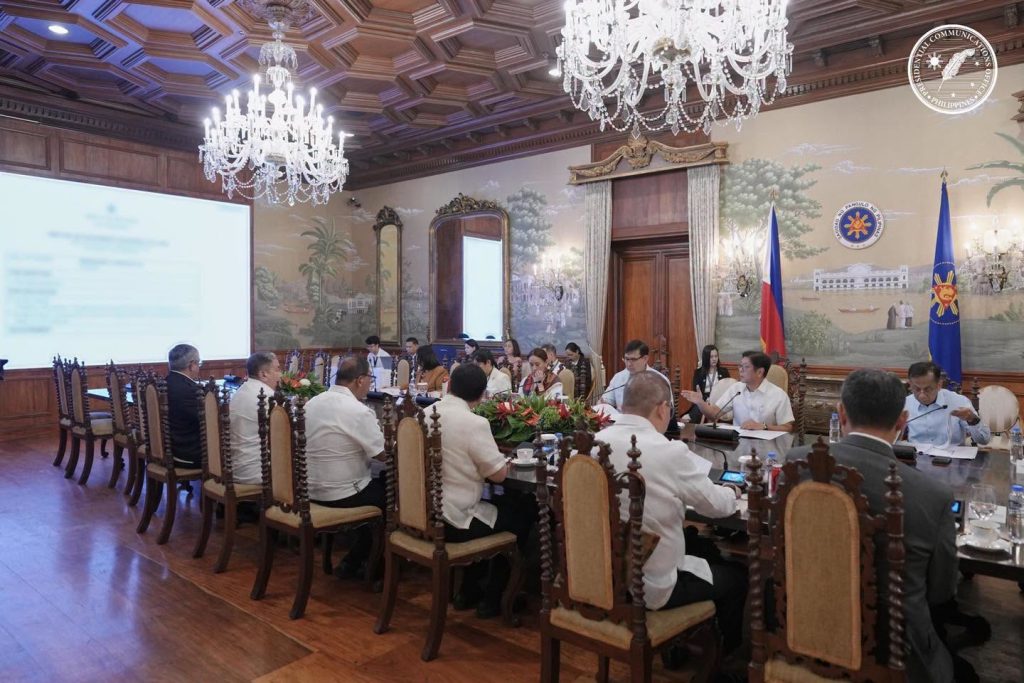
In his meeting with various government agencies at Malacañang on Monday, President Ferdinand R. Marcos Jr. assessed the nationwide response to the possible impact of the ongoing El Niño phenomenon on food, water, energy, health, and public safety.
Through a dialogue with agency heads, he ordered the accelerated completion of water projects and unhampered assistance and support for affected sectors.
President Marcos Jr. also made it a point to ensure that only factual and science-based information about the phenomenon reaches the public, including ways they can help conserve water and energy.
During the Palace press briefing, Department of Agriculture (DA) Secretary Francisco Tiu-Laurel Jr. shared the President’s prerogative to conduct regular meetings to monitor the interventions in place for the agricultural sector.
He expounded, “Mayroon ding mga programa ang DSWD para doon sa mga lugar na hindi talaga makatanim. Pero doon sa mga lugar naman na makakatanim, mayroon tayong fuel subsidy na ibibigay to help them, [such as] additional fertilizer subsidy, transport subsidy, at, of course, iyong binhi na kailangan nila among others.”
Secretary Tiu-Laurel Jr. also mentioned that his agency requested a total of P45 billion under the UPLIFT program (including P10 billion for solar irrigation, solar pumps, solar aerators, and additional biofertilizer), which would complement the P6.2 billion released earlier this year to support livelihoods of affected farmers and fisherfolk.
With the phenomenon expected to last until the first quarter of 2027, a P10 billion allocation for the Presidential Assistance for Farmers and Fisherfolk Program remains in the lineup for next year’s budget to account for the prolonged effects of El Niño.
Proactive approach
Addressing matters related to food security, the Agriculture chief noted that the agency has been collaborating with the National Food Authority (NFA) to increase palay procurement and warehouse capacity.
“We will be doing cloud seeding to make more water fall down sa mga agri lands natin. But besides that, we are also doubling down on iyong mga interventions doon sa areas ng tubig. Meaning, more intensity sa seeds per hectare, more fertilizer, then hopefully mas marami silang ma-produce doon sa mga areas na may tubig pa para ma-augment kahit paano ang mga areas na walang tubig.”
The Chief Executive has also directed the DA to prepare a work plan for farmers and fisherfolk who may be unable to produce during the height of El Niño. The plan includes alternative activities such as canal construction and land preparation for the next planting season.
Secretary Tiu-Laurel concluded by encouraging farmers in irrigated areas to continue with their planting intentions, as he promised continued support to ensure good production despite the dry spell.
jpv

