
By Dean Aubrey Caratiquet
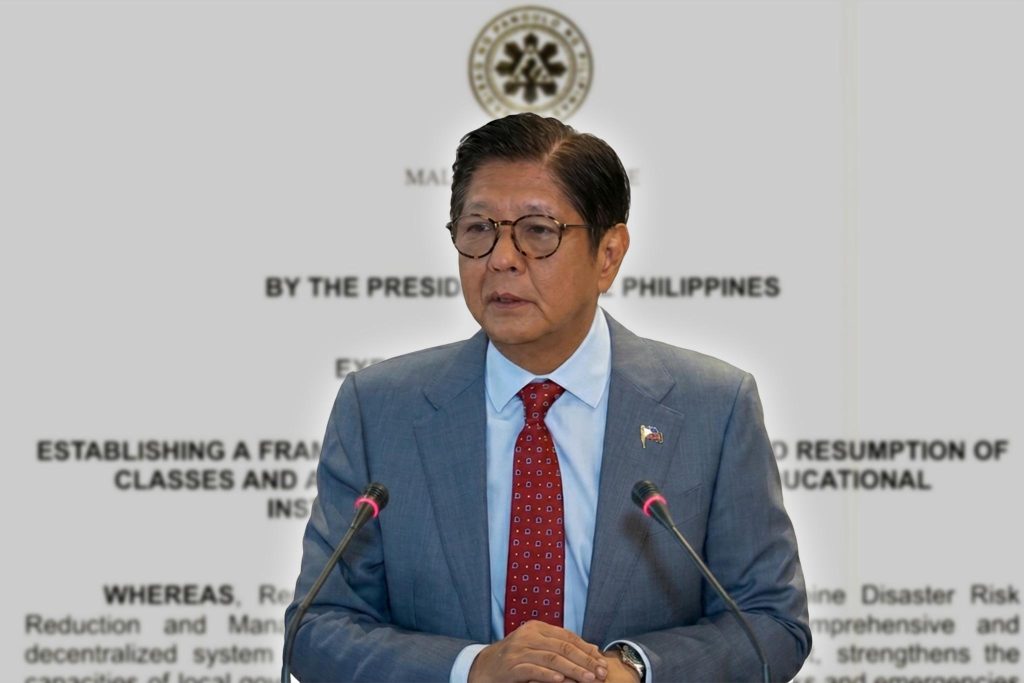
Applying lessons learned from the disharmony of class suspension announcements during the height of heavy rains brought by the enhanced southwest monsoon (habagat), President Ferdinand R. Marcos Jr. underscored the need for uniformity in issuing these advisories that prioritize student welfare.
On October 28, 2026, he issued an executive order that calls for a cohesive policy on the suspension and resumption of in-person classes and school activities.
Under Executive Order No. 130, the government will adopt three mechanisms for suspending classes and on-site work: automatic suspension based on prescribed technical thresholds, localized suspension declared by local chief executives, and granular suspension initiated by individual educational institutions based on documented, site-specific assessments.
The automatic suspension would take effect upon the issuance of a warning, advisory, or alert from the Philippine Atmospheric, Geophysical and Astronomical Services Administration (PAGASA), Philippine Institute of Volcanology and Seismology (Phivolcs), Environmental Management Bureau of the Department of Environment and Natural Resources (DENR-EMB), or another competent authority.
However, in its absence, local chief executives may intervene and declare localized suspensions upon stringent assessment of prevailing conditions in their area.
In doing so, they are required to coordinate with concerned agencies and consult relevant barangay officials, schools division superintendents, and heads of private educational institutions in determining the areas and duration covered by the suspension.
Moving down the chain of command, schools and learning centers may also declare granular suspensions in coordination with their respective local government units upon verification of site-specific assessments.
Back to school
EO 130 also includes mechanisms for the resumption of classes and on-site work on educational institutions in disaster-stricken areas.
For automatic and localized resumption, classes and onsite work may resume once the issued advisory, alert, or warning by a competent agency is lifted, and once required safety assessments and inspections are completed.
Section 5b explains granular resumption: “Where a localized suspension declared by the concerned LCE remains in effect, an educational institution or learning center may, through its duly authorized official, seek the earlier resumption of in-person classes and activities, and onsite work based on documented site-specific conditions warranting resumption, subject to the concurrence of the concerned LCE.”
Where applicable, schools and learning centers may implement alternative learning modes to ensure learning continuity and minimize disruption to the education of students, in accordance with the policies of the Early Childhood Care and Development Council, Department of Education (DepEd), Commission on Higher Education (CHED) and Technical Education and Skills Development Authority (TESDA).
In a media release, DepEd Secretary Sonny Angara welcomed the Chief Executive’s prerogative, which aligns with a proactive approach towards disaster response and other various challenges that may emerge within campuses nationwide.
The Education chief said, “While learner and teacher safety remains strictly non-negotiable, we can no longer rely on sweeping, blanket suspensions when a campus is dry, safe, and ready to teach.” (with report from Angelika Abrogar | PTV News)
jpv

