
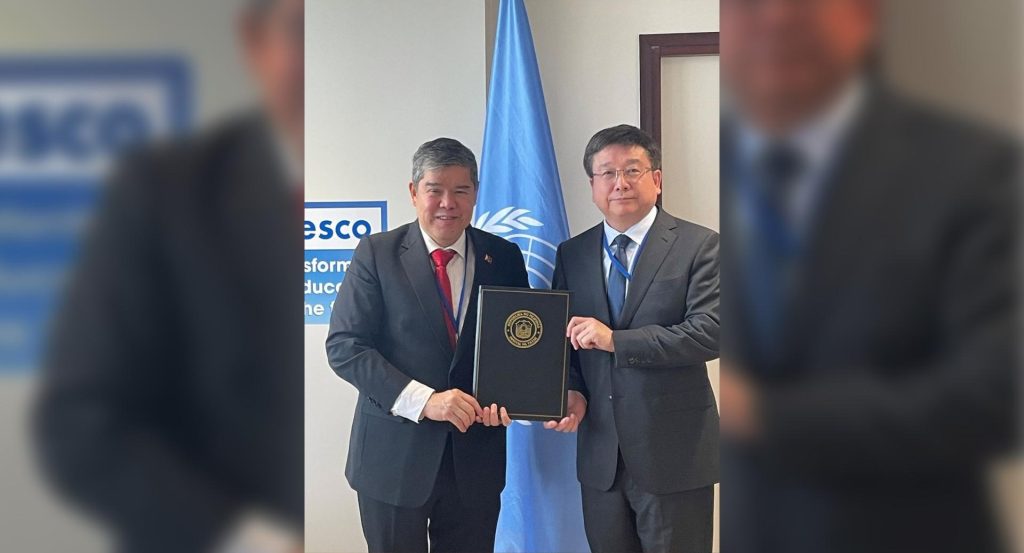
The Philippines has made history as the first Association of Southeast Asian Nations (ASEAN) Member State to accede to the Asia-Pacific Regional Convention on the Recognition of Qualifications in Higher Education, or the Tokyo Convention, marking a significant milestone in advancing the international recognition of Philippine higher education qualifications and expanding opportunities for Filipino learners and professionals.
The Philippines’ Instrument of Accession was formally deposited on November 16, 2026, at the United Nations Educational, Scientific and Cultural Organization (UNESCO) Headquarters in Paris, France.
It was received by Professor Qun Chen, UNESCO Assistant Director-General for Education, from the Philippines’ Permanent Delegate to UNESCO.
Adopted on November 26, 2011 in Tokyo, Japan, the Convention establishes a regional framework for the fair, transparent, and efficient recognition of higher education qualifications.
The Philippines’ accession, nearly 15 years after its adoption, reflects the country’s commitment to strengthening academic cooperation, facilitating educational mobility, and ensuring that the knowledge and qualifications earned by Filipinos are better understood and assessed beyond national borders.
The accession process gained significant momentum with the signing of the Instrument by President Ferdinand R. Marcos Jr. on October 10, 2025, followed by the Philippine Senate’s concurrence on September 7, 2026 through Senate Resolution No. 626, sponsored by Senate Majority Leader Juan Miguel Zubiri.
The successful completion of the process reflects the coordinated efforts of the Executive and Legislative branches, particularly the Commission on Higher Education (CHED) and the Department of Foreign Affairs (DFA).
Diplomatic Milestone
For CHED Chairperson Shirley Agrupis, the Convention represents an important step toward ensuring that international mobility translates into meaningful opportunities for Filipino learners and professionals.
“When people cross borders in pursuit of opportunity, their qualifications should not become barriers at the border,” Chairperson Agrupis emphasized the importance of qualifications recognition.
For Filipino students and professionals, the Convention promotes more transparent and predictable procedures for evaluating higher education qualifications across participating countries.
It can facilitate access to further studies, academic exchanges, research collaborations, and other cross-border educational opportunities, including the consideration of partial studies and diverse learning pathways, subject to applicable national requirements.
As the first ASEAN Member State to accede to the Convention, the Philippines is also positioned to contribute to regional dialogue and cooperation on qualifications recognition.
This milestone complements CHED’s ACHIEVE Agenda, particularly its commitment to Inclusive and Impact-Driven Internationalization, which seeks to translate international engagement into meaningful opportunities for Filipino learners, faculty, researchers, and higher education institutions.
More than a diplomatic milestone, the Philippines’ accession to the Tokyo Convention represents a commitment to expanding possibilities for Filipinos.
It advances the country’s aspiration for Philippine qualifications to be better understood internationally, for Filipino learners to pursue opportunities across borders, and for Filipino talent to thrive in an increasingly interconnected world. (PR)

