

WASHINGTON — U.S. Secretary of State Rex Tillerson has not announced a breakthrough or substantial progress after holding talks in Jeddah, Saudi Arabia with the ministers from four Arab nations that are locked in a stand-off with Qatar. On June 5, Saudi Arabia, the United Arab Emirates, Bahrain and Egypt severed diplomatic ties and instituted a land, air and sea blockade of Qatar.
The Saudi-led group of Arab nations accuses Qatar of supporting terrorism and has given Doha a 13-point list of demands. Qatar has said it is willing to negotiate, but will not give up its sovereignty.
Tillerson met with ministers from the Saudi-led group, but did not speak to reporters afterward. Prior to the talks, a senior UAE official said any resolution of the conflict must go beyond terrorism financing and address all key issues.
Tillerson also met separately with Saud King Salman and Saudi Crown Prince Mohammed bin Salman al-Saud, highlighting the importance of the U.S.-Saudi relationship.
The secretary then returned to Kuwait City, his “home base” in the Persian Gulf region this week. Kuwait is helping to mediate in the month-long dispute. Secretary Tillerson will return to Doha on Thursday to meet with the emir of Qatar, Sheikh Bin Hamad Al-Thani, as the diplomatic push continues.
The talks in Jeddah come a day after Tillerson announced the United States and Qatar signed a memorandum of understanding for Doha to take steps to curb terrorism financing.
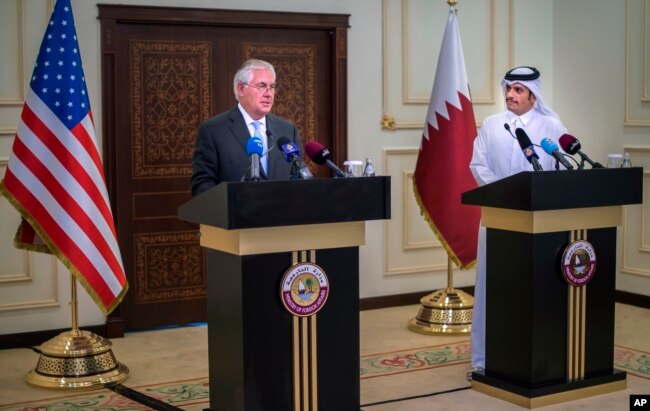
“I am here in Qatar today carrying with me the same spirit which President (Donald) Trump traveled in Riyadh with in May,” Tillerson said. “The United States has one goal: drive terrorism off the face of the Earth.”
Saudi Arabia, the United Arab Emirates, Bahrain and Egypt said in a statement that while they appreciate U.S. counterterror efforts, the agreement signed Tuesday “is not enough” and they will be closely monitoring Qatar’s “seriousness” in combating the funding and support of terrorism.
Brokering a crisis
“I think Qatar has been quite clear in its positions, and I think those have been very reasonable,” Tillerson said Tuesday after meeting with Qatar’s emir.
The U.S. is concerned the dispute could hurt its military and counterterrorism operations and enhance Iran’s influence in the region. Qatar hosts the largest U.S. military facility in the Middle East, which aircraft from the U.S.-led coalition use to launch attacks against Islamic State militants in Iraq and Syria.
Aaron David Miller of the Washington-based Wilson Center advised both Republican and Democratic secretaries of state in Middle East negotiations. He told VOA the conflict with Qatar and Saudi Arabia and its allies has been brewing for years, saying in many ways, Qatar’s open domestic policies embody Saudi Arabia’s worst fears, and amount to competing views of the shape of the Middle East. He said it would be very difficult for Tillerson, or anyone else, to help broker a long-term agreement.
Amnesty International issues warning
As Tillerson shuttled through the Gulf, Amnesty International called on the secretary to not overlook the issue of human rights and advocate for the release of activists being detained in Gulf states for “peacefully expressing dissent.”
“While Secretary Tillerson holds talks with the leaders of Saudi Arabia and other Gulf countries, human rights defenders are in prison and face torture for speaking out against horrific abuses in the region,” said Naureen Shah, senior director of campaigns at Amnesty International USA.
“Tillerson should condemn the persecution of peaceful dissidents, many who are facing bogus national security charges. Otherwise, Tillerson risks giving Gulf governments a green light to continue ruthless crackdowns on dissent.” | via voanews

