
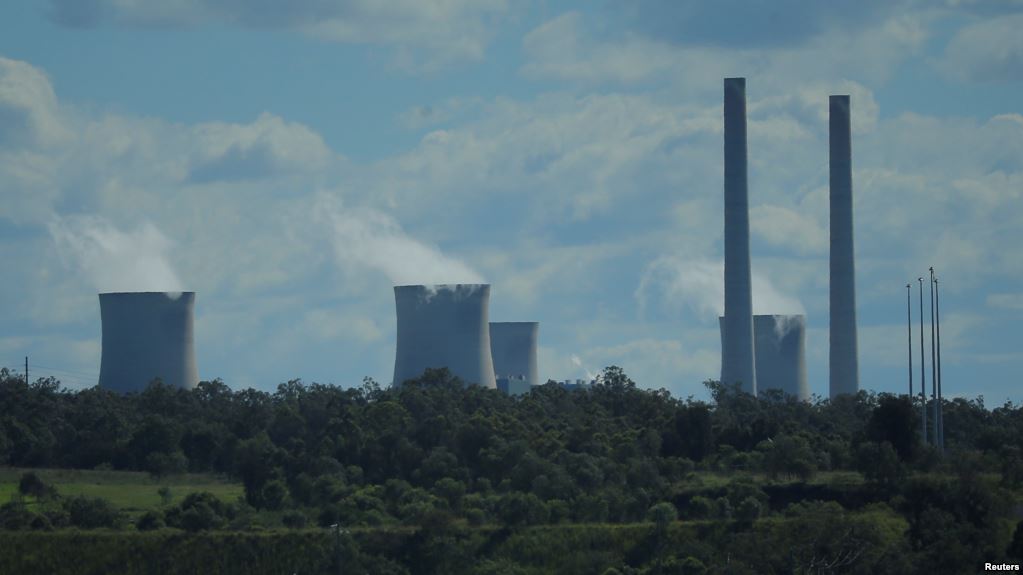
SYDNEY — Australia is rejecting the latest U.N. report on climate change, insisting coal remains critical to energy security and lowering household power bills.
The United Nations’ Intergovernmental Panel on Climate Change (IPCC) said in its report released Monday that global greenhouse gas emissions must reach zero by the middle of the century to stop global warming exceeding 1.5 degrees Celsius.
The authors warned that if warming was allowed to reach two degrees, the world would be on course toward uncontrollable temperatures.
They made special mention of coal, insisting that its use for power generation would have to fall to between zero and two percent of current usage.
The report has received a lukewarm response by Australia’s center-right government. It has said it has no intention of scaling back fossil fuel production because without coal, household power bills would soar.
Canberra also insists it is on target to meet its commitments under the Paris agreement, which attempts to unite every nation under a single accord to tackle climate change for the first time ever.
Australia earns billions of dollars exporting coal to China and other parts of Asia, while it generates more than 60 percent of domestic electricity.
Australia’s Environment Minister Melissa Price believes the IPCC report exaggerates the threat posed by fossil fuel.
“Coal does form a very important part of the Australian energy mixer and we make no apology for the fact that our focus at the moment is on getting electricity prices down,” Price said. “Every year, there is new technology with respect to coal and what its contribution is to emissions. So, you know, to say that it has got to be phased out by 2050 is drawing a very long bow.”
Australia has some of the world’s highest per capita rates of greenhouse gas pollution. A recent government report showed a failure to reduce levels of greenhouse gas pollution. The survey said that between January and March this year, Australia had its most elevated levels of carbon pollution since 2011.
Conservationists argue Australia is doing too little to protect itself from the predicted ravages of a shifting climate.
Australia is the world’s driest inhabited continent. Scientists warn that droughts, floods, heat waves, brush fires and storms will become more intense as temperatures rise, with potentially disastrous consequences for human health and the environment, including the Great Barrier Reef. Voice of America

