

PHNOM PENH — Cambodians headed to the polls Sunday for an election in which the only viable alternative party has been banned. That’s helped the country’s prime minister of more than three decades to extend his reign even longer.
There was little doubt that the country’s ruling Cambodian People’s Party will win the ballot in a landslide following the dissolution of the only viable opponent, the Cambodian National Rescue Party late last year.
But the shadow the CNRP’s dissolution has cast over the credibility of the election was magnified even further this weekend when the government suddenly blocked the websites of more than a dozen critical news outlets.
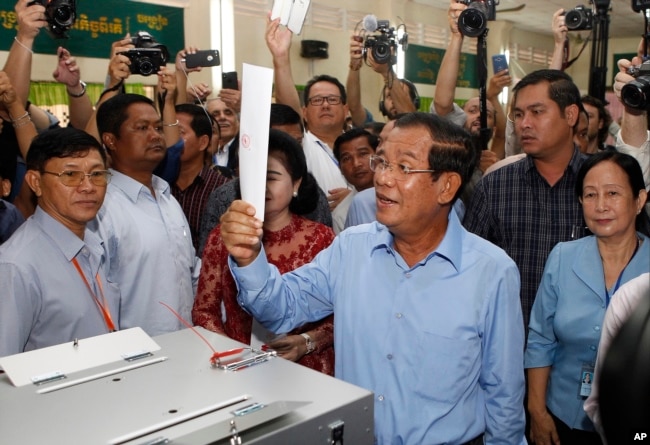
Shortly after polls opened Sunday, Prime Minister Hun Sen, who has ruled for 33 years, arrived at his local station on the outskirts of Phnom Penh with his wife Bun Rany to cast a vote that many rights groups and observers say signals the death knell for democracy in Cambodia.
“They don’t allow us to say anything today, we must follow the law,” Hun Sen told reporters before quickly leaving in a van.
Under Cambodia’s election law a 48 hour freeze is placed on campaigning on the day before and day of the election.
The government used this provision as a justification for blocking 15 news websites including the Voice of America’s Khmer service over the weekend while allowing pro-government outlets to continue reporting online unimpeded.
Outside the polling station National Election Committee spokesman Dim Sovannarom defended the selective blocking of online news websites.
“NEC has the right, has the law, article 42, to do everything to, to do every means to ensure the free and fair election,” he said, without specifically addressing why only certain news websites had been targeted.
In the absence of the CNRP, which was dissolved in November by the Supreme Court on accusations it had plotted with the United States to overthrow the government, the focus of the election has largely shifted from the result to the turnout. When polls closed, officials said voter turnout was 80 percent.
The CNRP’s leaders have launched a “clean finger” boycott campaign that the government claims amounts to obstruction of voters, though voting is not compulsory in Cambodia.
So Saonara, a 36-year-old resident of Phnom Penh’s Sen Sok district, said the turnout looked significantly down from last year’s commune elections.
“It looks like it is going fast. Last year you had to stand in a long queue,” he said.
In its battle to legitimize the widely derided election the CPP has pursued those calling for a boycott with criminal charges.
It has also brought in more than 539 election observers, largely from outright autocracies or highly precarious democracies, following the withdrawal of the United States, the EU, Japan, Australia and others.
Lebanese observer Youssef Awad, who is part of a delegation from the International Conference of Asian Political Parties, declined to tell reporters yesterday who had paid for him to perform his duties during the election.
“I mean let’s be honest about this. How do you know, this political party, where do they get their money from? Nobody knows. But what’s important is the men in power are doing a clean job and they’re serving their people.”
Pressed about who had financed the observation mission, Awad asked “are you from the IRS?”
“That’s an irrelevant question, you have to ask about the elections and not ask, how did I pay for my ticket. This is none of your business. Maybe I pay my own. Why, why you ask me this question?” he said.
Another observer, Nepalese Parliamentarian Arjun Thapa, said he had never spoken to anyone from the CNRP though he had received a resounding vote of confidence in the electoral process from some of the 19 minor parties participating.
“A developing country like Cambodia or Nepal or third world country, some way or other, the political outfit who is not in the mainstream political party, they keep on unnecessarily disturbing the election process,” he said.
One surprisingly frank observer said the more than 80 percent turnout figure was marred by rates of spoiled ballots of between 20 and 35 percent at every station he inspected.
“It was also very notable during the count that the second largest party in Cambodia is the spoiled ballot party,” said John McAuliff, Executive Director for the Fund for Reconciliation and Development.
CNRP vice president Mu Sochua said it was clear to people both within and outside Cambodia that the election was a sham.
“To vote or not to vote. Intimidation, threats, cajoling, vote buying, promises of all forms and shapes by CPP to justify their legitimacy have been intense and it will continue till the polls close today at 3 p.m.,” she said in an email. (David Boyle/Khan Sokummo/Voice of America)

