

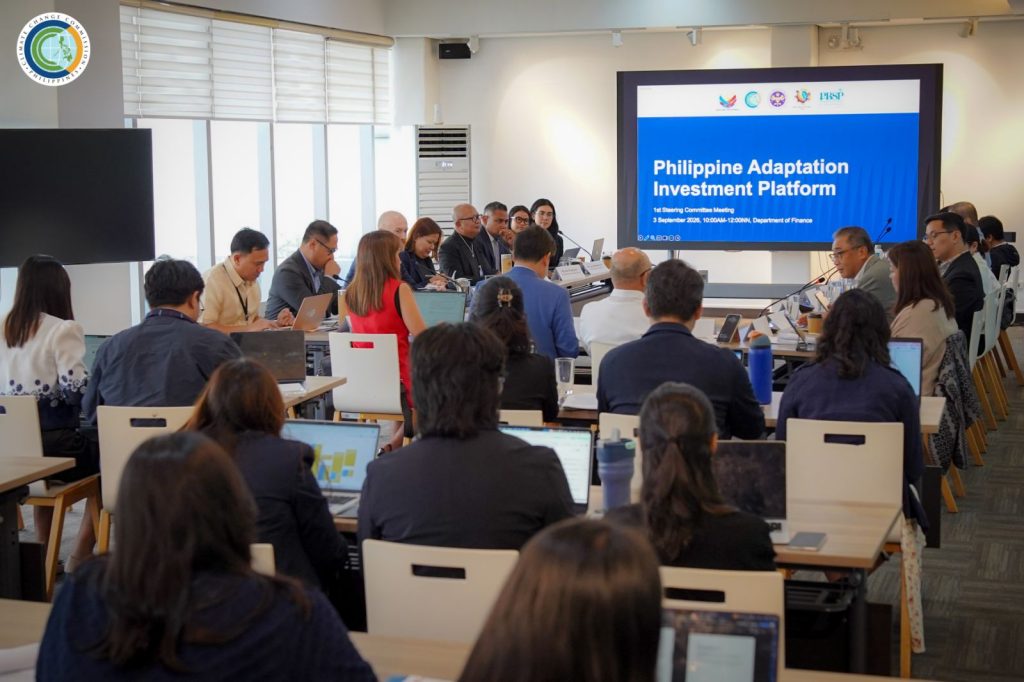
The Climate Change Commission (CCC) convened the first meeting of the Steering Committee of the Adaptation Investment Platform (AIP) on Sept. 3, advancing efforts to mobilize investments and accelerate the implementation of the country’s National Adaptation Plan (NAP).
The AIP seeks to help translate the country’s adaptation priorities into investment-ready projects by bringing together government, project proponents, financial institutions, and development partners to mobilize public, private, and concessional financing for locally led and NAP-aligned initiatives.
CCC Vice Chairperson and Executive Director Robert E.A. Borje underscored the importance of ensuring that adaptation plans are translated into concrete investments and actions that benefit communities.
“An adaptation plan becomes consequential only when it begins to change decisions: where the government directs public resources, which projects financial institutions support, and whether investment reaches communities before climate risk becomes climate loss,” Borje said.
Developed under the leadership of President Ferdinand R. Marcos Jr., the Philippines’ NAP was adopted by the CCC in April 2024 through Commission Resolution No. 2024-003.
The Philippines was the third ASEAN nation and 56th country in the world to submit its NAP to the United Nations Framework Convention on Climate Change (UNFCCC). The NAP identifies adaptation priorities across eight sectors and estimates the annual economic cost of climate inaction at P645 billion.
While the NAP provides the country’s policy direction for climate adaptation, Borje emphasized the need to develop a credible pipeline of projects that can attract financing and deliver measurable results.
The AIP is intended to address challenges that prevent adaptation projects from advancing, including fragmented institutional arrangements, limited project readiness, financing gaps, and the absence of clear pathways from national priorities to local implementation.
The Platform’s initial pipeline includes three projects in Negros Occidental and Iloilo, provinces identified within the high-exposure band of the NAP’s provincial categorization. As of Aug. 25, 2026, P59 million had been deployed, with P225 million identified for possible deployment over the next 12 months.
“These are projected results, not yet accomplishments. Our responsibility is to build the governance, financing, and delivery arrangements that can turn them into verified outcomes,” Borje said.
The first Steering Committee meeting focused on establishing the AIP’s governance and institutional arrangements, advancing the initial project pipeline, and identifying sustainable financing pathways to support the implementation of the NAP.
For the CCC, investments supported through the Platform must remain aligned with NAP priorities, provide meaningful pathways for local governments and institutions, and generate results that can be tracked through the NAP’s monitoring, evaluation, accountability, and learning system.
“Let us make sure that capital reaches the farm; that an investment becomes avoided loss, protected income, and greater security; and that the promise of the National Adaptation Plan is felt where climate risk is already lived,” Borje said. (PR)

