
/PNA
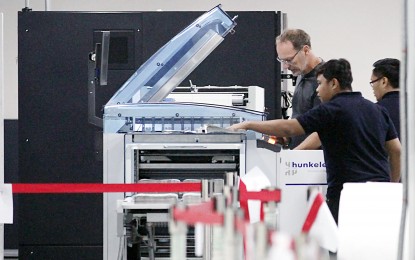
MANILA — The Commission on Elections (Comelec) on Saturday started the printing of the more than 63 million official ballots to be used in the May 13 National and Local Elections (NLE) at the National Printing Office (NPO) in Quezon City.
Ma. Victoria Dulcero, vice chairman of the Comelec Printing Committee, said they are looking to finish before April 25 the printing of the 63,662,481 ballots for the local polls and overseas absentee voting (OAV).
Of the number, a total of 61,843,771 ballots will be used in the local polls while 1,818,710 ballots are for the OAV.
“In the printing of official ballots, our agency partner is NPO. The NPO is providing us with three printers for this project, which will run 24/7,” the poll official said in a press briefing.
Dulcero added that aside from the official ballots, they will print a total of 1,142,063 ballots to be used in the final testing and sealing (FTS) to test the vote counting machines (VCMs).
“The FTS ballots will be used by our Board of Election Inspectors (BEIs) or Electoral Boards to test the VCMs,” she explained.
Dulcero added that they expect to print one million ballots per day.
Meanwhile, Comelec spokesperson James Jimenez said the OAV ballots will be the first to be printed, to be followed by those for Mindanao provinces, the Visayas provinces, Luzon and the National Capital Region (NCR).
“The first to be printed are overseas ballots, because elections overseas will start on April 13. The OAV election would be ongoing while we print the ballots for the rest of the country,” Jimenez said.
As for the printing of the local ballots, the poll body official said they usually start from the farthest areas.
“The order of printing starts from the farthest. Far-flung areas first and then the last few deliveries will be NCR since it the nearest destination,” he added.
Jimenez also noted that the ballot has its normal security features, such as barcodes, and ultraviolet (UV) marks.
“The ballots will have the normal security features that we normally have — thumb marks, barcodes, etc. And there are a few others that I cannot tell you because of security. The UV marks can be read by the machine. If the machine is not reading it, then it will be rejected,” he said.

