
By Brian Campued
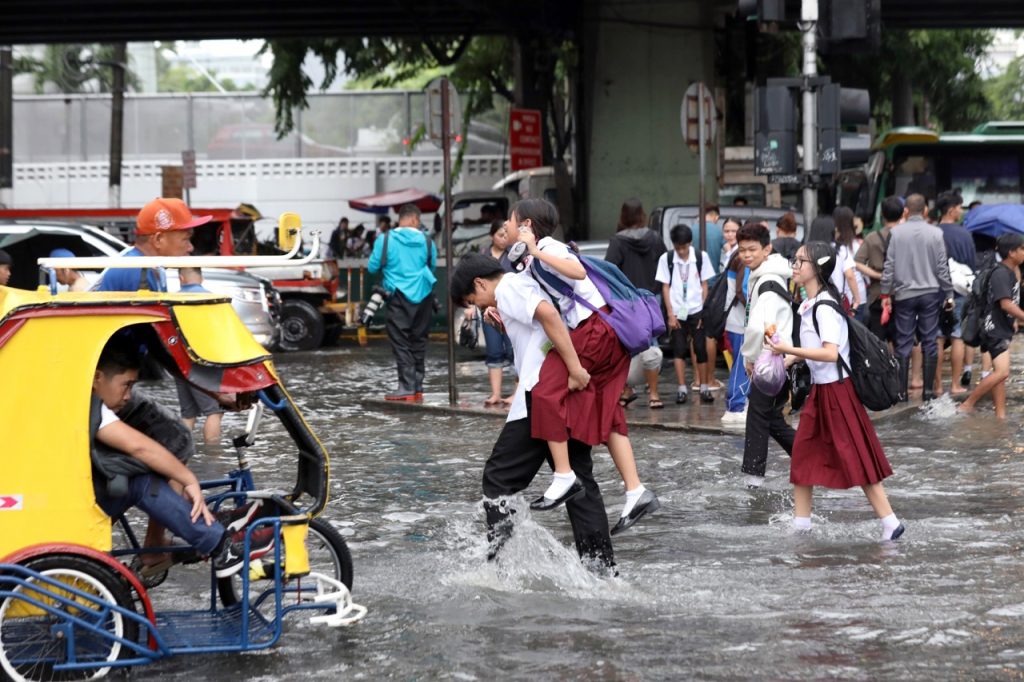
Recognizing that natural disasters, environmental hazards, and human-induced incidents continue to threaten learning continuity, the Department of Education (DepEd) has issued new guidelines to ensure learning delivery among schools during emergency situations.
Education Secretary Sonny Angara emphasized that during times of calamities or crises, not only the safety of learners and teachers paramount—but also whether they are able to learn and teach amid stressful conditions that disrupt classes and further exacerbate learning loss.
The DepEd chief stressed, “Hindi pwedeng pareho ang hinihingi natin sa kanila kapag normal ang sitwasyon at kapag may pinagdadaanan silang panganib, takot, o pagkawala.”
To address these challenges, Angara issued DepEd Order No. 14 s. 2026, providing school heads, division alternative learning system focal points, and schools division superintendents a “clearer framework” when making decisions before, during, and after emergencies without compromising the welfare and safety of learners, teachers, and other school personnel.
These crises include typhoons, heavy rainfall, floods, landslides, earthquakes, prolonged power outages, extreme heat, unhealthy air quality, health hazards, violence, and armed conflict.
“Ang tunay na learning continuity ay may malasakit—alam kung kailan magpapatuloy, kailan babagal, kailan magche-check in, at kailan kailangang huminto muna para unahin ang kaligtasan,” Sec. Angara pointed out.
This initiative reflects President Ferdinand R. Marcos Jr.’s directive to strengthen school preparedness and ensure that learners are continuously supported during emergencies while protecting the welfare of teachers and school personnel.
Levels-based response
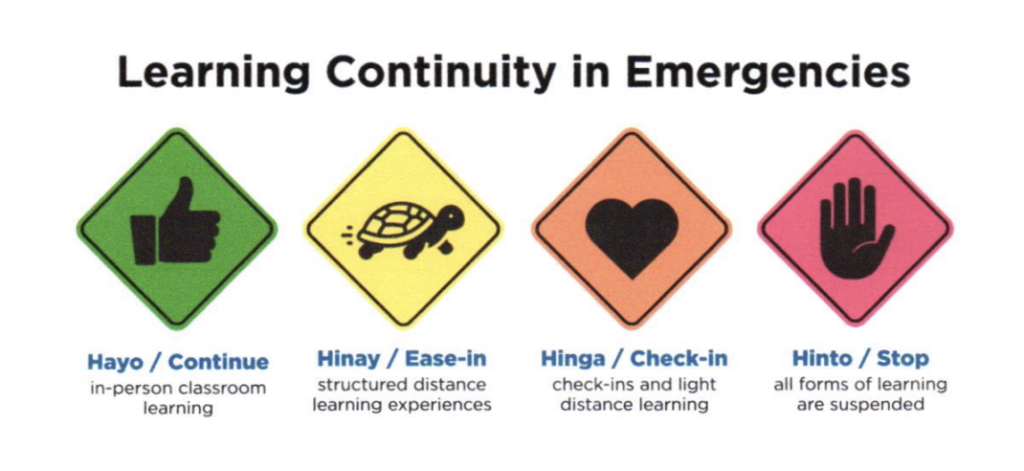
The policy introduces a levels-based learning continuity framework, designed to guide schools in selecting the appropriate response based on the safety, readiness, and condition of learners and teachers.
The four levels are “Hayo” or Continue, “Hinay” or Ease-in, “Hinga” or Check-in, and “Hinto” or Stop.
Under Hayo, regular in-person classes continue when learners and teachers are “physically
safe, emotionally regulated, and cognitively ready to engage in sustained learning.”
For Hinay, learning continues but at a slower, more flexible pace during minor to moderate disruptions where learners experience “mild stress.” Teachers may engage learners via online synchronous classes, digital modules, broadcast materials, print modules, or learning packets.
Emergencies and hazards that may signal the enactment of the second level include the raising of Tropical Cyclone Wind Signal (TCWS) Nos. 1 and 2, yellow rainfall warning, earthquakes with Intensity IV and below, transport strikes, and an official declaration of emergency by the national or local government authorities.
Under Hinga, on the other hand, stakeholders experience “heightened stress” due to crises, such as TCWS No. 3, orange rainfall warning, an Intensity V temblor, power outages lasting for two to three days, bomb threats, and actual viral/bacterial outbreaks among others.
This level means academic demands are heavily reduced to give way to physical, psychological, and social-emotional well-being checks. Learning shall also focus on reviewing concepts from previous lessons through broadcast materials, learning packets, check-in guides, and other trauma-informed, simplified learning resources.
Meanwhile, for Hinto, academic learning is halted completely, and full attention must be given to the protection, emergency response, and basic needs of learners, teachers, and school personnel.
Under this tier, “distress or displacement is highly likely” due to extremely unsafe conditions within the community, such as TCWS No. 4, red rainfall warning, severe flooding, earthquakes of Intensity VI and above, power outages for four or more days, 42-52°C heat indices, hazardous air quality posing serious risk of respiratory illness for the entire population, armed conflict, as well as the occurrence of famine, drought, or pandemic.
Affected teachers and learners must be provided with Mental Health and Psychosocial Support (MHPSS), including psychological first aid, to address psychosocial well-being and mental health conditions of individuals in distress.
Other salient points
Under the DepEd Order, school heads are also empowered to coordinate closely with schools division superintendents and local government units to implement granular class suspensions based on actual community conditions, thereby preventing unnecessary learning disruption in areas that remain safe.
This complements the existing guidelines on class and work suspensions in schools during disasters and emergencies.
To help sustain learning during class disruptions, the guidelines also set standards for emergency learning tools, including learning packets, print or digital modules, broadcast materials, family kits, check-in guides, home learning support, and emergency learning kits.
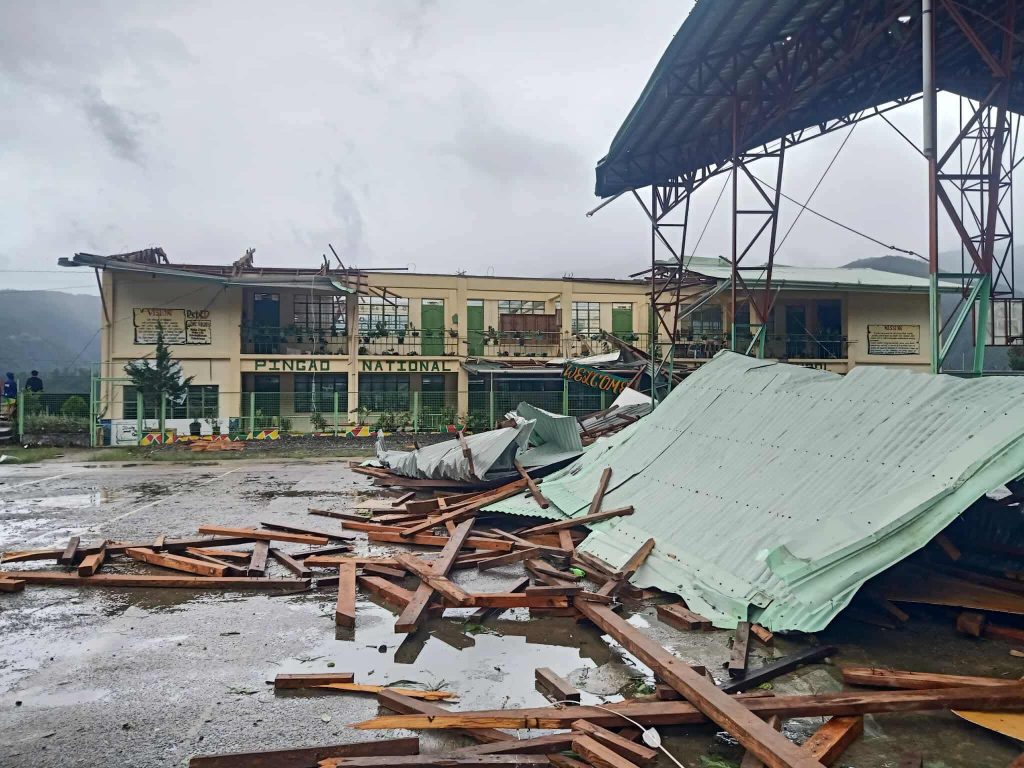
The policy also strengthens the use of “EduKahon,” DepEd’s specialized school recovery kit containing essential education materials tailored to ensure learning continuity even when classrooms are inaccessible or damaged during disasters.
Public schools, meanwhile, are directed to update their Learning and Service Continuity Plans annually before the school year and every term, conduct capability mapping, establish emergency call trees, and orient parents and guardians on emergency learning protocols at the start of each school year.
Teachers shall also undergo capacity building regarding trauma-informed teaching, psychological first aid, and learning delivery across different emergency levels.
Regional and school division offices are likewise ordered to support the mental health of teachers and provide emergency assistance, especially in high-risk or under-resourced areas.
The guidelines cover all public elementary and secondary schools, DepEd-operated community learning centers, and accredited Alternative Learning System providers, while private schools and state and local universities and colleges offering basic education are encouraged to adopt the same framework.
-jpv

