
By Brian Campued
President Ferdinand R. Marcos Jr. on Thursday underscored the importance of inter-agency coordination in boosting local agricultural production and increasing farmers’ income through the use of modern technology and equipment.
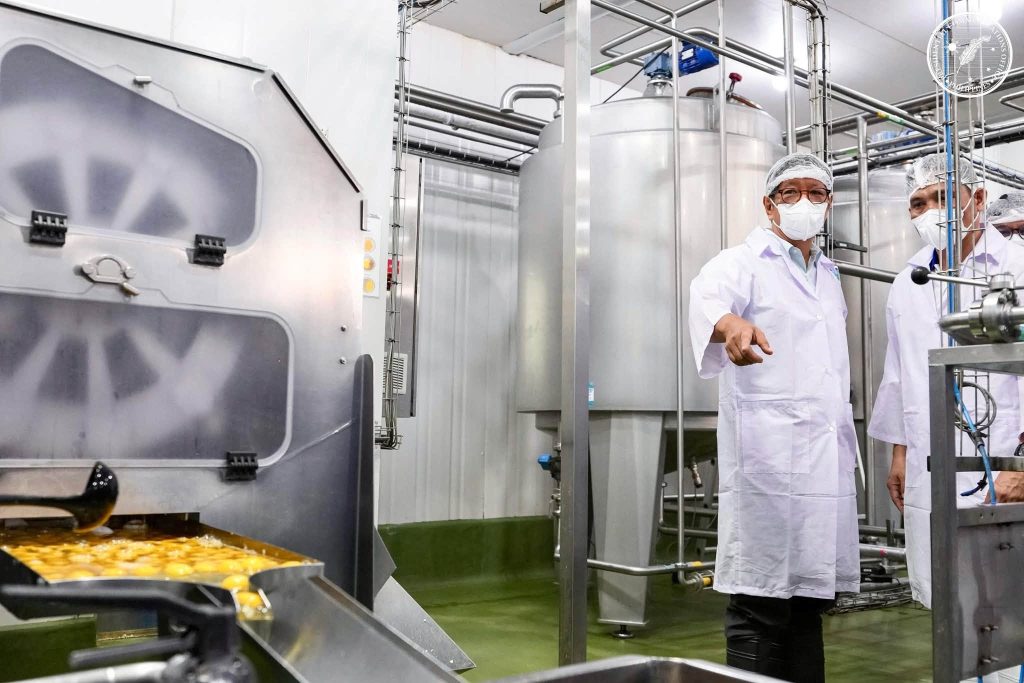
During a visit to the Batangas Egg Producers Multipurpose Cooperative (BEPCO) in San Jose, Batangas, President Marcos Jr. said government agencies, along with farmers and cooperatives, must work together to minimize waste and add value to agricultural products.
The President said the Department of Science and Technology (DOST) helped BEPCO develop technologies to process eggs and extend their shelf life, while the Department of Agriculture (DA) provided machinery and financial support—helping increase the cooperative’s sales by 125% and productivity by 25%.
These technologies, Marcos Jr. said, allow BEPCO to process excess eggs into pasteurized, frozen, and powdered products that can be stored longer, helping farmers manage overproduction.
Marcos Jr. assured that while the initiative remains in its pilot stage, additional machinery will be installed to increase production.
“This is the continuing effort of government to cut out the middleman from between the farmer, between the producer, and the market. Ito ‘yung magandang halimbawa na kapag talagang nagtutulungan ang lahat ng mga ahensya ng pamahalaan, ng national government, ng local government, at ng ating mga kooperatiba, ating mga producers, ay makita natin ay napakaganda magiging resulta,” he said.
During the visit, the President toured BEPCO’s new and key facilities, including the Liquid Egg Pasteurization Facility, the Spray Drying Line Facility, and the new three-story Cold Storage Facility.
He was accompanied by Executive Secretary Ralph Recto, DA Secretary Francisco Tiu-Laurel Jr., DOST Secretary Renato Solidum Jr., and BEPCO Chair Victorino Michael Lescano.
Located in Barangay Don Luis, San Jose, Batangas, BEPCO has 97 members operating small- to commercial-scale layer farms.
Batangas is the leading egg-producing province in CALABARZON, with production reaching 217,581 metric tons in 2025.

