
Japan, ILO ink $2.6-M Bangsamoro water supply project

By Joyce Ann L. Rocamora/PNA

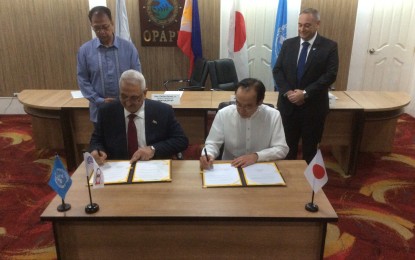
ILO Philippines Director Khalid Hassan and Ambassador Koji Haneda sign the exchange of note on a project to ensure water and jobs in the Autonomous Region in Muslim Mindanao. Witnessing the signing are OPAPP Secretary Carlito Galvez Jr. and Food and Agriculture Organization Philippine Representative Jose Luis Fernandez. (Photo by Joyce Ann L. Rocamora)ILO Philippines Director Khalid Hassan and Ambassador Koji Haneda sign the exchange of note on a project to ensure water and jobs in the Autonomous Region in Muslim Mindanao. Witnessing the signing are OPAPP Secretary Carlito Galvez Jr. and Food and Agriculture Organization Philippine Representative Jose Luis Fernandez. (Photo by Joyce Ann L. Rocamora)

MANILA — More households in the Autonomous Region in Muslim Mindanao will soon have access to safe and potable water through a USD2.6 million-worth project that will build a community-based water supply in the region.

On Wednesday, the Japanese government and the International Labor Organization (ILO) inked a deal that would aid in the construction of water supply and recovery systems in the region using local workforce.

The initiative is expected to benefit over 1,800 workers and at least 12,000 households in the conflict-affected areas.

“I look forward to seeing more households in the Bangsamoro region gain better access to potable water, averting vulnerabilities to water-borne diseases caused by unsafe sources,” Ambassador Koji Haneda said during the signing ceremony.

“Aside from making optimum use of these water infrastructure, I hope the beneficiaries will also find opportunities for decent work and better living conditions through this project with the ILO,” he added.

Khalid Hassan, director of ILO Philippines, said the project would serve as “one of the centerpieces” for ILO’s centenary “as interventions in the Bangsamoro areas are meant to create jobs” while advocating the decent work agenda.

“Using a peace lens, the project will reach out to returning combatants, vulnerable youth, indigenous peoples, and men and women displaced and vulnerable to conflict,” he added.

In the ARMM, only 53 percent of families have access to safe water– lower than the national average of 85 percent, based on the 2016 data from the Philippine Statistics Authority.

Popular

PBBM hails timely completion of 2 new school buildings in QC

By Dean Aubrey Caratiquet “I am very, very happy to see that the students are already using it.” After a major fire gutted an old building...

DEPDev pushes for stronger gov’t-industry tie-ups to boost labor market resilience

By Brian Campued The Department of Economy, Planning, and Development (DEPDev) on Tuesday called for stronger collaboration between government and industry to equip workers with...

‘Hayo, Hinay, Hinga, Hinto’: DepEd issues emergency learning continuity guidelines

By Brian Campued Recognizing that natural disasters, environmental hazards, and human-induced incidents continue to threaten learning continuity, the Department of Education (DepEd) has issued new...

PhilHealth boosts healthcare services in DepEd schools ahead of class opening

By Brian Campued As the Department of Education (DepEd) intensifies preparations ahead of the opening of the School Year 2026–2027 on June 8 through the...