

PENTAGON — North Korea launched another intercontinental ballistic missile ((ICBM)) Friday, the second such launch in just a few weeks, the Pentagon said.
“We detected and tracked a single North Korea missile launch,” Pentagon spokesman Navy Captain Jeff Davis told reporters. “We assess that this was an ICBM; this was a launch that had been expected.”
Davis said North Korea launched the missile from Mupyong-ni arms plant in the country’s north. He said it flew “in excess of 40 minutes” and traveled about 1,000 kilometers laterally before splashing down into the Sea of Japan, about 163 kilometers from Hokkaido, Japan’s second-largest island.
Possible landing site
Japan’s Prime Minister Shinzo Abe said the missile may have landed in that country’s exclusive economic zone, and he convened an emergency meeting with Japanese officials to respond to the launch.
Davis said the United States remains “as committed as ever to the defense of our allies, especially the Republic of Korea and Japan, in the face of these threats.” He added the missile did not pose a threat to North America.
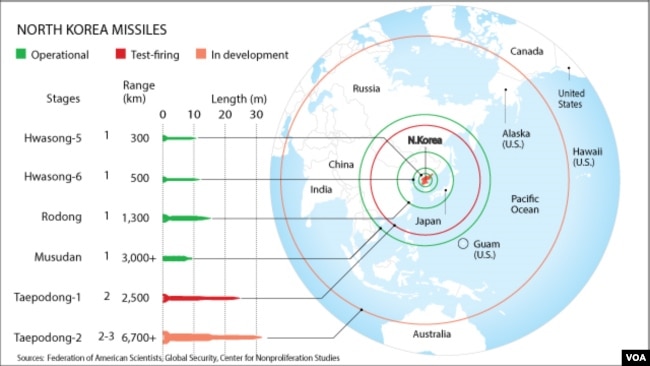
North Korea has carried out several ballistic missile tests over the past two years. Earlier this month, Pyongyang launched an intercontinental ballistic missile for the first time. The missile flew for 39 minutes and landed in the Sea of Japan. Experts said the ICBM may have had a range capable of reaching the U.S. state of Alaska.
“North Korea is slowly morphing into a nuclear and missile power right before our very eyes,” said Harry Kazianis, director of defense studies from the Center for the National Interest.
After Friday’s launch, the top U.S. general, Chairman of the Joint Chiefs of Staff Gen. Joseph Dunford, and the head of U.S. Pacific Command, Admiral Harry Harris, called the Republic of Korea’s Joint Chiefs of Staff Chairman, General Lee Sun Jin. The U.S. Chairman’s office said the military leaders discussed military response options and reaffirmed their “ironclad commitment” to the U.S.-Republic of Korea alliance.
Susan Thornton, the acting assistant secretary of state for East Asian and Pacific affairs, testified on Capitol Hill Thursday that North Korea is “the most urgent and dangerous threat.”
“We are working to isolate and increase pressure on North Korea with the goal of convincing the regime to return to serious talks aimed at denuclearization. This has been and remains this Administration’s top diplomatic priority,” said Thorton.
VOA’s State Department correspondent Nike Ching contributed to this report | via voanews

