
The OCTA Research Group reported today (July 21) that the COVID-19 reproduction number in the National Capital Region (NCR) from July 14 to 20 increased to 1.08, an indication of continuous virus transmission.
“Likely, ‘yung ating pagsunod sa minimum public health standards ay lax, hindi disiplinado, pag-increase ng mobility dahil nagluwag tayo ng restrictions. So it is to be expected tataas siya nang kaunti,” OCTA Research fellow Prof. Ranjit Rye said in an interview.
The group said they have not yet seen the contribution of Delta variant transmission to the reported increase of COVID-19 cases, since there is no official declaration of local transmission yet.
However, infectious disease expert Dr. Rontgene Solane said the higher viral loads in the Delta variant would also lead to higher reproduction numbers, noting that an infected individual can infect four to eight people in a single interaction.
“Overall, it is 97% highly transmissible… Because of the overwhelming viral load in the body of the infected individual, it will also be automatic that the reproduction number will also be increased,” Solante said.
Both Manila and Makati have high reproduction numbers in Mega Manila at 1.21 and 1.22, respectively. Other local governments with significant growth rates were Valenzuela, Pasay, Marikina, and Parañaque.
The intensive care unit (ICU) utilization in Taguig City likewise increased to 100% or full occupancy.
“At this point, kailangan na i-contemplate ng Metro Manila Mayors at ng IATF [Inter-Agency Task Force] na magkaroon ng GCQ with restrictions dito sa National Capital Region dahil na rin sa pagtaas ng cases natin at dahil may totoong banta talaga ng Delta variant,” Rye said.
Four-door strategy
The government is currently implementing its four-door strategy to prevent transmission, which includes travel bans (Door 1); screening, quarantine, and testing at points of entry (Door 2); strengthening of vaccination and the implementation of the Prevent-Detect-Isolate-Treat-Reintegrate (PDITR) strategy (Door 3); and ensuring the healthcare system is prepared for a possible surge (Door 4).
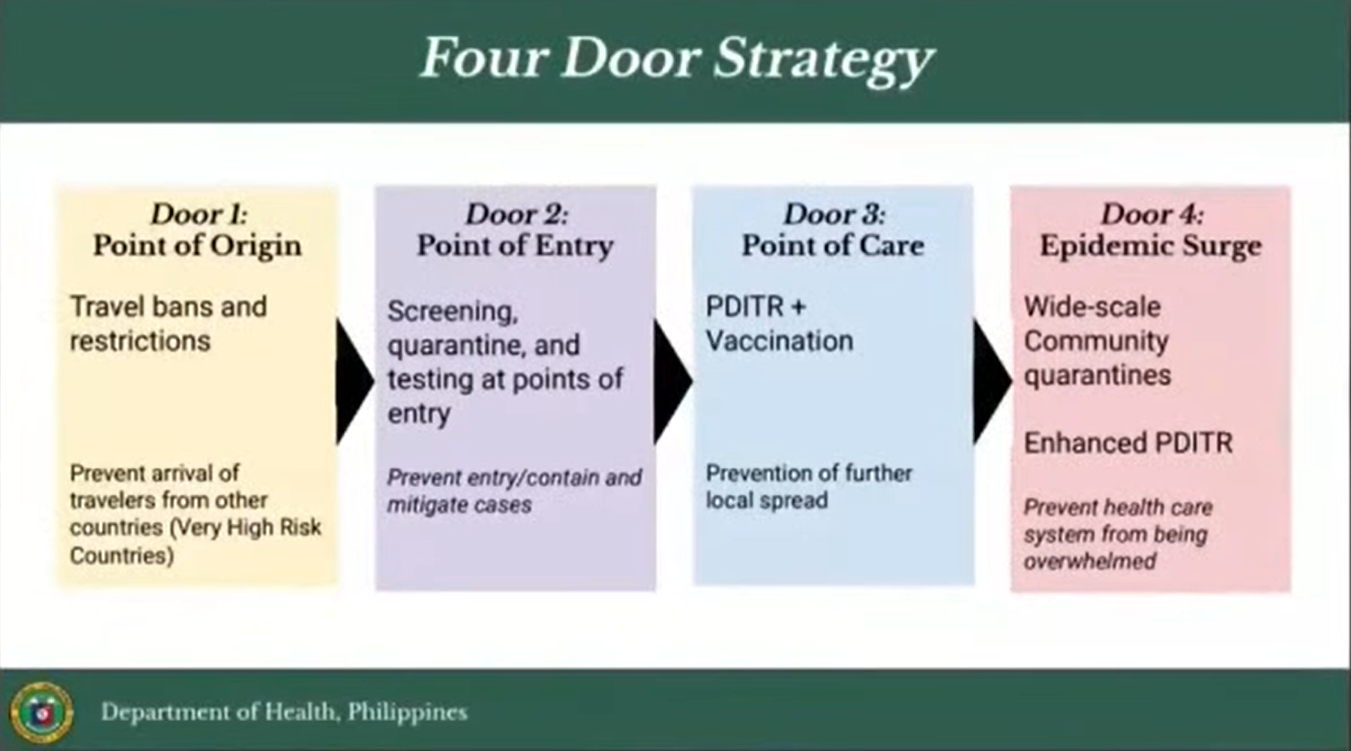
DOH Undersecretary Maria Rosario Vergeire said in the July 20 briefing that the quarantine and testing measures in the country’s borders under Door 2 have been effective.
“Nagiging effective because we are being able to assess or identify itong mga variants from the ROFs (returning overseas Filipinos) na pumapasok dito sa ating bansa,” she said.
The Department of Justice (DOJ) said that the Bureau of Immigration has been strictly monitoring all borders in response to the Delta variant threat. – Report from Mark Fetalco/AG- jlo
Watch full report here:

