
By Dean Aubrey Caratiquet
With the agriculture sector among the possible hardest-hit sectors by the Super El Niño phenomenon, water has become a crucial component of the government’s response to cushion the impact of this weather event on farmers.
This, as President Ferdinand R. Marcos Jr. led the inauguration of the Pamplona Solar Pump Irrigation Project (SPIP) in Pamplona, Cagayan on Monday.
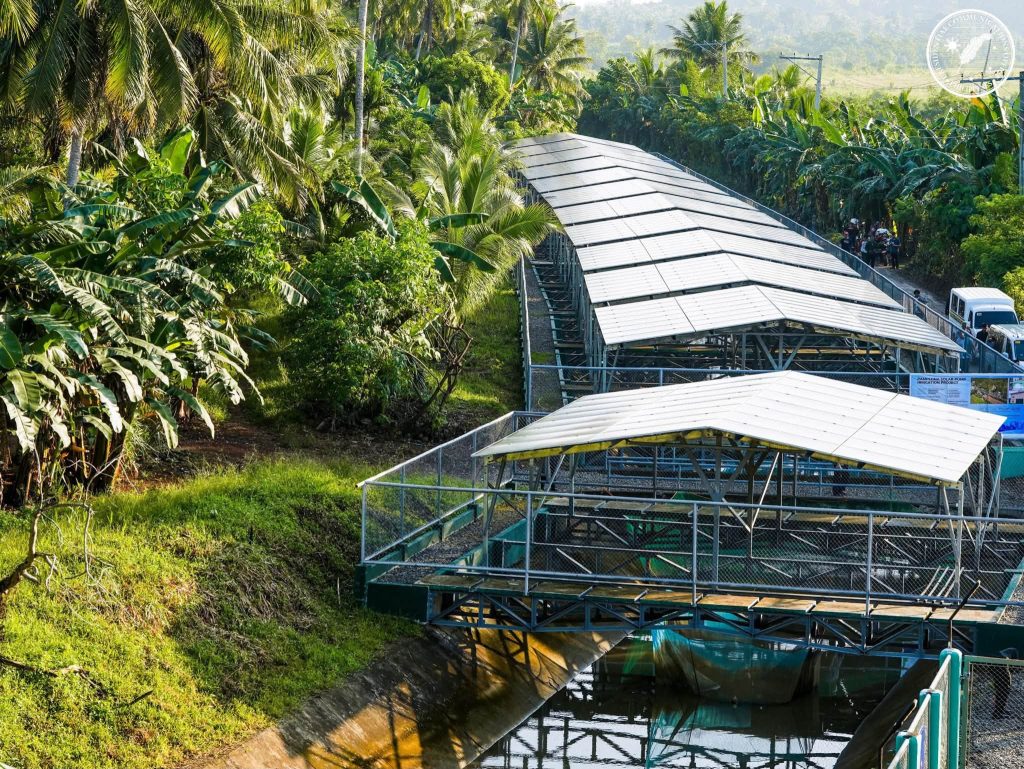
The event began with a walkthrough of the facility, which also doubles as an aquaculture hub where farmers raise fish on certain portions of the irrigation canal that were enclosed with fishnets, thus augmenting their livelihoods and bringing additional income to their families.
In his speech, President Marcos Jr. noted the significant reduction in operating costs through the operations of the new facility, which relies on 384 solar panels that run three units of 50 hp solar-powered submersible pumps.
“Dati, P300,000 to P400,000 ang buwanang gastos sa paggamit ng traditional irrigation. Dito sa solar power, P50,000 to P100,000 [na lang], nakatipid tayo ng P150,000-P250,000 kada buwan.”
He also shared that since assuming office in 2022, the government has already constructed 3,000 solar-powered irrigation systems nationwide, further reducing the farmers’ reliance on fossil fuels and paving the way for them to participate in the transition towards renewable energy.
The Chief Executive concluded, “Kaya patuloy ang ating pagtayo ng mga solar-powered irrigation systems upang pagandahin at matulungan ang buhay ng ating mga magsasaka, upang maging mas handa sa pagbabago ng panahon.”
Capable of irrigating 602 hectares of farmland in the barangays of Gattu, Capallalian, San Juan, Allasitan and Cassitan, the Pamplona SPIP caters to the needs of 307 farmer-beneficiaries by providing their paddy fields with continuous supply of water, lowering carbon emissions, and fostering climate-smart agriculture.
av

