
By Ruth Abbey Gita-Carlos | Philippine News Agency
President Ferdinand R. Marcos Jr. on Tuesday expressed optimism over the ceasefire agreement between the United States and Iran, describing it as a positive development that could help restore global peace and stability amid rising geopolitical tensions.
Marcos stressed that any step toward peace is a “good step,” noting that the Philippines joins other countries in hoping that the agreement would lead to the full cessation of hostilities and the reopening of the Strait of Hormuz.
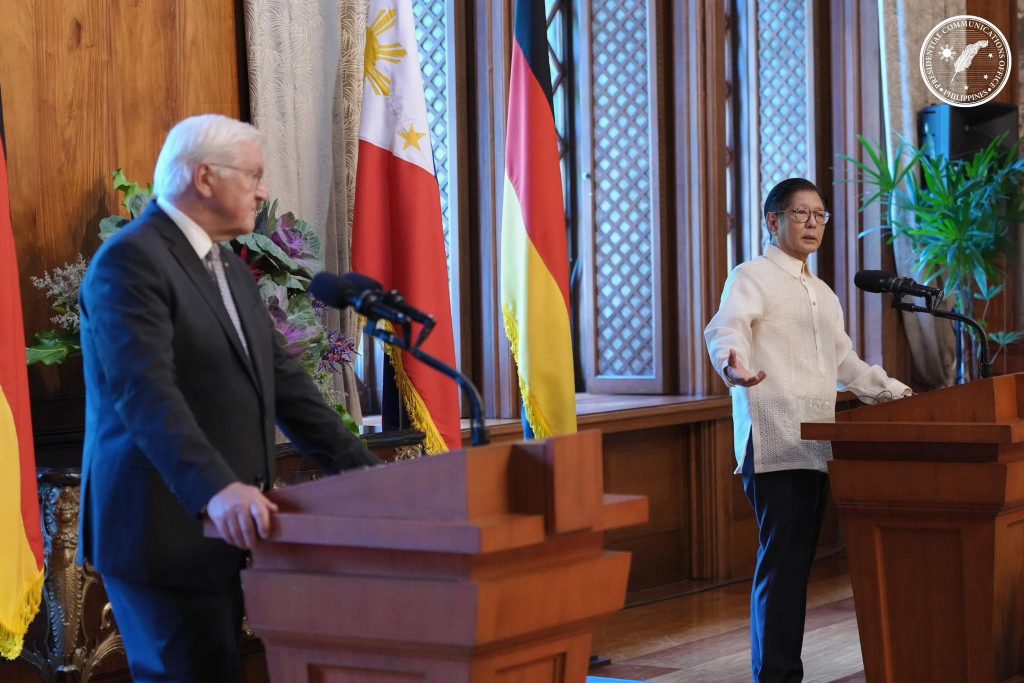
“We heard the news a couple of days past that there has been an agreement that has been arrived at, at least on the basis of that agreement that the fighting immediately will stop, the blockade of the United States will be withdrawn, and the Strait of Hormuz will be opened,” he said in a joint press conference with German President Frank-Walter Steinmeier at Malacañan Palace in Manila.
“The freedom of navigation will once more return to the Strait of Hormuz. That is what we have been hoping for since the day after the war started,” he added.
Marcos said countries like the Philippines and Germany have been affected by the instability brought about by the conflict, particularly through its impact on global oil supply and prices.
He noted that prolonged instability makes life more difficult, especially for petroleum-dependent economies, due to rising prices and disruptions in global trade.
Although Germany and the Philippines are affected differently, Marcos said, both countries feel that there is very much a crisis, adding that the effects of the conflict are felt “in every country around the world.”
Marcos expressed caution, saying the Philippines remains watchful until the agreement is fully implemented.
This, as he lamented that similar announcements in the past had not materialized.
“Therefore, we await with bated breath the actual finalization of that agreement. Again, it is some of the best news that we could hope for if indeed it comes to fruition. That is what we are looking forward to,” he said.
Marcos said he remains hopeful that the pronouncement “will come true,” allowing economies to return to “a normal state and be able to support our people properly,” without worrying about global oil price volatility.
However, he acknowledged that recovery from the crisis would take time due to the scale of instability caused by the conflict.
“Because of the enormity of the problem, of the instability that this war has caused – it’s inevitable that it will take some time for us to adjust back to what will be the new normal. So, we, of course, are always cautiously optimistic,” Marcos said.
“We have unfortunately heard these proclamations before, and they have not come true.
Steinmeier underscored the urgency of reopening the Strait of Hormuz, citing its impact on the “lives of hundreds of thousands of people that are affected,” as well as on prices of food, oil, and fertilizers.
“We both, therefore, hope that we will see an actual agreement, not only a signing of a document, but that we will see an ending of the fighting and an end to the blockade of the Strait of Hormuz,” he said.

