
By Ruth Abbey Gita-Carlos | Philippine News Agency
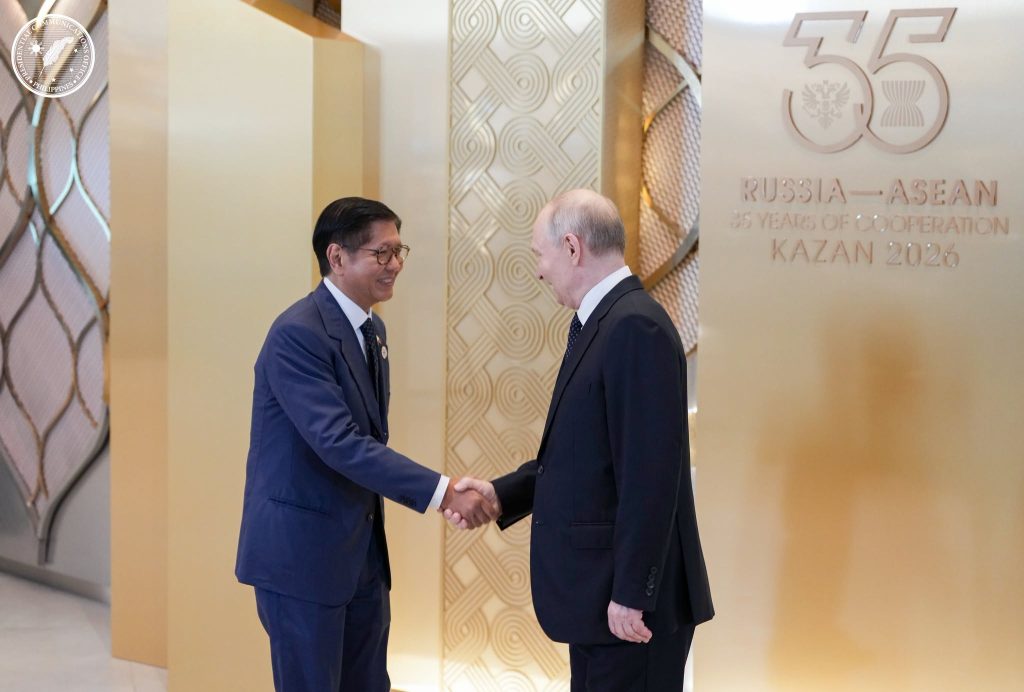
The Philippines and Russia are considering expanding cooperation in emerging sectors, such as nuclear energy, space technology, and artificial intelligence (AI), according to President Ferdinand R. Marcos Jr.
This developed as Marcos Jr. and Russian President Vladimir Putin acknowledged that the two nations have to step up their cooperation beyond traditional sectors.
“Beyond that, we now are available – (there are) other sectors that we didn’t talk about before. We talked a great deal about nuclear energy. We talked a great deal about space technology. We talked a great deal about AI, of course, as we always do,” Marcos said in a media interview before departing Kazan, Russia on Thursday.
He noted that while the Philippine-Russian bilateral trade has notably risen to approximately $500 million, the two countries could still “have done a little better.”
He said the level of trade and engagement between Russia and the Philippines in traditional areas remains “quite low,” attributing it to the “old way of doing business.”
“But we are shedding that and I think that—that gives us a great deal of potential in terms of developing our relation with Russia, in terms of many, many different sectors,” Marcos said.
He said no concrete pledges or agreements have been finalized during his working visit to Russia, but his initial talks with business leaders had allowed them to identify several promising sectors for future investments.
Marcos said identifying emerging sectors and initiating dialogue are crucial in forging a more vibrant cooperation.
He added that the Philippines is transitioning away from Cold War-era bipolar alignments, embracing a multipolar world that offers expanded diplomatic and economic possibilities.
“There are no definite agreements that have been signed. But certainly, the number one thing that we have been able to do is to identify sectors that we can further work on, that we can further develop. And that have, in my opinion, a very serious potential for development, not only for trade, for people-to-people, cultural exchanges, all of these things,” Marcos said.
“What all countries do to engage each other and to make the relationship stronger, deeper, more vibrant. And that’s what we are hoping to achieve.”
PH-Russia oil deal
Meanwhile, President Marcos Jr. said the Philippines is seeking to enhance energy security by developing a system that will formalize its oil arrangement with Russia amid global oil volatility and geopolitical tensions.
He stressed that while there were no contracts signed between the Philippines and Russia, there is a mutual understanding to institutionalize the supply chain to avoid future disruptions amid the Middle East crisis.
He also noted that the arrangement with Russia was initiated on an “ad hoc” basis, which means oil from Moscow will only be imported to the Philippines when needed.
“In terms of energy, there have been no firm agreements, but merely an understanding that we will continue to develop what we had already started as a response to the oil crisis that was the effect of the war in the Middle East, which we are hoping will come to an end soon,” Marcos said.
“But, nonetheless, even if the war does come to an end, we, the Philippines, will still continue to look for so-called non-traditional partners in terms of the supply of petroleum products,” he added.
According to the Chief Executive, the Philippines aims to diversify its petroleum product suppliers and is “very open” to getting oil supply from Russia, saying it will be “very good for the Philippines to have another assured lifeline when it comes to petroleum products.”
He said formalizing the oil deal with Russia will give the Philippines more options to secure its energy supply.
“This is yet to be decided. There are many complications to that. It is not that simple,” Marcos said. “There are, of course, political considerations—geopolitical considerations. But when two parties are determined to make it work, I’m always very confident that it will work and we will find a way around those challenges and those complications so that we make it a reality.”
A ship carrying over 700,000 barrels of Russian crude oil arrived in the Philippines in March, after the country declared a national energy emergency due to the Middle East conflict.

