
By Ruth Abbey Gita-Carlos | Philippine News Agency
President Ferdinand R. Marcos Jr. pledged to strengthen government mechanisms aimed at safeguarding the rights and welfare of media workers and intensifying the fight against misinformation and disinformation.
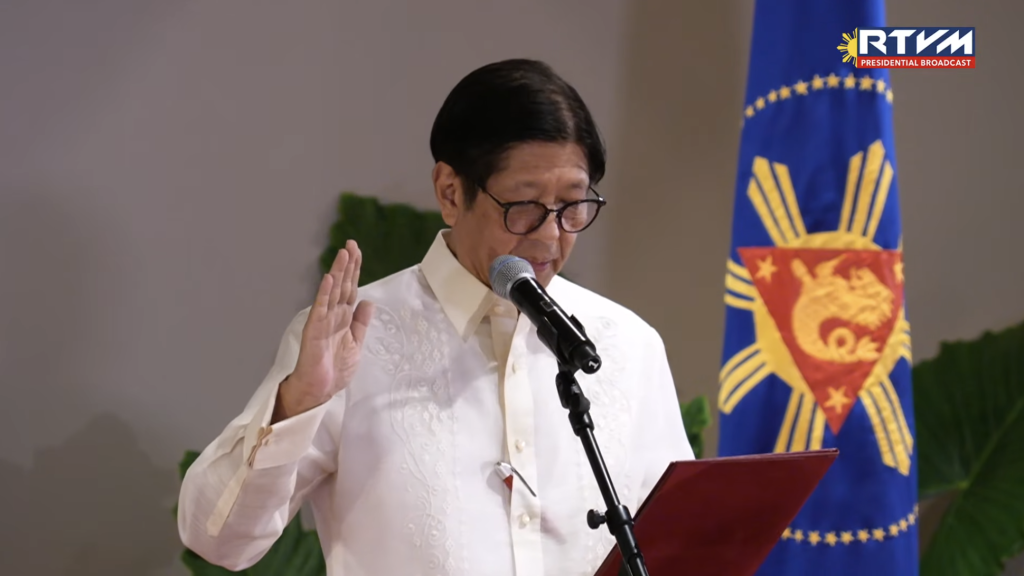
During the oath-taking of the Kapisanan ng mga Brodkaster ng Pilipinas (KBP) Board of Trustees at Malacañan Palace in Manila on Wednesday, Marcos underscored the importance of continued and closer collaboration with media stakeholders to enhance transparency in government and uphold democracy in the country.
He said media organizations and practitioners play a significant role in combatting fake news, stressing that his administration sees them as “bearers of facts” and as “voice of [the] people,” especially amid global geopolitical tensions and uncertainties.
“With the crises and the difficulties and the shocks that the world is providing not only the Philippines but the entire globe, it is more essential than ever that we combat fake news and disinformation,” he said.
“In that way, we will be able to face those challenges that we are now beginning to feel and our people can much better address the ways and means that we can mitigate the effects of the difficulties that we are seeing developing, especially along the horizon.”
The President said the government needs the help of all media workers to keep the public updated on the true situation of the state of the world and of the country.
“And so that our people, as I have mentioned, can make the proper decisions… can go to the right people for assistance, and are knowledgeable about what is available in terms of what help can be provided to them,” he said.
Marcos, however, acknowledged that the Philippines “remains one of the most dangerous places for journalists,” citing the 2025 World Press Freedom Index, which showed that the country ranked 116th out of 180 countries and territories.
He said the ranking reflects the country’s “difficult and complicated media landscape.”
The Chief Executive, nevertheless, said the government would ensure the safety and welfare of all journalists “at all times.”
He said the Presidential Task Force on Media Security (PTFoMS) has partnered with the National Bureau of Investigation (NBI) to reinforce the fight against violence and threats against media workers, as well as with the Public Attorney’s Office (PAO) to provide legal services to our media personnel.
He added that the Department of Information and Communications Technology (DICT) collaborated with Google in May 2025 and with Meta in February 2026 to strengthen content safeguards.
The Presidential Communications Office (PCO) has also signed a memorandum of understanding with print media to intensify the campaign against misinformation and disinformation.
“This shall create a rapid-response system to counter the spread of disinformation. We are promoting greater transparency and accountability in the bureaucracy. This supports our efforts to report facts—to have facts and truth reported,” Marcos said.
He said his administration has also included the proposed Right to Information Act in the LEDAC Common Legislative Agenda for the 20th Congress.
The induction of the new members of the KBP Board of Trustees highlights its crucial role as both a trade organization and a self-regulatory body for the country’s broadcast industry, particularly in a rapidly evolving media environment shaped by digital transformation.
Established in April 1973, the KBP has over 52 years of successful self-regulation, during which it has worked to upgrade the standards of broadcasting and journalism in the Philippines.

