
By Dean Aubrey Caratiquet
While the 2028 national elections are still 2 years away from now, public opinion polls about theoretical matchups for those eyed as the next President and Vice President reflect the citizenry’s pulse on the current political climate in the Philippines.
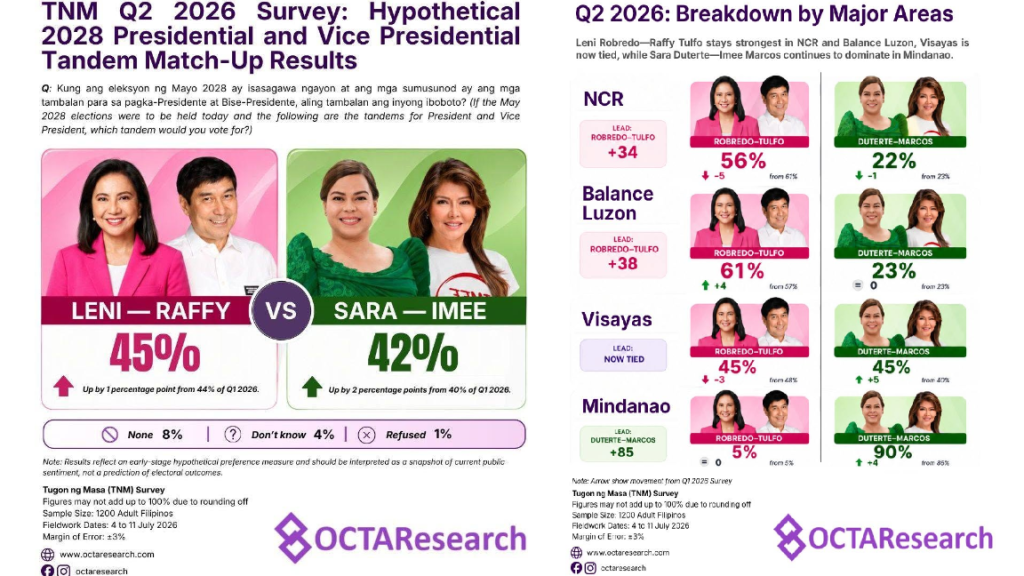
This, as a survey, conducted by OCTA Research Group places a spotlight on the tandems of Naga City Mayor Leni Robredo and Senator Raffy Tulfo; and Vice President Sara Duterte and Senator Imee Marcos and how they would fare in a hypothetical election.
Figures show that 45% of polled respondents favored the Robredo-Tulfo duo, while 42% sided with the Duterte-Marcos pair, with the remaining 13% still undecided on who they would vote for.
Compared to previous surveys that have shown a noticeable disparity between the number of those who support either hypothetical pairing, the latest statistics garnered by OCTA show that both tandems are nearly tied in a two-horse race as these percentages fall within the poll’s ±3% margin of error at a 95% confidence level.
Notable disparities in numerical figures
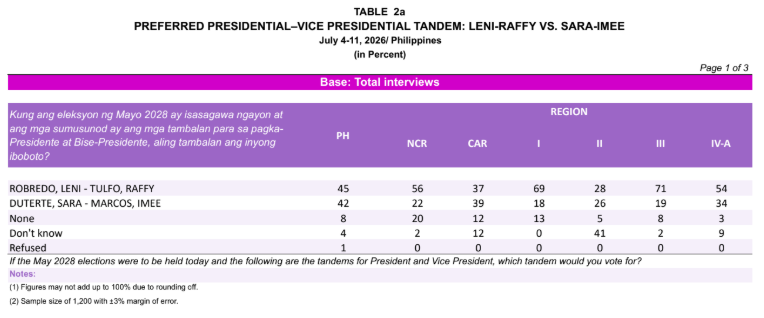
But despite a significant shift in the tandem preferences of respondents, the survey shows that the race is sharply regionalized, with each duo anchored in a different geographic base.
The Robredo-Tulfo tandem, for instance, leads in Balance Luzon (61%) and NCR (56%), but loses out to Mindanao at just 5%. On the other hand, the Duterte-Marcos tandem tops the charts in Mindanao (90%), but loses out in Balance Luzon (23%) and NCR (22%).
Both pairings, however, are statistically tied in Visayas at 45% each, which makes this region of the Philippines the next battleground for the sentiments of voters to decide which pair they would choose to lead the nation in a hypothetical election.
The aspect of socioeconomic class reveals another layer of nuance that influences the public perception of both tandems, with the Robredo-Tulfo duo leading among Class ABC (41% vs. 37%) and Class D (48% vs. 41%), as the Duterte-Marcos pair earning the favor of Class E (53% vs. 33%).
These figures indicate that the voter base of the former is mostly middle- and lower-middle-class individuals, while the latter draws support among the poorest households.
Further breaking down these percentages show a significant generational divide reflected in the respondents’ responses, with the Robredo-Tulfo tandem having the strongest foothold among those aged 75+ (76%), followed by 65-74 (60%); 18-24 (52%); 55-64 (48%); 45-54 (43%); 35-44 (35%); and 25-34 (33%).
On the other hand, the Duterte-Marcos duo captured the hearts of those aged 25-34 and 35-44 (50%), followed by 45-54 (48%); 55-64 (40%); 18-24 (32%); 65-74 (29%); and 75+ (23%).
Adding another layer of nuance into the equation, the Robredo-Tulfo tandem earns the approval of urban residents (48% vs. 38%), while the Duterte-Marcos tandem has a voter base anchored in rural residents (47% vs. 40%).
The non-partisan poll was conducted from July 4-11, 2026 using face-to-face interviews with 1,200 male and female respondents aged 18 and above, which represents the sentiments of most Filipinos across the country.
jpv

