

WHITE HOUSE — The leaders of the United States and South Korea on Friday reaffirmed the need to bring Pyongyang back to the negotiating table by applying maximum sanctions and pressure, according to the office of President Moon Jae-in.
Moon and U.S. President Donald Trump spoke by telephone Friday, officials in Washington and Seoul said.
“Talking is not the answer,” Trump had tweeted earlier in the week after the latest launch of a North Korean ballistic missile, which leader Kim Jong Un was quoted as saying was a simulation of war meant to demonstrate his military’s capability to strike the U.S. territory of Guam.
Asked by VOA during Friday’s White House briefing to clarify Trump’s stance on diplomacy with Pyongyang, press secretary Sarah Huckabee Sanders replied, “The president is looking for an integrated process. And we’re continuing to move forward on that. We take North Korea extremely seriously and all options are on the table. That hasn’t changed.”
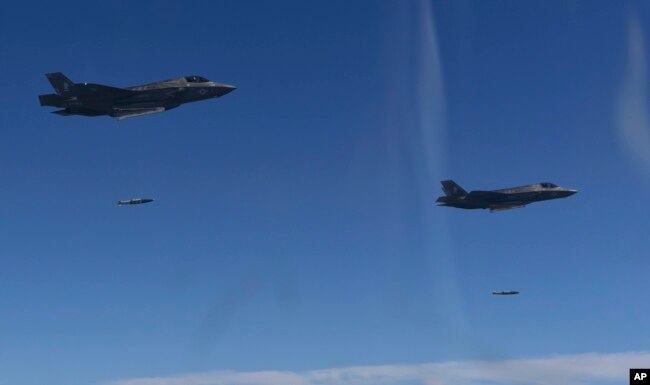
Those options, both Trump and Sanders have repeatedly stated, include military action.
Mixed messages
Mixed messages on how to respond to Pyongyang’s provocations have emerged this week in statements by the president and some Cabinet members.
“Mr. Trump is not a model of consistency, so I wouldn’t read too much” into what he tweeted and what he reportedly agreed upon with Moon, said Sue Mi Terry, formerly a CIA analyst and National Security Council director for Korea and Japan.
Trump and Moon during their phone conversation also agreed, according to the South Korea’s Blue House, to enhance Seoul’s capability of deterring the North Korean threat by giving it missiles with greater capabilities.
South Korea is currently allowed to possess ballistic missiles with a range of 800 kilometers and payload of 500 kilograms, but it wants to raise the weight limit to 1,000 kilograms.
Friday night, the White House released a readout of the phone call between the two leaders, saying Trump provided a conceptual approval of the sale of billions of dollars’ worth of American military equipment to South Korea.
The latest Trump-Moon conversation occurred three days after a North Korean intermediate-range ballistic missile flew high over Japan.
Trump has also spoken twice this week with Japanese Prime Minister Shinzo Abe.
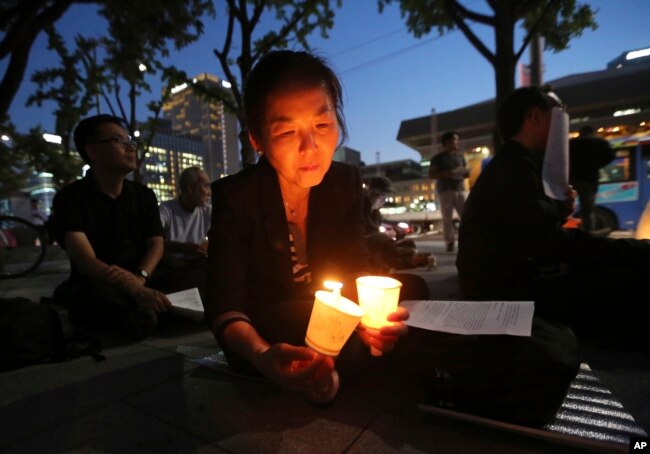
“I cannot tell you about our forthcoming response to North Korea, but we have just completely agreed on it,” Abe told reporters at his office after his latest call with Trump on Thursday.
Defense, State taking the lead
U.S. Defense Secretary Jim Mattis told reporters Thursday that the Pentagon was working with Secretary of State Rex Tillerson, who is taking the lead, concerning North Korea.
While military options are necessary to back up the diplomacy, Mattis said, “we’re not done with diplomacy.”
Many analysts are skeptical diplomacy can persuade Pyongyang to give up its missiles and nuclear bombs. And repeated rounds of U.N. resolutions and sanctions against North Korea appear to have had little or no impact.
“The reality is that talks with the North are unlikely to be successful, but the U.S. hands Pyongyang an unearned public relations win if it simply dismisses talks out of hand,” Terry, now managing director for Korea with the Bower Group, a government affairs and public policy consulting firm, told VOA. “In any case, there is nothing wrong with talking as long as we don’t make unilateral concessions.” | via voanews

