
by Kevin Enochs/ Voice of America
Insects are the most biodiverse group of living things on the planet. And it is a good thing there are so many of them because they are responsible for many of the fundamental processes that allow life on earth, from pollination to decomposition. But a new report suggests they are disappearing, and that could be catastrophic.
A new review of over 70 studies of insect populations suggests that human pressures are causing insect populations to plummet, by as much as a quarter every decade.
Max Barclay, an entomologist at London’s Natural History Museum, says, “Some of my colleagues have compared it to playing Jenga — you know, you move pieces from the Jenga tower and everything seems to be OK and then you remove one piece and the whole thing falls down and you don’t know which piece in advance that’s going to be, and once you’ve removed it you can’t put it back again, so the loss of species is inevitably concerning, because often we don’t know what those pieces are doing, we don’t know what other species are depending on them.”
Insects make up the largest class of animals on earth and represent more than half of all known living organisms. They are incredibly diverse and in many ways make life on earth possible.
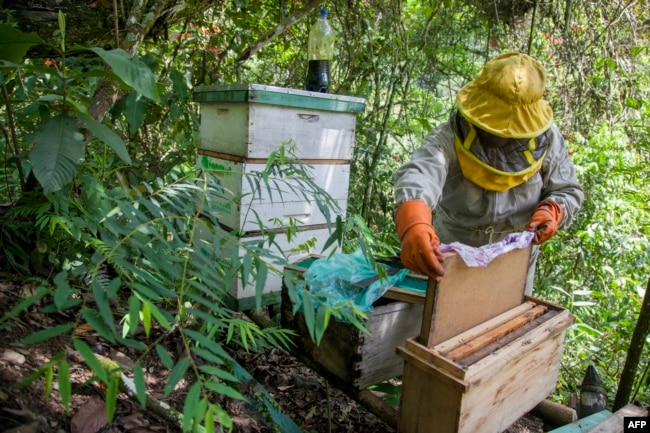
Bees and butterflies pollinate our food, flowers and trees. They feed all kinds of larger animals, including humans.
And insects play a vital role in the decomposition of all kinds of organic matter from leaves to roadkill.
Their collapse is being driven by human activity: everything from traffic to industrial farming and pesticides to light pollution.

Scientists like Mark Wright, with the World Wildlife Fund, say doing nothing to solve the problem is not an option.
“A large number of the crops we eat and rely on are pollinated by insects, so imagine a world where that pollination process is not taking place. And there are some cases around the world already where we are having to pollinate by hand — at huge cost — at huge economic cost simply because the insects aren’t there to do the work that we would normally ask them to do for free. In some cases, if you are talking about food crops, just try to imagine the scale of what that would look like if insects weren’t doing that for us.”
One big caveat: all of the studies come from industrialized countries in Europe and North America.
The researchers say they simply don’t have the data to census the robust insect species in more tropical regions. But in these industrialized countries, the report predicts that all insect species could be gone in a century.

