
By Dean Aubrey Caratiquet
On the heels of the arrival of Vietnamese President Tô Lâm on Sunday for a two-day state visit aimed at strengthening ties between Hanoi and Manila, the Communist Party Leader participated in a wreath-laying ceremony at Rizal Park on Monday.
This was followed by the conferring of welcome rites to the Vietnamese Chief Executive, wherein the two nation’s anthems are played and a 21-gun salute is rendered in honor of the leaders of both Southeast Asian countries.
The state visit, considered a first by a Vietnamese General Secretary to the Philippines, symbolizes enduring camaraderie between the 4th and 5th largest economies in the region, respectively.
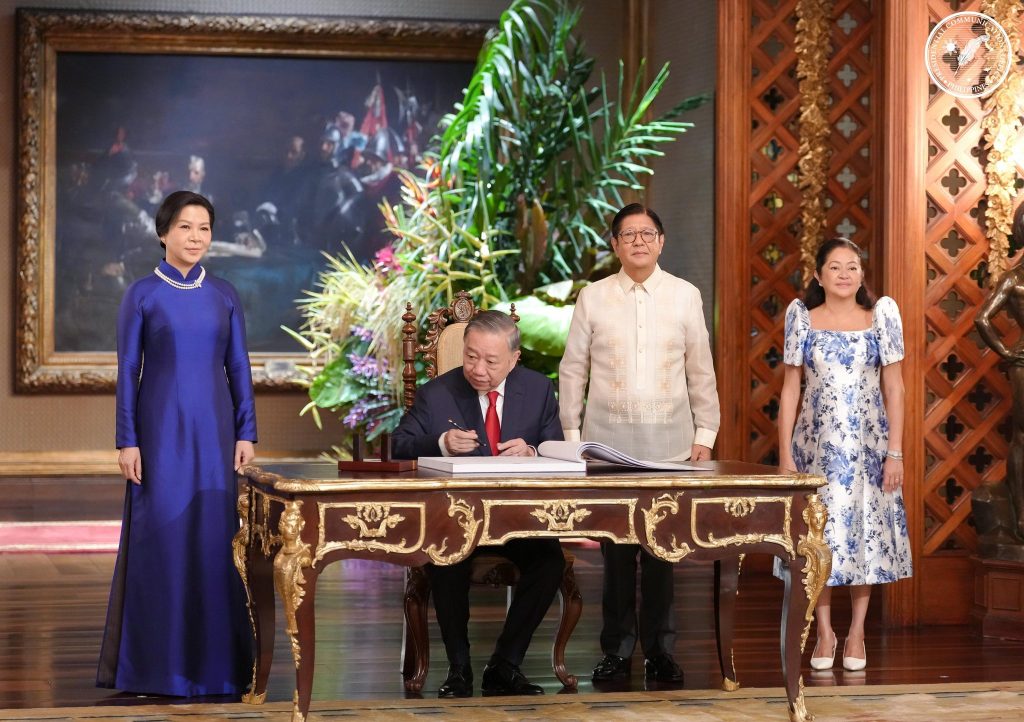
After the welcome ceremony, the members of both delegations are introduced to both Heads of State, with Vietnamese First Lady Ngo Phuong Ly and the First Couple witnessing President Tô Lâm as he signs the guestbook.
A productive exchange
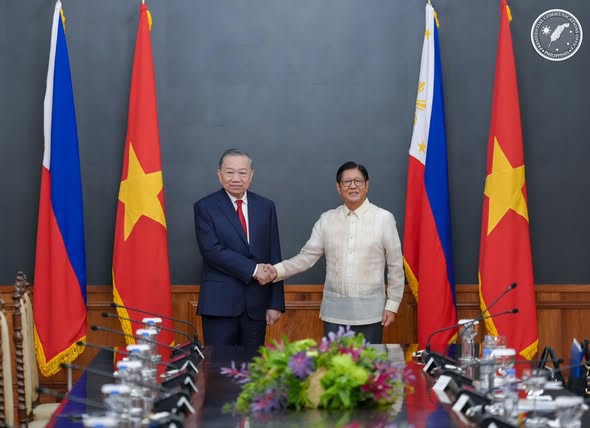
During the bilateral meeting with the Vietnamese delegation, President Ferdinand R. Marcos Jr. honored Vietnam’s role as the country’s sole strategic partner in the region, with 2026 marking a decade since both nations teamed up with each other in the areas of defense and security.
The President announced the elevation of these ties through an Enhanced Strategic Partnership, which he expects would mutually benefit Filipinos and Vietnamese alike.
President Marcos Jr. moreover underscored the importance of this collaboration in the face of omnipresent threats to international stability and security, such as geopolitical tensions erupting in various parts of the world.
“Our robust bilateral trade exceeding USD7 billion demonstrates a mutually beneficial and vital economic partnership. This, along with our active agricultural exchanges, regional and multilateral cooperation and defense initiatives, among many areas of cooperation, keep the Philippines-Vietnam partnership closely intertwined and thrive on shared progress.”
The Chief Executive concluded his speech by expressing optimism that this state visit would result in more educational, cultural, and people-to-people exchanges.
For his part, Vietnamese President Tô Lâm expressed gratitude for the warm welcome that he received from the Philippine delegation, likewise honoring the country’s leadership in its hosting of ASEAN 2026.
The Vietnamese leader concluded his remarks by praising the Philippines’ steady economic growth, expressing optimism about the country achieving its upper middle-income status in the foreseeable future.
Sealing the deal
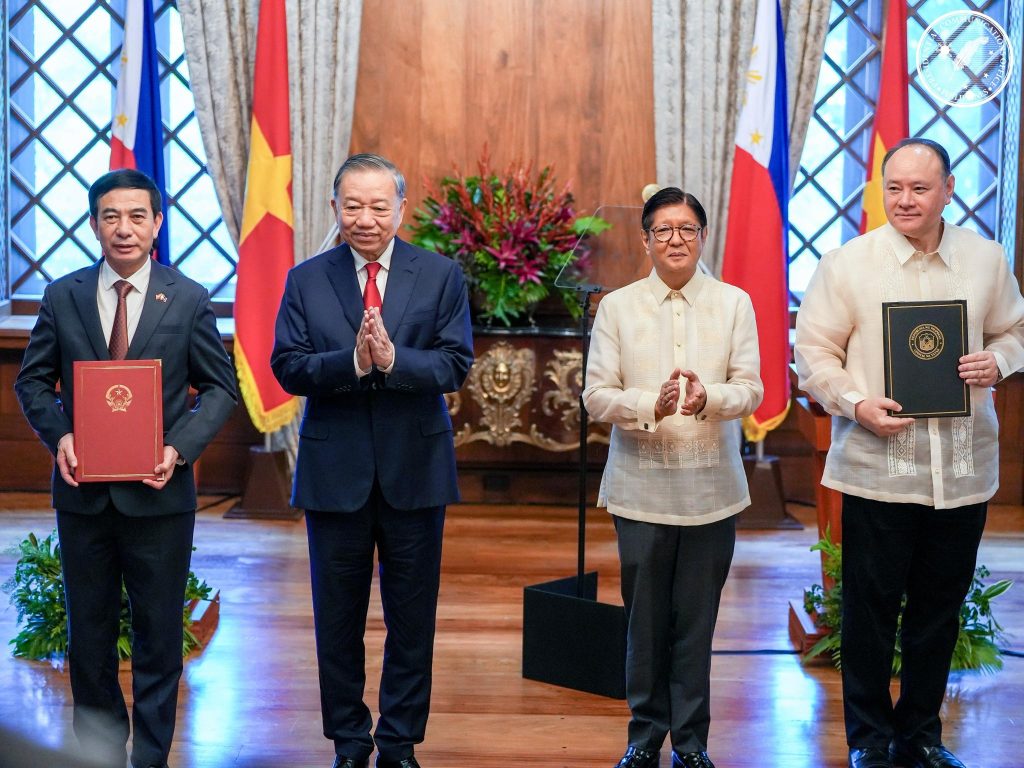
Sustaining the momentum of the Enhanced Strategic Partnership, both Heads of State witnessed the exchange of signed agreements between the Vietnamese and Philippine delegations, respectively.
These agreements focused on various aspects such as political cooperation; economic cooperation; maritime, security, and defense cooperation; people-to-people and cultural cooperation; and regional and international cooperation.
Chief among these is the renewal of the 2010 Philippines-Vietnam Memorandum of Agreement on Defense Cooperation, a document that outlines the framework of both countries in the aspects of maritime security, military education, and disaster risk reduction and management.
President Marcos Jr. reaffirmed both nations’ stance on the South China Sea issue, “We stand resolute in our commitment to the peaceful resolution of disputes, grounded firmly in international law, particularly the 1982 UN Convention on the Law of the Sea or UNCLOS and the 2016 South China Sea Arbitral Award.”
The Chief Executive added, “Furthermore, we recognize the urgent need for a unified front against severe cross-border threats such as internet fraud, human trafficking, illegal gambling, and people smuggling. We have agreed to address these challenges decisively through accelerated intelligence sharing and coordinated law enforcement actions.”
President Marcos Jr. moreover expressed his optimism on enhanced economic and agricultural cooperation, hailing Vietnam’s position as the Philippines’ 11th largest trading partner which can lead to expanded opportunities for growth and investment.
In keeping up with the times, both nations also inked a new memorandum of understanding on information technology and digital transformation, recognizing the role of emerging technologies as a catalyst for further growth and development.
The Chief Executive concluded by acknowledging the finalization of the Tourist Cooperation Program for 2026-2029 and the institutionalization of student and faculty exchanges, which are expected to boost the tourism and education sectors of both countries, respectively.
avds

