
By Brian Jules Campued
The Philippine Institute of Volcanology and Seismology (Phivolcs) reminded the public that Mayon Volcano remains on alert level two as no sustained increases in volcanic activity were observed after the phreatic eruption on Sunday.
Phivolcs director Dr. Teresito Bacolcol reported that there were no escalations recorded in terms of volcanic earthquake, seismic energy release, number of rockfall events, pyroclastic density currents, as well as sulfur dioxide emission in Mayon Volcano.
“So far wala po tayong indikasyon na tumataas ang mga parameter na nabanggit ko,” Bacolcol said in an interview with Rise and Shine Pilipinas on Monday.
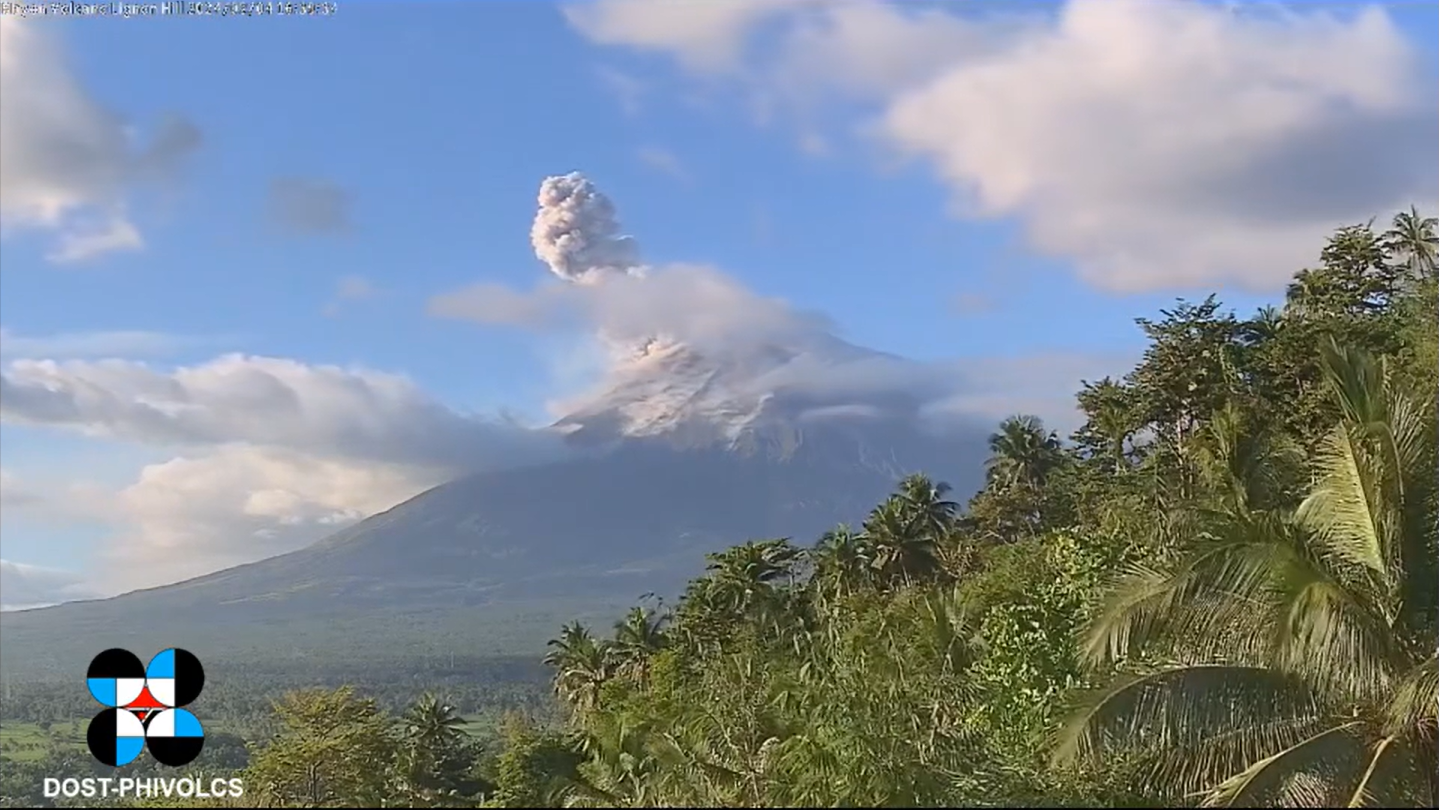
The phreatic eruption, which occurred from the volcano’s summit at around 4:37 p.m. on Feb. 4 and lasted for about 169 seconds, generated a booming sound, rockfall and pyroclastic density currents based on Phivolcs’ seismic record.
“Nangyayari po ang phreatic eruption when hot materials come into contact with water,” Bacolcol explained, adding the magmatic eruption last June 2023 left volcanic materials in Mayon Volcano crater which resulted in the recent eruption event.
“It’s (phreatic eruption) not as violent as magmatic eruption but it can still send rocks into the air,” the Phivolcs director added.
The steam-driven eruption also triggered a plume that was 1,200 meters tall and drifted to the southwest vicinity of Mayon.
Bacolcol, however, clarified that there were no reports of ashfall reaching the barangays around the volcano. He still advised the residents to wear face masks to avoid inhalation of volcanic ash.
Meanwhile, no ashfall was detected on the runway of Bicol International Airport.
The agency reiterated that entry into the six-kilometer radius permanent danger zone as well as flying of aircraft close to the volcano is still prohibited since a phreatic eruption can happen anytime.
The Civil Aviation Authority of the Philippines likewise issued a Notice to Airmen (NOTAM) forbidding flights to operate approximately 10,000 feet from the surface as sudden phreatic eruption can be dangerous to aircraft. -avds

