
By Brian Campued
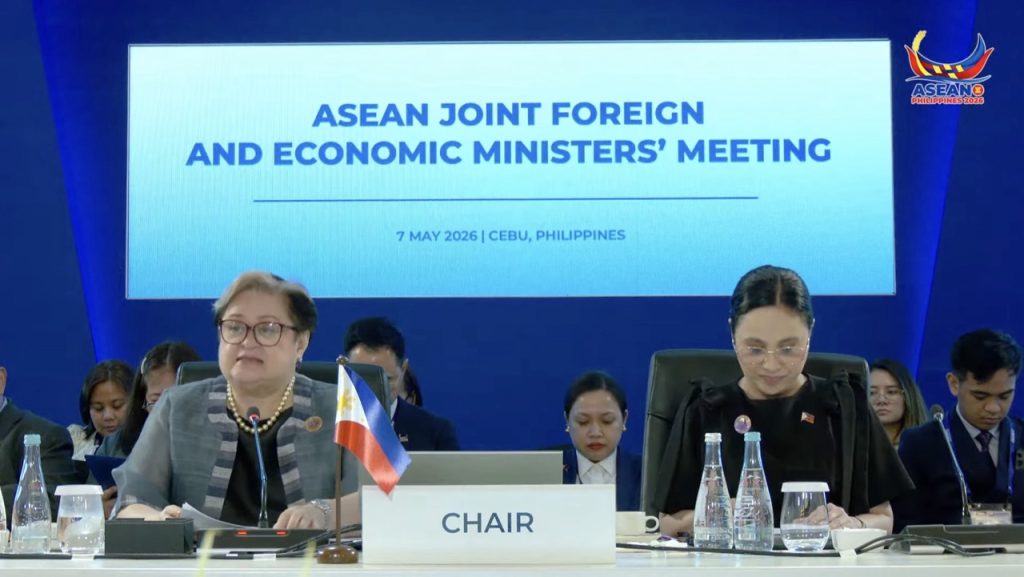
The foreign and economic ministers of the Association of Southeast Asian Nations (ASEAN) convened on Thursday in Cebu to advance collective response to the impacts of geopolitical tensions on trade, security, and stability in the region.
In her opening remarks for the ASEAN Joint Foreign and Economic Ministers’ Meeting in Cebu Thursday, Department of Foreign Affairs (DFA) Secretary Ma. Theresa Lazaro, as chair of the ASEAN Political-Security Community Pillar, reiterated the bloc’s call for continued negotiations between parties involved in the Middle East conflict, from full de-escalations to a permanent end of the war.
Lazaro recognized that challenges facing ASEAN call for collective resolve and coordinated response, particularly on the most urgent priorities identified for the 48th ASEAN Summit: energy security, food security, and safety of ASEAN nationals.
“With these in mind, we will look to issue at the summit an ASEAN Leaders’ Statement of the Response to the Middle East, which expresses not just our unified position but also our foundation for our response to future crises,” she said.
“We stand ready to work closely with all ASEAN member states and the ASEAN Secretariat in collectively pursuing decisive actions and concrete measures to the immediate challenges facing ASEAN.”
Meanwhile, Department of Trade and Industry (DTI) Secretary Ma. Cristina Roque, chair of the ASEAN Economic Community Pillar, underscored the importance of addressing the crisis through both foreign and economic policies.
“Energy security, trade flow, and supply chain resilience are shaped by geopolitical developments, just as they are economic decisions. Addressing them requires us to work across our pillars, not in parallel but together,” Roque said in her remarks.
She said that ASEAN’s responses to the crisis must be coordinated, practical, and timely, involving actions to stabilize energy supply and manage price pressures; address risk to food security and supply chain disruptions; and ensure sustained support for businesses, particularly the micro, small, and medium enterprises (MSMEs).
“If we act together, we reinforce stability. If we act decisively, we strengthen confidence. And if we focus on implementation, we deliver results our people can feel,” she said.
During the 27th ASEAN Economic Community (AEC) Council Meeting earlier in the day, Roque assured that aside from addressing current challenges, ASEAN will continue advancing the Philippines’ Priority Economic Deliverables, including the ASEAN Digital Economy Framework Agreement (DEFA), while beginning work to translate the ASEAN Community Vision 2045 into concrete actions.
The ASEAN Community is anchored on three interconnected pillars—Political-Security, Economic, and Socio-Cultural—established in 2015 to advance a peaceful, stable and resilient region.
The Philippines is hosting the 2026 ASEAN Summit under the theme “Navigating Our Future, Together,” with President Ferdinand R. Marcos Jr. and fellow leaders of other member states expected to convene for the summit proper on Friday.
-av

