
By Dean Aubrey Caratiquet
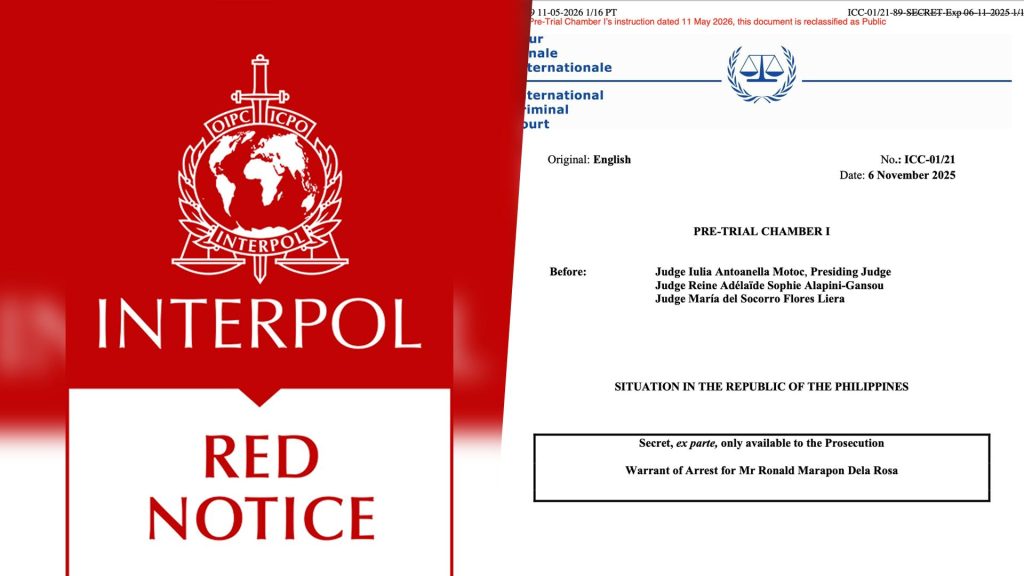
On Monday, the International Criminal Court (ICC) welcomed the unsealing of its arrest warrant against Senator Ronald “Bato” dela Rosa.
This was closely followed by the confirmation of the Interpol’s Red Notice against former Bureau of Corrections chief Gerald Bantag, entrepreneur Charlie “Atong” Ang, and former police officer Rafael Dumlao III, who were under the law’s crosshairs for various high-profile cases.
But one may be wondering, what is the difference between these two requests dished out by their respective global entities? Read on to find out more about these.
The issuance of a Red Notice, commissioned by the International Criminal Police Organization (Interpol), serves as a non-binding advisory sent to a government to track down and provisionally arrest a person facing charges in either his/her home country, or before the international tribunal.
This request for international cooperation is issued for fugitives wanted for serious ordinary law crimes such as murder, rape, and fraud, as well as transnational crimes—with a Red Notice holder found guilty by a court in the country that sought the publication of this lookout advisory.
It contains two main types of information:
- Information to identify the wanted person, such as their name, date of birth, nationality, hair and eye colour, photographs and fingerprints if available.
- Information related to the crime they are wanted for, which can typically be murder, rape, child abuse or armed robbery.
An explainer on the website read, “Extracts of Red Notices are published at the request of the member country concerned and where the public’s help may be needed to locate an individual or if the individual may pose a threat to public safety.”
The implementation of the Red Notice, however, is limited to just apprehending the suspect and subjecting such to deportation proceedings back to his/her home country to face the court’s music, leaving the trial in the hands of the nation that requested for the publication of a person as a Red Notice holder.
The nuances of ICC’s warrant of arrest
While the Red Notice only covers the apprehension of a person for serious ordinary crimes in his/her home country, the warrant of arrest issued by the ICC works similarly to how governments seek to apprehend suspects who breached the law, but on a global scale.
The issuance of an ICC arrest warrant strictly focuses on the commission of four main crimes as stipulated in the Rome Statute, which are genocide, crimes against humanity, grave breaches of the Geneva Convention, and the crime of aggression.
Genocide refers to crimes committed against a national, ethnic, racial, or religious group, which especially affects children, women, and unborn babies.
Offenses such as murder, rape, imprisonment, enforced disappearances, enslavement, sexual slavery, torture, apartheid, and deportation are among the 15 forms of crimes against humanity enshrined in the Rome Statute.
In the context of armed conflict, the use of child soldiers, the killing or torture of persons such as civilians or prisoners of war, and intentional direct attacks against hospitals, historic monuments, or buildings dedicated to religion, education, art, science, or charitable purposes are considered serious offenses under the Geneva Convention.
The crime of aggression refers to the “use of armed force by a State against the sovereignty, integrity or independence of another State.”
Should an individual be tagged as responsible for committing any of these heinous acts or if the high court receives a complaint lodged against a person, a thorough legal process with six major steps would come into play.
- Preliminary examinations (The Office of the Prosecutor determines the sufficiency of crime evidence under ICC jurisdiction, and whether a probe would serve the interests of justice and the victims.)
- Investigations (An ICC judge may issue either an arrest warrant calling for a transfer of suspects, or a summons to appear—a voluntary call for an offender to face the court.)
- Pre-trial stage (In the initial appearance, three judges confirm the suspect’s identity and make sure he/she understands the charges. After a period of 60 days, the judges decide whether the evidence is sufficient for the case to go to trial.)
- Trial stage (Prosecution must prove the guilt of the accused in front of the trial judges, from which the judges can issue a verdict. After weighing the evidence and identifying a verdict of guilt, a sentence would be issued.)
- Appeals stage (The Prosecutor and Defense were given the right to appeal a Trial Chamber’s decision on the verdict, while the victims and the convicted person may seek an order for reparations.)
- Enforcement of sentence (Sentences are served in countries that have agreed to enforce ICC sentences.)
Since the Philippines remains a recognized member of the Interpol, but not included in the scope of ICC’s jurisdiction, authorities can make apprehensions of fugitives found to be Red Notice holders, while those individuals served with an ICC warrant of arrest cannot be easily apprehended until further interventions are put in place.
jpv

